Can the ‘highlight moment’ of the U.S. bond market be replicated? With ambiguous rate-cut paths and fiscal stimulus, total returns by 2026 may decrease.

Investors in the U.S. Treasury market and high-rated corporate bonds may face a more challenging environment in 2026. Some market observers predict that investment returns in the U.S. bond market (including Treasuries and corporate bonds) could slow amid a potential significant reduction in the pace of Federal Reserve rate cuts and complex fiscal stimulus measures driven by Trump’s “big and beautiful bill.” This comes after a standout year for bond funds in 2025.
Zhitong Finance APP reports that this cautious market consensus follows an unexpectedly robust performance in 2025, driven by the Federal Reserve’s accommodative monetary policies and a favorable “soft landing” economic environment. Investors are now weighing whether a less aggressive Fed and new fiscal policies could disrupt this growth momentum, posing strong headwinds to total returns in the U.S. bond market.
In 2025, the Fed’s rate-cutting cycle — totaling 75 basis points for the year — significantly boosted U.S. Treasury prices as lower policy rates substantially reduced yields, making existing bonds (with relatively higher coupon payments) more attractive. In the U.S. corporate bond market, economic resilience supported corporate profits, keeping the additional yield investors demanded for holding corporate bonds over Treasuries near historic lows. This resulted in exceptionally strong price returns for corporate bonds, with exceptions such as Oracle’s investment-grade bonds, which plunged due to over-reliance on the loss-making OpenAI and record-high debt issuance amid the ‘AI bubble storm.’
The latest data shows that the Morningstar US Core Bond TR YSD Index, which tracks dollar-denominated bond assets with maturities exceeding one year, delivered a total return of approximately 7.3% in 2025, marking the strongest performance since 2020. This benchmark index includes both U.S. Treasuries and investment-grade corporate bonds.
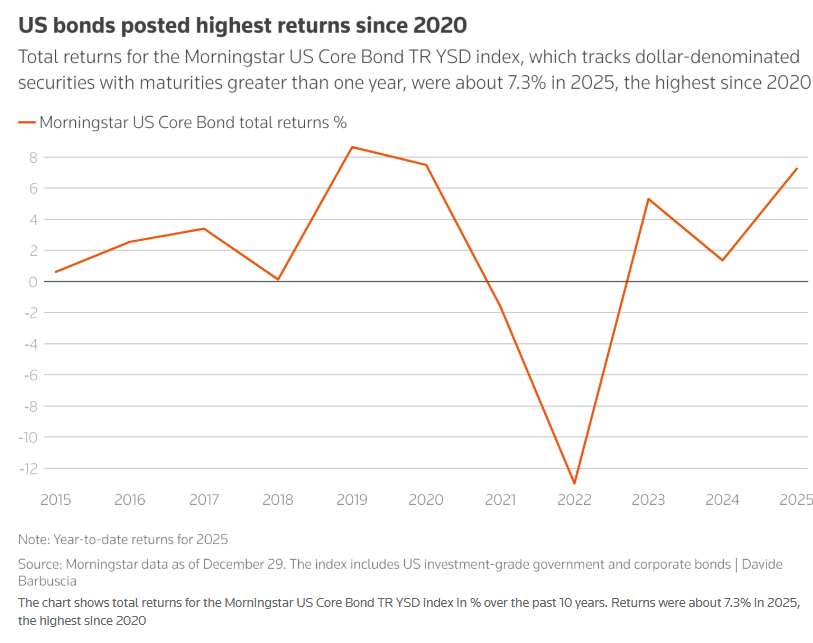
While some investors expect the U.S. bond market environment in 2026 to remain somewhat similar, total returns — including bond coupons and price volatility — may struggle to match the robust performance seen in 2025.
The market widely anticipates that the Federal Reserve’s rate cuts in 2026 will be smaller than in 2025. As of Monday, interest rate futures traders priced in about 50 basis points of easing for 2026, compared to 75 basis points of cuts already implemented in 2025. Moreover, Fed officials remain sharply divided on the 2026 rate-cut outlook, with some even suggesting no cuts throughout the year. Unlike the strong consensus for three rate cuts in the second half of 2025, expectations for 2026 have become increasingly uncertain, which could act as a major negative catalyst for the bond market.
Additionally, some investors note that fiscal stimulus measures from Donald Trump’s tax and spending policies are expected to drive significant economic growth in 2026 but may prevent long-term U.S. Treasury yields from continuing their downward trajectory seen this year.
“I think next year will be trickier,” said Jimmy Chang, Chief Investment Officer of Rockefeller Global Family Office.
“Short-term U.S. Treasury yields will continue to decline as the Fed is likely to cut rates one or two more times in 2026. However, short-term Treasuries (two-year maturities and below) are unlikely to deliver as strong returns as they did this year. Meanwhile, renewed economic growth acceleration and inflationary effects from tariffs persisting into 2026 may push up longer-term Treasury yields… These factors could negatively impact total returns for U.S. Treasuries in 2026,” he said in an interview.
Duration Concerns
The benchmark 10-year U.S. Treasury yield, a key measure of government and private sector borrowing costs in the United States, has fallen by more than 40 basis points this year, standing at about 4.1% as of Monday. This strong rebound was driven by three consecutive interest rate cuts by the Federal Reserve since October, panic-driven capital inflows amid the ‘AI bubble narrative,’ rising yields across European and Japanese bonds pushing global low-risk appetite funds into U.S. Treasuries, alongside growing concerns over the U.S. labor market.
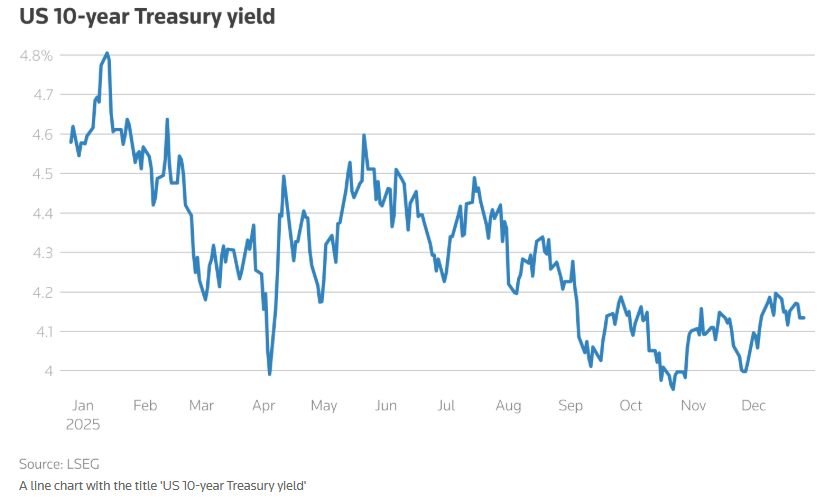
Few investors expect such a strong performance to be repeated in 2026. Many market participants are betting that the 10-year yield will be at its current level or slightly higher by the end of next year.
JPMorgan’s analyst team forecasts that the 10-year U.S. Treasury yield will reach 4.35% by the end of 2026, while Bank of America’s interest rate analysts predict it will be around 4.25%.
Anders Persson, Chief Investment Officer and Head of Global Fixed Income at Nuveen, said he expects the benchmark 10-year U.S. Treasury yield to decline to approximately 4%. However, he remains cautious about the performance of long-term bonds, as rising global government debt levels may push up yields on longer maturities, meaning that the persistent upward trend in ‘term premiums’ will remain a core factor influencing U.S. Treasuries with maturities of 10 years or more.
“We may see the long end of the U.S. Treasury yield curve largely anchored, with a potential for a slow upward drift,” he said in an interview, adding that he remains “underweight duration assets,” meaning his allocation to longer-term U.S. Treasury bonds is lower compared to other U.S. debt securities—these long-duration bonds tend to suffer larger negative impacts when global sovereign bond yields rise.
Will credit spreads widen across the board?
The credit spread for investment-grade corporate bonds—the premium paid by highly-rated companies relative to U.S. Treasuries—stood at about 80 basis points as of Monday, roughly the same as at the beginning of the year and near its lowest level since 1998.
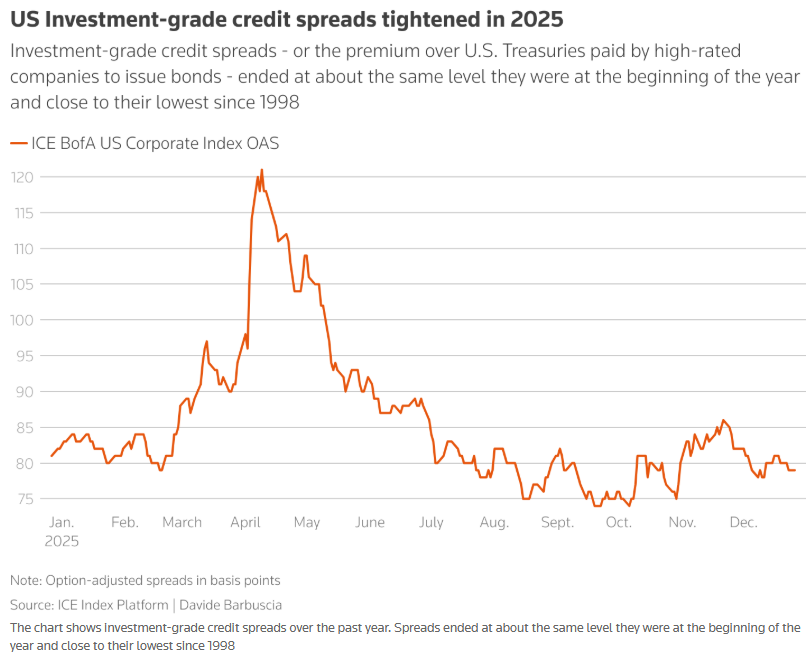
The above chart shows the investment-grade credit spread over the past year. Spreads at the end of the year are roughly the same as at the beginning and near their lowest level since 1998.
The total return for investment-grade credit bonds this year—measured using the widely followed ICE BofA US Corporate Index (.MERC0A0)—was close to 8% as of Monday, far exceeding last year’s 2.8%. The so-called junk bond returns (measured by the ICE BofA US High Yield Index) were approximately 8.2%, even surpassing the total return of investment-grade corporate bonds and nearly matching last year’s robust performance.
JPMorgan analysts predict that investment-grade credit spreads may widen significantly to 110 basis points next year, primarily due to expectations of a substantial increase in corporate bond issuance by U.S. tech companies. They also forecast that the overall total return for high-rated bonds will drop to just 3%. However, some institutions are more optimistic; BNP Paribas predicts that spreads will only reach 80 basis points by the end of next year.
Emily Roland, Co-Chief Investment Strategist at Manulife John Hancock Investments, expressed extreme optimism about the fundamentals and investment returns of ‘high-quality’ corporate bonds heading into 2026. She anticipates a significant slowdown in the U.S. economy next year, with the Federal Reserve likely to cut interest rates more aggressively than the market currently expects.
“The bond market has not yet priced in the disinflation and weaker economic growth that we believe will arrive in 2026,” she emphasized. “From a fundamental perspective, corporate bond prices should rise more substantially in our view.”
However, bond traders remain cautious about high-rated corporate bonds (i.e., investment-grade companies) for 2026. Amid an environment where the AI-driven lending boom has triggered short-term panic in the private credit markets, compounded by frequent defaults and ongoing concerns about an ‘AI bubble,’ those high-rated bonds—whose spreads are near historical lows and appear safest—are now among the assets most likely to be reduced on rallies or even heavily shorted by Wall Street firms.
Michael Hartnett, a Bank of America strategist renowned as ‘Wall Street’s most accurate strategist,’ made a bold prediction in his latest report: the best trade entering 2026 will be shorting the corporate bonds of ‘hyperscalers’—tech giants heavily investing in AI infrastructure. He argues that the debt burden triggered by accelerated construction of AI data centers will become a new ‘Achilles’ heel’ for these technology behemoths.
“If the AI-driven borrowing frenzy continues to heat up while the market sees a flood of new issuances, borrowers will have to pay a higher premium. If companies incur higher borrowing costs, their profits will drop significantly, ultimately puncturing the market’s illusion of false prosperity.” John Stopford, Head of Multi-Asset Income at Ninety One, stated in a report, adding that he had reduced credit exposure in his funds to near zero over the past few weeks.
As the most direct indicator of the ‘AI bubble theory,’ the credit default swap (CDS) market has already signaled a warning. Recently, the spread on Oracle’s five-year CDS has almost doubled over the past two months to 150 basis points, reaching its highest level since 2009. Even Microsoft’s CDS spread surged from around 20.5 basis points at the end of September to approximately 40 basis points. Bond yields also reflect distortions in credit ratings: the yield on Oracle’s corporate bonds maturing in 2035 rose to 5.9%, surpassing levels of some high-quality ‘junk bonds,’ suggesting that the market is pricing its credit risk as if it no longer belongs to investment-grade entities.
Amid intensifying competition in AI computing infrastructure, even cash-rich, highly-rated tech companies have had to take on substantial debt to finance related investments. Morgan Stanley predicts that by 2028, total global investment in hyperscale AI data centers will reach approximately $2.9 trillion, with more than half ($1.5 trillion) reliant on external financing.
It is reported that Amazon recently launched its first investment-grade bond issuance in three years, aiming to raise $15 billion. Oracle plans to finance its hyperscale AI data center project in collaboration with OpenAI through a massive debt financing deal—approximately $38 billion is underway, marking the largest-ever debt financing for AI infrastructure to date. Additionally, SoftBank and Oracle’s joint ‘Stargate’ initiative is expected to exceed $400 billion in investment over the next three years.
This nearly reckless capital expenditure has placed immense pressure on previously robust balance sheets. Investors in the bond market, known for their keen sense of risk, have begun reassessing the default risks of these tech giants, triggering significant volatility in credit pricing systems.