CAS Space finishes IPO tutoring as companies in sector rush to list
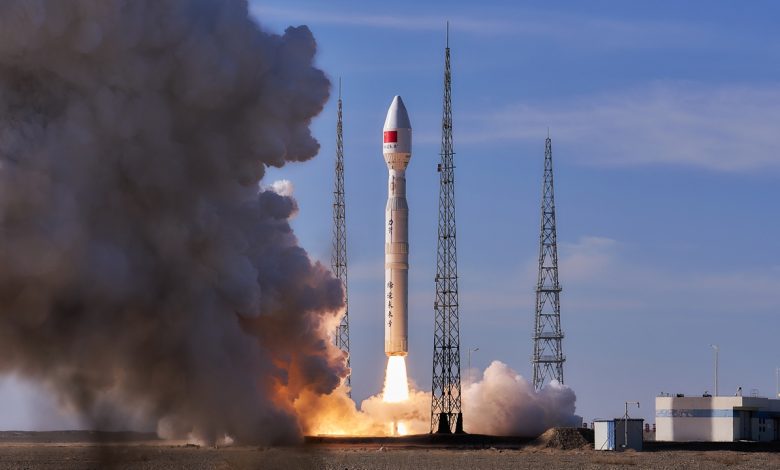
China launches the Lijian-1 Y11 carrier rocket with nine satellites onboard, including three international payloads for the United Arab Emirates (UAE), Egypt and Nepal, on December 10, 2025. Photo: CAS Space
Chinese commercial rocket company CAS Space has completed its IPO tutoring process, according to the China Securities Regulatory Commission’s public IPO tutoring disclosure system, the Securities Times reported, as observers noted that more Chinese private space firms are accelerating their listing progress amid the sector’s rapid expansion.
With the development of China’s domestic industries and growing demand for next-generation communication networks, the country’s commercial aerospace sector has entered a new phase marked by large-scale deployment, long-term operations and systematized support, Xiang Ligang, director-general of the Beijing-based Information Consumption Alliance, told the Global Times.
The listing announcement came after CAS Space’s Lihong-1 Y1 vehicle completed a suborbital flight test mission at the Jiuquan Satellite Launch Center in Northwest China’s Gansu Province on January 12, 2026, with the returnable payload capsule making a safe parachute-assisted landing and being successfully recovered, according to a statement sent to the Global Times.
Founded in 2018, CAS Space is a high-tech enterprise incubated by the Institute of Mechanics under the Chinese Academy of Sciences. Its core businesses cover the development of medium- and large-lift launch vehicles, commercial satellite launches and suborbital spacecraft, with its main products being the “Lijian” (Kinetica) series of launch rockets.
Lijian-1, or Kinetica-1, has successfully sent 84 satellites into space, with a total payload mass exceeding 11 metric tons, maintaining the leading share in China’s commercial and civilian launch services market, the company’s website showed.
On December 26, 2025, the Shanghai Stock Exchange issued Review Guidelines for Commercial Rocket Companies under the Fifth Set of STAR Market Listing Standards, according to the exchange’s website, establishing a clear pathway for commercial rocket firms seeking to list on the STAR Market.
Against this backdrop of policy support, multiple leading commercial aerospace companies — including Galactic Energy, Space Pioneer, LandSpace, and CAS Space — accelerated their listing processes starting last year. On December 31, 2025, LandSpace’s STAR Market IPO application was accepted, and on the evening of January 22, its review status was updated to “in inquiry,” the Securities Times reported.
On December 24, 2025, the third Commercial Aerospace Development Conference was held in Beijing. An industry report released at the event showed that China’s commercial space industry reached a scale of 2.5 trillion yuan ($358.5 billion) to 2.8 trillion yuan in 2025, with more than 600 commercial space enterprises nationwide.
Observers said that the rapid increase in the number of companies has driven greater competition and spurred industry consolidation, highlighting the need for stronger coordination across the commercial space ecosystem.
On Friday, the Beijing Municipal government released a set of measures to promote the development and utilization of commercial satellite remote-sensing data resources, encouraging capable enterprises to conduct mergers and acquisitions across upstream and downstream satellite data businesses, integrate ground station networks and data application services, and cultivate globally competitive industry leaders.
Xiang noted that commercial space is a high-tech, capital-intensive industry involving multiple segments including research and development, manufacturing, launches and operations, making it unsuitable for low-threshold, fragmented expansion, and rendering industry consolidation an inevitable trend.
Beyond satellite launch applications, some companies are also developing space tourism projects. On Thursday, Beijing Interstellor Human Spaceflight Technology Co announced plans to achieve its first suborbital crewed flight around 2028, with tickets priced at 3 million yuan each, and more than 10 tourists have already registered.