Catherine Opie’s “To Be Seen” and The Politics of Photography
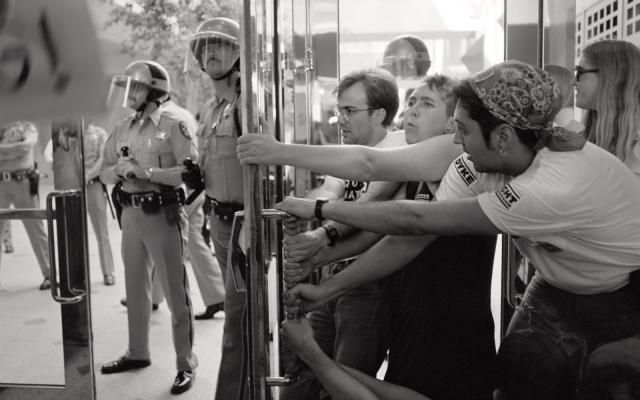
She draws a direct line from governmental neglect during the AIDS crisis to the present moment. “At that point in time, it really was like, how do you make really beautiful, bold work for a community that is being disenfranchised through the government?” she says. “Here we are again. We might have been able to get rights for [gay] marriage in some countries… but all of that is backtracking again under these authoritative, national Christian ideologies. Unless we question our own belief systems, we’re only going to keep recapitulating feelings of hate toward those who are othered.”
Organized across three rooms, the exhibition unfolds as what Opie calls her “little novels” — discrete bodies of work that together form a compelling visual narrative. The first gallery includes her childhood Self-Portrait (1970) alongside Bo (1994), part of the breakthrough Being and Having series, in which the artist sports a fake mustache as one of 13 members of her leather dyke community.
The second room shifts toward an art historical dialogue, connecting Opie’s contemporary practice to established visual traditions. This section acts as a conceptual bridge, showing how her work engages canonical artists while retaining urgent contemporary relevance. Opie wants to elevate her marginalized subjects the way Renaissance painter Holbein portrayed nobility — granting them the same dignity, the same unflinching gaze.
This space includes Untitled #15 (2017), an abstracted landscape of the White Cliffs of Dover. Opie describes the photograph as a response to Brexit, noting that Dover is where many immigrants arrive after crossing the English Channel. Even the landscapes, it becomes clear, carry political weight.
Credit: Source link