Danger of conspiracy politics – The Korea Times
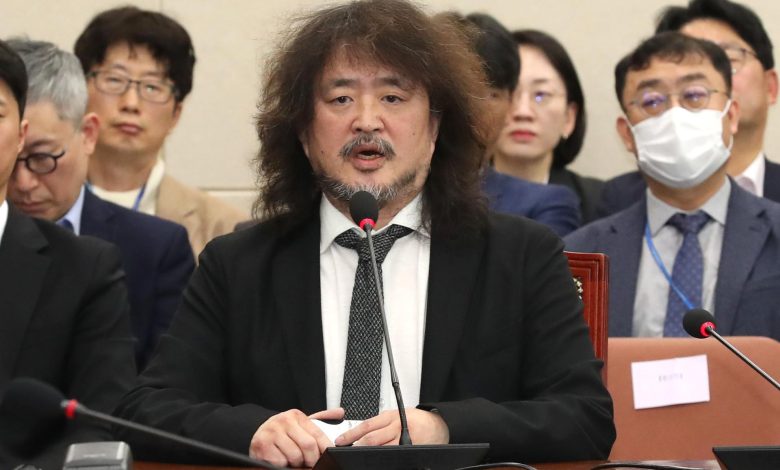
TV personality Kim Ou-joon appears as a witness at the National Assembly’s Science, ICT, Broadcasting, and Communications Committee, Dec. 13, 2025, during a hearing on the December 2024 martial law crisis. Yonhap
The recent controversy sparked by broadcaster Kim Ou-joon has once again thrown Korea’s political discourse into needless turmoil.
His platform recently aired claims insinuating that President Lee Jae Myung and the prosecution struck a covert deal: that certain past prosecutions might be canceled in exchange for advancing prosecutorial reform. The allegation, dramatic enough to shake the foundations of the nation’s constitutional order, was presented without concrete evidence, corroborated sources or verifiable documentation. Instead, the public was offered a familiar mix of speculation, insinuation and narrative conjecture.
Such claims carry enormous weight. To suggest that a sitting president and a constitutional institution secretly negotiated over the administration of justice is not a minor political jab; it is an accusation of profound institutional corruption. When raised without substantiation, it ceases to be investigative journalism and becomes something far more reckless: a destabilizing rumor presented as a revelation.
Predictably, the political consequences were immediate. The main opposition People Power Party seized upon the claim, characterizing it as a potential “constitutional crisis,” demanding special investigations and even raising the specter of impeachment. What began as an unverified statement on a broadcast platform quickly escalated into a full-scale political confrontation, diverting national attention from pressing policy matters to an argument over an allegation that remains unsupported.
This episode also follows a familiar pattern. Over the years, Kim has repeatedly been associated with highly sensational claims, from conspiracy theories surrounding the 2014 Sewol ferry disaster to controversial allegations about election manipulation linked to the 2017 documentary “The Plan.” In many cases, these narratives have relied more on circumstantial speculation than on verifiable fact. Critics have long argued that such controversies thrive on confirmation bias, reinforcing the beliefs of loyal audiences while fueling polarization in an already divided political environment.
Yet the responsibility does not lie solely with one broadcaster. The political ecosystem that elevated him must also be scrutinized. For years, figures from the ruling Democratic Party of Korea have appeared frequently on his platform, eager to engage with its large and highly mobilized audience. In doing so, they helped transform a partisan media figure into a political power broker. It is difficult to denounce irresponsible commentary today while having relied on the same platform for political advantage yesterday.
That contradiction has now become glaring. Even within the ruling party, voices have begun to warn that continued association with such controversies undermines credibility. When political leaders appear to tolerate or excuse inflammatory claims simply because they resonate with their base, they erode the broader public trust necessary for democratic governance.
The damage extends beyond partisan reputations. The Lee administration has spent considerable effort attempting to stabilize governance after years of political confrontation. Efforts to normalize state institutions and restore economic confidence, reflected in renewed attention to financial markets and economic policy, require political focus and institutional credibility. When public debate becomes consumed by unverified allegations and the political battles they ignite, those efforts risk being overshadowed.
At a time when Korea faces significant external uncertainties — from global economic volatility to rising geopolitical tensions in regions such as the Middle East — the nation can ill afford endless cycles of domestic political spectacle. Citizens expect their leaders to address economic security, national resilience and the long-term competitiveness of the country. Manufactured controversies, however dramatic, do little to advance those priorities.
For his part, Kim owes the public either credible evidence or a clear acknowledgment that the allegation cannot be substantiated. Media platforms, whether traditional or digital, carry the same fundamental responsibility: to verify information before amplifying claims capable of shaking public confidence in democratic institutions.
At the same time, the ruling party and the president must demonstrate political clarity. They should resist the temptation to chase partisan narratives or appear overly defensive about prosecutorial controversies. The stronger response is transparency, composure and a firm commitment to governing in a principled and lawful manner.
Korea’s political class would do well to return to principles. Democratic debate must be grounded in facts rather than speculation, and public discourse must serve the broader national interest rather than a narrow factional advantage. The country faces complex challenges ahead. Addressing them requires sobriety, responsibility and a renewed commitment to the public good.
Credit: Source link