Escalation of Middle East conflicts drives safe-haven demand, pushing gold prices above the 5,300 mark. Could this lead to a new all-time high?
On Monday (March 2), the global gold market experienced significant volatility. Following military strikes by the United States and Israel against Iran, geopolitical risks in the Middle East escalated sharply, prompting a surge of safe-haven funds into the gold market. Spot gold prices briefly broke through the $5,400 mark, peaking at $5,419.01, before closing at $5,321.97, representing a 0.3% increase from the previous trading day. So far this year, gold has risen 23%, extending its astonishing 64% rally since June 2025. In early Asian trading on Tuesday (March 3), spot gold remained volatile at high levels, currently trading near $5,332.87 per ounce. The conflict involving the United States, Israel, and Iran has spread to Lebanon, with U.S. media reporting that the United States is preparing for a potential ‘large-scale attack’ on Iran within the next 24 hours. Gold prices are expected to continue their upward momentum in the short term, although gains have been somewhat constrained by rising U.S. Treasury yields.
Geopolitical conflicts escalate comprehensively, with risk aversion dominating market direction.
The current situation in the Middle East is at its most perilous point in decades. After the United States and Israel launched airstrikes on Iran, the conflict not only failed to be contained but also spread outward at an alarming rate. The death of Iran’s Supreme Leader Khamenei during the attack became a turning point for the rapid deterioration of the situation. In response, Hezbollah, supported by Iran, fired missiles and drones at Israel, which immediately retaliated with large-scale airstrikes on southern Beirut suburbs, killing at least 31 people and injuring 149. Meanwhile, Iran’s Revolutionary Guard claimed to have attacked a U.S. military base in Kuwait and destroyed 10 drones. The conflict even extended to Cyprus, where a missile struck the British Royal Air Force base at Akrotiri.
U.S. President Trump stated in an interview that military operations could last several weeks and warned that ‘a bigger wave of attacks is yet to come.’ The U.S. Central Command confirmed that six American soldiers had died in the conflict, while an accidental downing of three U.S. F-15E fighter jets by Kuwait further highlighted the chaos on the battlefield. The U.S. Department of State has urged American citizens in fourteen Middle Eastern countries to evacuate immediately via commercial means due to ‘serious security risks.’
 For the gold market, geopolitical risks have always been one of the core driving factors. The breadth and depth of the current conflict exceed previous market expectations, spreading from Iran itself to Lebanon, Kuwait, and Cyprus, showing a comprehensive escalation. David Meger, Director of Metals Trading at High Ridge Futures, noted: ‘The market is currently trying to assess whether follow-up strikes will occur in the coming weeks, and it is precisely this uncertainty that supports gold prices.’ Until the situation becomes clearer, safe-haven demand will continue to provide upward momentum for gold.
Against the backdrop of escalating conflict after the U.S. and Israeli strikes on Iran, the U.S. Department of State urged Americans in more than a dozen Middle Eastern countries to leave via commercial routes due to ‘serious security risks.’ On Monday, the U.S. Department of State advised Americans to leave Bahrain, Egypt, Iran, Iraq, Israel, the West Bank and Gaza, Jordan, Kuwait, Lebanon, Oman, Qatar, Saudi Arabia, Syria, the UAE, and Yemen. U.S. Secretary of State Marco Rubio stated on Monday that ‘the heaviest blows by U.S. forces are still ahead,’ while an Iranian commander threatened to attack ships crossing the Strait of Hormuz.
Shipping through the Strait of Hormuz obstructed, oil price spikes exacerbate inflation concerns.
The impact of the Middle East conflict on the global energy market is accelerating. An Iranian commander publicly threatened to attack any vessels attempting to cross the Strait of Hormuz, the world’s most critical oil shipping channel, which handles about one-fifth of global seaborne crude oil trade daily. According to Lloyd’s List Intelligence, vessel traffic through the strait has dropped by over 80% since military actions began, with only one crude oil tanker passing through on Sunday.
Oil prices soared accordingly, with U.S. crude futures surging 12% at one point on Monday before closing up 6.28% at $71.23 per barrel; Brent crude rose 6.68% to close at $77.74 per barrel. Qatar has suspended liquefied natural gas production, while preventive shutdowns have been implemented at multiple oil and gas facilities across the Middle East, adding further uncertainty on the supply side.
The rapid rise in oil prices is spilling over into broader economic sectors. The February ISM Manufacturing Purchasing Managers’ Index (PMI) in the United States showed that the input prices index jumped from 59.0 in January to 70.5, reaching its highest level since June 2022. Notably, this data reflects pre-war conditions, indicating that inflationary pressures will intensify further in the coming months. For gold, rising inflation expectations typically present a positive catalyst, especially when economic growth faces headwinds, highlighting gold’s role as a hedge against inflation.
Changes in monetary policy expectations, with real interest rate trends supporting gold prices.
The rapid rise in inflation expectations is reshaping market expectations for the Federal Reserve’s monetary policy. The CME Group’s FedWatch tool shows that market expectations for a Fed rate cut in June have dropped from 57.4% before the conflict to 45.2%. The U.S. Treasury market reacted more directly, with the two-year Treasury yield surging 11.1 basis points to 3.49%, marking the largest single-day increase since last June; the ten-year Treasury yield rose 8.6 basis points to 4.048%.
From the perspective of gold pricing logic, while rising nominal interest rates do create pressure, the increase in inflation expectations has been greater, driving real interest rates lower. The five-year breakeven yield on U.S. Treasury Inflation-Protected Securities (TIPS) rose to 2.487%, indicating that the market expects average annual inflation of about 2.5% over the next five years. When inflation expectations rise faster than nominal interest rates, the opportunity cost of holding gold relatively declines, providing strong support for gold prices.
Brian Jacobsen, Chief Economist at Annex Wealth Management, pointed out: ‘For a manufacturing recovery to transform into a renaissance, the conflict with Iran needs to be short-lived rather than the prolonged quagmire people fear.’ The current market concern lies precisely in the possibility that this conflict could evolve into a protracted war. If a prolonged war leads to a stagflation scenario, the allocation value of gold will become even more prominent.
Disruption to the Dubai gold hub, with physical supply facing challenges.
The impact of geopolitical conflicts on the gold market is not only evident on the financial level but is also beginning to show in the physical market. According to three metal industry sources, the flow of physical gold via Dubai’s gold trading hub will be severely restricted in the coming days due to flight cancellations caused by the attack. As one of the world’s most important gold trading centers, Dubai connects western producers with eastern consumer markets, and disruptions to its flow will disturb the global gold supply chain.
At the same time, sharp volatility in the U.S. stock market is reinforcing gold’s appeal as a safe haven. Although U.S. stocks recovered losses after a sharp drop in early trading, sectors such as travel, aviation, and cruises were hit hard, with Delta Air Lines falling more than 2% and Carnival plunging 7.6%. In stark contrast, energy and defense stocks performed strongly, showing that market funds are shifting from risk assets to defensive sectors. Against this backdrop, gold, as a traditional safe-haven asset, continues to see increasing inflows.
Conclusion: Uncertainty dominates the market, with gold likely to remain strong.
Overall, the gold market is currently at the intersection of multiple favorable factors. Geopolitical risks are at their highest level in recent years, with no signs of easing in the short term; disruptions to shipping in the Strait of Hormuz are pushing oil prices higher, continuously accumulating inflationary pressures; the Federal Reserve’s monetary policy is caught in a dilemma, with falling real interest rates providing support for gold; restrictions on physical gold circulation are further exacerbating supply tensions.
Trump stated that ‘a bigger wave of attacks has yet to come,’ which itself implies that the situation could worsen further. Until uncertainty is resolved, safe-haven demand will continue to dominate market direction. Technically, gold has broken through the $5,300 mark, just one step away from the historical high of $5,596. If the conflict escalates further or inflation data continues to exceed expectations, gold prices may challenge new highs. Investors should closely monitor upcoming U.S. ADP employment data, non-farm payroll reports, and inflation indicators while keeping an eye on geopolitical developments, as these data will provide more clues about the Fed’s policy path.
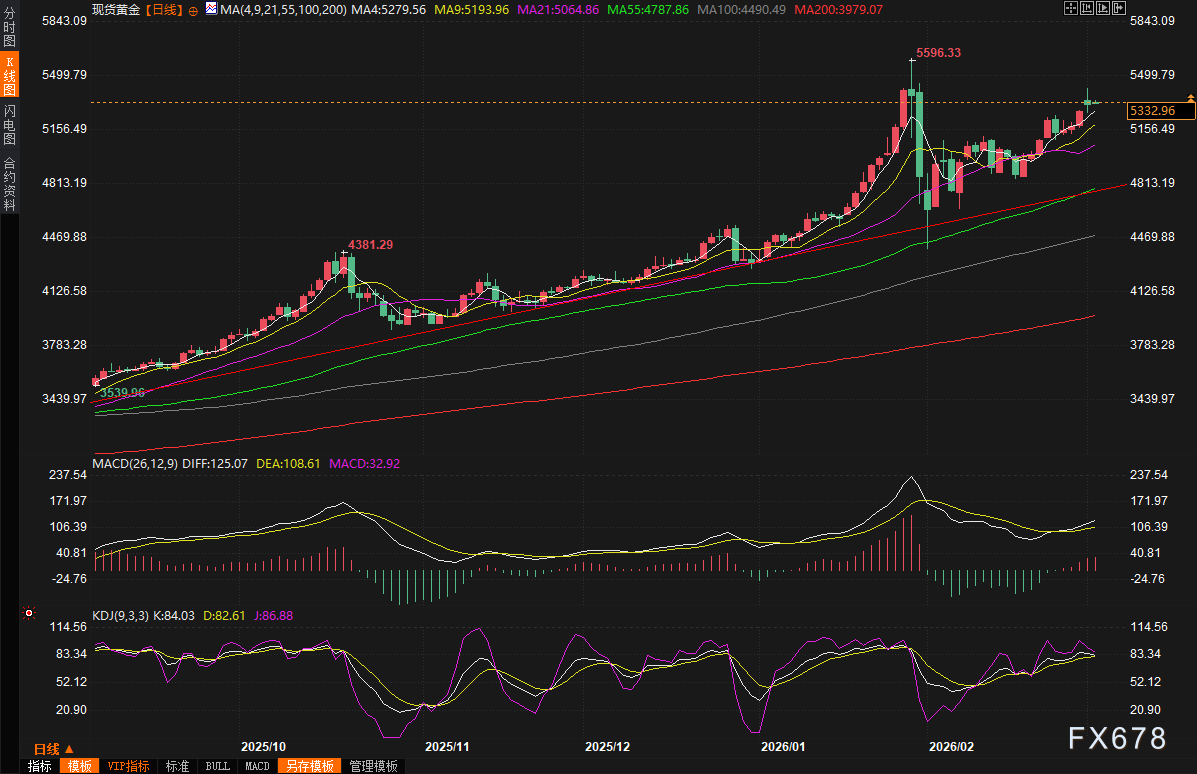
(Spot gold daily chart, source: Easy Forex)
As of 07:40 Beijing Time, spot gold is trading at $5,332.44 per ounce.