Five key points on Trump’s Greenland push
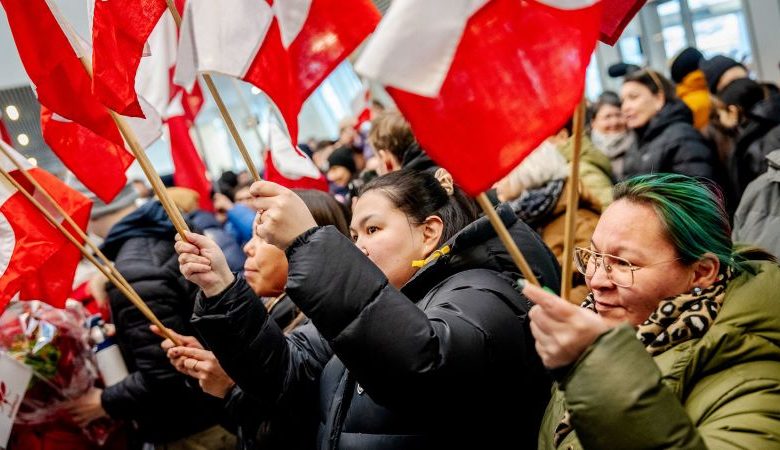
President Donald Trump’s quest to take over Greenland isn’t going away.
If anything, he’s ratcheted up his pressure and threats in recent days, even as he began to get more domestic pushback — including from some advisers.
The situation has now roiled the United States’ relationship with multiple European allies, with no end in sight.
So where do things stand, and where do we go from here? Here are five key points to know.
Trump allies who oppose his designs of Greenland, even very recently, preferred to act as though this were not a serious proposal. They seemed to hope that he would eventually move on.
The last few days have made clear this is a serious situation.
Even if you believe Trump’s efforts to control Greenland remain impractical and unlikely to succeed, the methods he’s using are increasingly fraught and carry potential long-term impacts. Trump’s efforts to leverage Denmark to turn over Greenland are threatening the unity of the Western alliance in a way few things have.
Trump has responded to increasing Republican and European criticisms by not backing off, but instead ratcheting up his pressure campaign:
-
He threatened significant new tariffs on several European countries unless a deal is reached to purchase Greenland, furthering the prospect of an ugly trade war.
-
He sent a letter to Norway’s prime minister connecting his Nobel Peace Prize snub to a sentiment that “I no longer feel an obligation to think purely of Peace” but instead “what is good and proper for the United States of America.”
-
That letter was leaked, and Trump has in turn started posting private messages he’s received from NATO’s secretary general and French President Emmanuel Macron.
-
Trump is also posing memes of himself conquering Greenland.
The president has long relished the idea of throwing his weight around on the world stage and testing allies. But he’s never done so in the context of trying to take over territory that is under an ally’s control. Greenland is also under NATO protection, meaning allied countries would be obliged to defend it from a US invasion.
But even shy of an invasion, this is hugely provocative. It’s entirely possible it could significantly damage NATO, the bedrock alliance forged after World War II to unite against Soviet Union and other threats, regardless of whether Greenland changes hands. The situation in Greenland seems to be furthering the sense among Western allies that they need to craft a future independent of the United States.
That could also make it much more difficult for the US to enter into treaties in the future, if other countries don’t trust it to abide by the terms.
Beyond that, this is not an isolated example of Trump’s territorial ambitions and military threats. He appears increasingly emboldened to pursue a domination of the Western Hemisphere. And he’s promised a takeover of Greenland so firmly that it would be difficult to walk away empty-handed.
It all makes the situation plenty urgent for those who have sought to pretend otherwise.
Lots of Republicans are clearly skeptical of this; in fact, it’s tough to find strong supporters in Congress or in the public at large. Rep. Don Bacon of Nebraska recently called Trump’s Greenland fixation “the dumbest thing I’ve ever heard.” GOP Sen. John Kennedy of Louisiana has called Trump floating military action “weapons-grade stupid.”
The GOP’s preferred method for dealing with these situations is to hint that maybe this isn’t the best idea and to hope that’s good enough.
But that might not be good enough this time. And some Republicans seem to be starting to come to terms with that.
So what could they do?
One option is a war powers resolution along the lines of the Venezuela one that narrowly failed last week. There is already a bipartisan proposal from GOP Sen. Lisa Murkowski of Alaska and Democratic Sen. Jeanne Shaheen of New Hampshire to block Trump from taking territory from any NATO member state.
Such a measure might be able to pass, but it would likely need two-thirds majorities in both chambers to thwart a Trump veto.
GOP Sen. Thom Tillis of North Carolina predicted last week that an effort by Trump to take Greenland would produce “sufficient numbers here to pass a war powers resolution and withstand a veto.”

Beyond that, there’s always impeachment — the true last resort.
It seems fanciful to think that Congress would impeach Trump again after doing so twice in his first term, especially since the branch is controlled by Republicans, who would have hell to pay from the base.
But Bacon said last week that impeachment would be in play if Trump invaded Greenland. (Tillis on Tuesday downplayed that possibility, focusing instead on war powers.)
Even if these might be remote possibilities, it says something that some Republicans are talking about them out loud.
It’s one thing to pursue new territory; it’s another to do it based on a series of distortions and false claims.
CNN’s Daniel Dale on Tuesday ran through the butchered facts in Trump’s letter to Norway about his Nobel snub. Those include that no written documents support Denmark’s claim to Greenland. (In fact, US documents and plenty of others do.)
He’s repeatedly spoken as though Russia and China are circling the island and primed to take it over if the United States doesn’t; that’s simply not true. Chinese Foreign Ministry spokesperson Guo Jiakun on Monday told the US to “stop using the so-called China threat as a pretext for itself to seek selfish gains.”

Trump early Tuesday morning also savaged the United Kingdom for handing over the island of Diego Garcia in the Indian Ocean to Mauritius, calling it an “act of total weakness.” The situation carries parallels to Greenland, given the UK originally purchased Diego Garcia and it holds a joint US-UK military base; Trump also said the transfer makes it more important for the US to take Greenland.
In fact, the Trump administration previously supported the transfer of Diego Garcia and the Chagos Islands. In a statement last May from Secretary of State Marco Rubio, it said the transfer “secures the long-term, stable, and effective operation” of the military facility.
Finally, CNN’s Jim Sciutto reported Monday that Trump conceded to UK Prime Minister Keir Starmer this weekend that he might have been given “bad information” on European troop deployments to Greenland.
But those troop deployments were the stated reason for Trump’s tariffs threat. To the extent he’s taking such major actions on bad information, that’s really something.
The Nobel letter to Norway was particularly stunning. Trump basically signaled he wasn’t so interested in peace anymore.
And the administration seems to have tacitly acknowledged that message isn’t terribly helpful.
Asked about it by reporters Monday, Trump downplayed a connection between his Nobel snub and his ambitions for Greenland.
“No, I don’t care about the Nobel Prize,” Trump said, adding that “I really don’t care about that. What I care about is saving lives.”

Treasury Secretary Scott Bessent on CNBC on Tuesday morning called the tying of the Nobel to the events in Greenland “a complete canard.”
“This has been on the president’s mind since his first term,” Bessent said. “It’s been on the presidential mind for 150, 160 years, the US has been trying to acquire Greenland. This is not something new.”
But Trump clearly tied the two together.
What’s perhaps most stunning is just how little anyone (not named Trump) seems to be asking for it. It would be one thing if Trump were pursuing something the American people wanted.
But they decidedly do not.
A CNN poll released last week showed 75% of Americans and even nearly half of Republicans opposed the effort to take control of Greenland. A majority of Republicans (52%) strongly opposed it, while just 7% strongly supported it.
And that’s without even mentioning the prospect of military action.
A CBS News-YouGov poll this weekend showed opposition went up to 86% if Trump used military force to take Greenland.
We might have expected Trump’s base to move in favor of this idea as he continued to push it, but that hasn’t happened.
The fact that he’s still pressing the envelope on something so vastly unpopular suggests he’s truly politically unshackled with no more presidential campaigns in front of him and fewer people around him to check his impulses.
Credit: Source link