Hawai‘i’s celebrity politicians
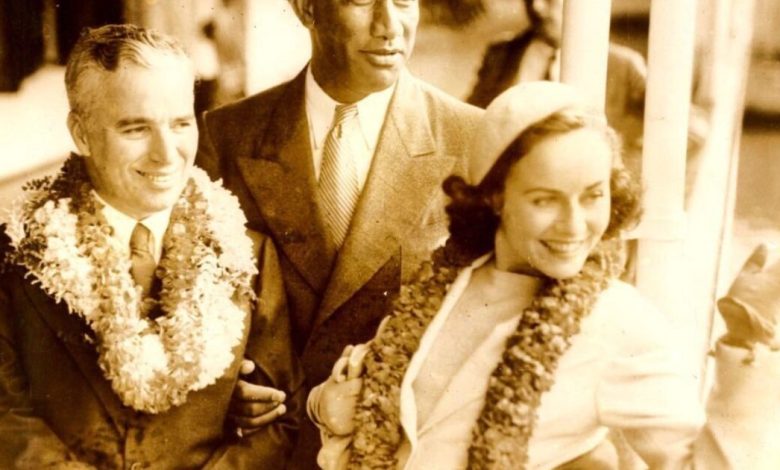
Here in Hawai‘i, celebrity politicians make marks under particular circumstances. Historically, they swoop-in to seize oft-forgotten seats in the State Legislature, the county level, or some government board.
There is no blueprint for political success as a local celebrity. Success, however, has been possible at the county level, within state legislative offices, and on minor statewide boards and commissions.
Celebrities may bring attention to these forgotten races and win elections in the process.
Finding a County Seat
Duke Kahanamoku is perhaps the most notable example of a ‘celebrity’ politician. His trajectory is notable in that he focused much of his political career on a single office in the City and County of Honolulu.
Kahanamoku had risen to prominence in the United States as an Olympian. He won medals on at least three separate occasions (1912 in Stockholm, 1920 in Antwerp, and 1924 in Paris). His success on the global stage later served him in this capacity.
There was a time when the top law enforcement official in the City and County of Honolulu, known as the Sheriff, was elected. Kahanamoku served as a candidate, beginning in 1934 as a Democrat. He served in that position until 1961, two years after Hawai‘i’s admission into the union as a U.S. State.
He is perhaps the best example of a celebrity in the territorial era. He won re-election in 1936 as a Democrat, before switching parties before the 1940 elections. For the next two decades, the wily swimmer served as a member of the Republican Party.
Kahanamoku showed how a celebrity, with enough tenacity, could endure as a force in Island politics.
Many decades later, another such local athlete took a stab at county politics on O‘ahu.
Arnold Morgado Jr., formerly of the Kansas City Chiefs, briefly served in the Hawai‘i House of Representatives before gaining a seat on the Honolulu City Council through a special election in 1985.
While he eventually rose to become Chair of the Honolulu City Council, he was ultimately defeated in a race for mayor in 1996. A celebrity flair is not always enough to win election.
Athletes are not alone when seeking political office. Augie Tulba worked hard to win his seat on the Honolulu City Council in 2020, where he serves to this day. His background as a well-known comedian played a part in gaining name recognition. It certainly played a part in his upset defeat against former State Senator Will Espero. Tulba is likely the best contemporary example of a local celebrity who has gained office.
Success in local politics is not only reserved to county positions. There is room for celebrities to also find limited success at the state level.
The Legislators
At least a couple celebrities initially parlayed their fame in sports into stints at the state legislature.
Jim Clark, a notable football player for the Washington Redskins, later served in the Hawai‘i State House of Representatives and the State Senate throughout the ’60s. His father-in-law, then-Honolulu Mayor Neal Blaisdell, likely influenced his initial affiliation with the Republican Party. However, evolving political circumstances ultimately led Clark to the Democratic Party.
A few years after Clark vacated the House, another former football player (and longtime actor in “Hawai‘i Five-O”) made a play for a seat in the Legislature. Following a brief stint on the Honolulu City Council in 1968 as a Republican, Herman Wedemeyer successfully won a seat in the House of Representatives as a Democrat, where he briefly served as Chair of the House Committee on Tourism. After leaving the House, he continued to make regular appearances on the show.
Fred Hemmings, a renowned surfer of O‘ahu’s North Shore, parlayed his fame into a seat in the State Senate at a time when the Republican Party’s fortunes were far from certain. He served three terms in the State House of Representatives in the late ’80s before serving as a State Senator for over 10 years nearly a decade later.
Between those two stints, he was also an unsuccessful candidate for Governor in 1990, losing to incumbent Governor John D. Waihe‘e by more than 20 points.
Both Clark and Hemmings show that celebrities, even when they are not affiliated with the most popular political party, can still gain some level of support.
Quiet Statewide Offices
In crowded statewide races with little voter engagement, celebrities can attract a notable amount of support. This is especially true where multiple candidates compete for multiple seats.
This has been the case with two local celebrities that competed for seats on two particular legislative bodies: the Office of Hawaiian Affairs and the Board of Education.
Rockne ‘Rocky’ Freitas, a football player of Detroit Lions and Tampa Bay Buccaneers fame, served on the Board of Trustees of the Office of Hawaiian Affairs, eventually ascending to briefly become the Board’s Chair. He ultimately served until 1986, opting to not seek re-election.
What is surprising is that Freitas started his tenure as an appointee. His predecessor, Frenchy DeSoto, had resigned to unsuccessfully seek a seat in the State Senate.
In the realm of business, the well-known tire salesman Lex Brodie also parlayed his brand into a notable political career born out in his retirement years.
Starting in 1992, Brodie served several terms on the State Board of Education. During his first election, he received more votes than any other candidate. Ultimately, he served on the Board for more than 10 years.
By the time he was running for a third term, the businessman was also serving as a campaign manager for Honolulu Mayor Jeremy Harris. It didn’t matter that he had reached his 80s.
Such boards as the Office of Hawaiian Affairs and the Board of Education do not always garner the most attention from members of the public. Nevertheless, celebrity candidates electrify these sleepy races.
From the vantage point of civic engagement, that might not always be a bad thing.
Celebrity Fame Isn’t Everything
Celebrity status does not always accord with political success. At least two examples have played out at the highest rungs of state office.
When longtime Mayor Frank Fasi ran for Governor as a third-party candidate in 1994, he needed an affable name to attract attention to their ticket. This is where he turned to the longtime entertainer Danny Kaleikini.
The melodic Kaleikini was tapped to balance out Fasi’s sharp edges. In that three-way race, the Fasi-Kaleikini ticket was sandwiched between the victor (Governor Ben Cayetano) and the third-place finisher (former U.S. Representative Pat Saiki).
A more recent example is the boxer B.J. Penn. Penn, who has now been an unsuccessful candidate at the statewide level and at the local level.
In the 2022 Republican primary for Governor, Penn captured second place and more than a quarter of all votes. It was a telling sign that many GOP voters, despite the conspiracy theories, liked the candidate. Penn ran for a seat on the Hawai‘i County Council in 2024 and may well do so again in 2026.
Celebrities, for the time being, are not projected to disappear from the political scene. They’re not very common. Nor are they very rare.
In an era where fewer and fewer candidates are filing to run for office, could celebrities be the answer to our civic apathy?
Maybe the state legislature needs an actor or two. Time will tell.
Credit: Source link