How fearful is the market of a recession? Soaring oil prices spark safe-haven buying in US Treasuries, with focus shifting to non-farm payrolls.

①As investors shifted their focus to the risk that surging energy prices could weigh on economic growth, U.S. Treasury bonds rose again on Thursday in a rare move amid a sharp rise in oil prices… ②In terms of weekly performance, the yield on the 10-year U.S. Treasury bond has fallen by about 13 basis points since the beginning of this week, on track for the largest weekly decline since the week of February 9.
As investors shifted their focus to the risks that surging energy prices could weigh on economic growth, U.S. Treasury bonds rose again on Thursday, a rare occurrence on a day when oil prices surged…
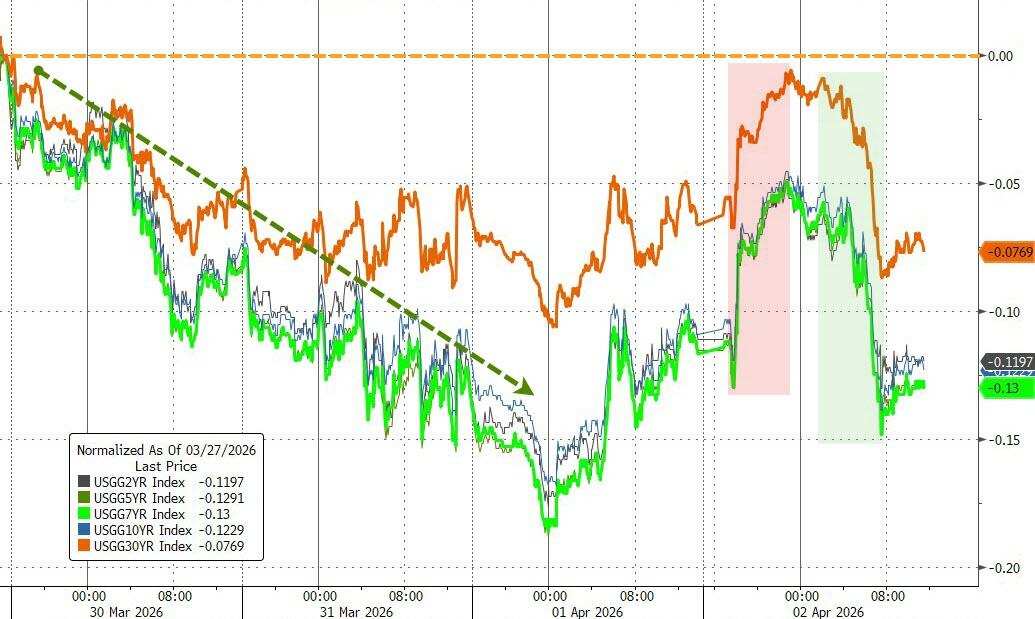
Market data showed that yields on U.S. Treasury bonds of all maturities collectively fell overnight, with the 2-year yield down 0.06 basis points to 3.796%, the 5-year yield down 0.17 basis points to 3.946%, the 10-year yield down 1.17 basis points to 4.305%, and the 30-year yield down 1.83 basis points to 4.880%.
The ‘inverted V’ movement in U.S. Treasury yields during Thursday’s trading session gave many traders a scare.
Previously, Trump, the U.S. President, made threatening remarks against Iran during a speech in the Asian session on Thursday, which initially caused Treasury yields to rise along with oil prices. However, the higher oil prices climbed, the more investors worried that this shock could trigger a recession, hitting the stock market and driving funds into the bond market. In the end, the yield on the 10-year Treasury bond fell by about 1 basis point in late trading, despite having risen by as much as 6 to 7 basis points at one point during the session.
In terms of weekly performance, the yield on the 10-year U.S. Treasury bond has fallen by about 13 basis points since the beginning of this week, on track for the largest weekly decline since the week of February 9.
Gregory Faranello, head of U.S. rates at Amerivet Securities, said that while inflation would rise first, the U.S. Treasury market had realized a reality: over time, if energy prices remain high or continue to rise, the economy will be impacted.
In a speech delivered in Washington on Wednesday evening local time, Trump virtually dashed hopes for a quick end to the Middle East conflict, saying the U.S. planned to launch a new attack on Iran in the next two to three weeks, although he reiterated that the war was ‘very close’ to being over.
The settlement price of the U.S. benchmark WTI crude oil futures stood at $111 per barrel on Thursday, while the average daily retail price of unleaded gasoline in the U.S. had exceeded $4 per gallon earlier this week, both reaching these levels for the first time since 2022.
The market seemed to be preparing for a ceasefire announcement, but Trump’s speech sent the opposite message,’ said Molly Brooks, a rates strategist at TD Securities.
Focus Shifts to Non-Farm Payrolls
Looking ahead, industry insiders noted that the short-term movement of U.S. Treasury bonds largely hinges on the U.S. March non-farm payroll report, which is scheduled for release on Friday. Economists surveyed by the media generally expect that 60,000 non-farm jobs were added in March, compared to a decrease of 92,000 jobs in the previous report.
Before the release of the non-farm payroll data, Thursday’s initial jobless claims data indicated that the U.S. labor market conditions remained relatively stable for the time being. Last week, the number of Americans filing for unemployment benefits unexpectedly dropped to 202,000.
Of course, tonight’s release of the non-farm payroll report will be somewhat unique — the U.S. stock market will be closed for Good Friday. The decentralized bond market typically also shuts down during holidays, but when holidays coincide with the employment report release date, it is more common to shorten trading hours.
The Securities Industry and Financial Markets Association (SIFMA) currently recommends halting dollar-denominated bond trading at noon New York time (midnight Beijing time) on Friday, one hour later than the close of CME Group interest rate futures trading.
Tom di Galoma, Managing Director at Mischler Financial Group, stated, ‘This non-farm payroll data is highly likely to exceed bond market expectations. Throughout the week leading up to the long Easter holiday weekend in the UK and Europe, risk aversion and position unwinding have been underway.’
From an interest rate pricing perspective, prior to the outbreak of the U.S.-Iran conflict on February 28, overnight index swaps (OIS) had priced in more than two Federal Reserve interest rate cuts (each by 25 basis points) for this year. These expectations were subsequently erased due to inflation concerns, and traders began pricing in the possibility of the Fed’s next move being a rate hike. However, recently, the market has started repricing toward the view that the Fed may be closer to cutting rates again.
Last year, the Federal Reserve cut interest rates three times to address weakness in the labor market. In January, they paused rate cuts, citing improvements in labor market conditions. Since then, the Labor Department’s monthly non-farm payroll report for January was stronger than expected, while the February data showed signs of weakness — turning negative.
Strategists at Bank of America this week postponed their forecast for the Federal Reserve’s rate cut window from June and July to September and October.
 Looking to pick stocks or analyze them? Want to know the opportunities and risks in your portfolio? For all your investment-related questions,just ask Futubull AI!

Editor/Doris