Inflation ‘reignites’! Collapse of US-Iran talks shatters rate cut expectations, bond traders rush to postpone cuts to 2027

According to Zhitong Finance, the failure of peace negotiations between the United States and Iran has further redirected the bond market’s attention to inflation and strengthened the expectation that interest rates will remain elevated for an extended period. Rising energy costs could exacerbate already high price pressures and delay Federal Reserve rate cuts, becoming the primary concern for investors in the $31 trillion U.S. Treasury market. Traders and strategists at Pacific Investment Management Company (PIMCO), Brandywine Global Investment Management, and Natixis North America are preparing for yields to remain high—most institutions are unwilling to make significant asset allocation adjustments until there is more clarity on the inflation outlook.
March inflation data released on Friday showed that the consumer price index (CPI) rose at its fastest monthly pace since 2022, pushing the 10-year U.S. Treasury yield above 4.3% and prompting traders to scale back expectations for rate cuts this year. On Monday, following the collapse of U.S.-Iran weekend talks, President Trump ordered the blockade of the Strait of Hormuz, sending yields up another 3 basis points to 4.35%. John Briggs, head of U.S. interest rate strategy at Natixis North America, noted: “The focus has indeed shifted back to inflation. While the labor market remains stable, it lacks structural dynamism; inflation is now the core issue.”
 This shift highlights a rapid change in market narratives: oil prices are now significantly higher than pre-conflict levels, making inflation harder to ignore. For many investors, they must also contend with the risk that a prolonged conflict could eventually weigh on economic growth. The more pressing question is how long elevated energy costs will persist and ultimately feed into consumer prices. Japan’s 10-year government bond yield climbed to its highest level since 1997, while equivalent yields in Australia and New Zealand rose by at least 6 basis points.
Meanwhile, the U.S. labor market remains robust. Nonfarm payrolls in March saw their largest increase since late 2024, with the unemployment rate falling to 4.3%, complicating arguments for imminent rate cuts. Kevin Flanagan, head of investment strategy at WisdomTree, stated that it would take at least three months to obtain clear inflation data. He added that with inflation still about one percentage point above the Federal Reserve’s target and unemployment hovering near 4.5%, the central bank’s urgency to consider rate cuts from this point has diminished.
Traders have adjusted their expectations, postponing the Federal Reserve’s next 25-basis-point rate cut to mid-2027. Prior to the conflict, markets had anticipated two rate cuts this year, but the Fed has remained on hold since lowering its policy range to 3.5%-3.75% in December.
Meanwhile, unresolved questions about ceasefire prospects, the status of the Strait of Hormuz, and oil price trends continue to pressure the front end of the U.S. Treasury yield curve, keeping market expectations for monetary policy volatile.
Andrew Jackson, head of investments at Vontobel Asset Management, remarked: “In a sense, the Federal Reserve’s job has become slightly easier because they can argue that medium-term inflation trends are uncertain.” He pointed out that the Fed is “highly likely to pause rate hikes for longer than previously expected,” making the three-to-five-year segment of the Treasury yield curve more attractive.
Others prefer to remain on the sidelines for now. Jack McIntyre, portfolio manager at Brandywine Global Investment Management, stated that he is currently underweight U.S. Treasuries. “If the ceasefire holds and oil prices continue to underperform, the market will refocus on the labor market. If conditions change, we will adjust our views quickly,” he said.
March inflation data showed that prices rose 0.9% month-over-month, driven primarily by surging gasoline prices, while core prices excluding food and energy were slightly below expectations. This increase was broadly in line with forecasts, following pricing signals issued by companies such as Delta Air Lines and the U.S. Postal Service.
Molly Brooks, U.S. Rates Strategist at TD Securities, stated: “The Federal Reserve will need to see a pullback in surging inflation and several reports indicating moderation before feeling comfortable continuing with rate cuts, assuming no deterioration in economic growth. Although recent labor market data has shown resilience, the Fed’s dual mandate is becoming increasingly balanced.”
The minutes from the Federal Reserve’s meeting on March 17-18 showed that officials saw risks in both directions prior to the conflict, with ‘the vast majority’ of them citing upside risks to inflation and downside risks to employment.
Daniel Ivascyn, Chief Investment Officer at Pacific Investment Management Company, stated that the spike in energy prices has exacerbated these tensions, creating a ‘supply-side inflation shock.’ He noted: ‘Given the current environment of persistently high inflation and broad-based weakness in financial assets, this is indeed a plausible market risk.’ The firm favors high-quality bonds while seeking to profit from any market dislocations.
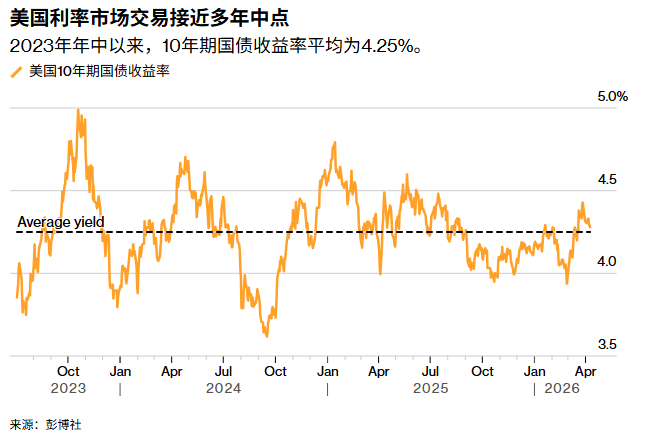
Amid shifting prospects for Federal Reserve policy, one anchor point remains: since mid-2023, the yield on the 10-year U.S. Treasury note has primarily fluctuated between 4% and 4.5%, averaging around 4.25%. Flanagan remarked: ‘There are still many uncertainties at present, and the yield on the 10-year Treasury has returned to the middle of its long-term range.’