Iranian Crypto Tolls in Strait of Hormuz
Key takeaways
- Iran deployed cryptocurrency as a payment option for Strait of Hormuz transit tolls beginning in mid-March 2026 — the first time a state has used crypto infrastructure as a sovereign revenue mechanism at a major maritime chokepoint
- The IRGC charges up to USD 2 million per vessel; various public estimates suggest the toll system could generate up to USD 20 million per day from oil tankers alone, with USD 600–800 million per month possible if LNG vessels are included
- The unnamed intermediary administering toll collection remains publicly unidentified — a critical gap for any future enforcement or sanctions action targeting the payment network
- Crypto payments can be settled quickly and outside US correspondent banking, making real-time interdiction of toll payments technically difficult
- A Pakistan-brokered ceasefire took effect April 7, 2026, but may be in question as of April 8 based on Iranian government statements
- Tolls remain in effect, and Iran’s institutional infrastructure — dedicated legislation, IRGC command structure, and a Qeshm Island crypto conversion window — suggests no near-term rollback
{{horizontal-line}}
Iran’s use of digital assets as payment for Strait of Hormuz transit tolls represents a critical deployment of cryptocurrency for state-level sanctions evasion. Since mid-March 2026, the Islamic Revolutionary Guard Corps (IRGC) has charged ship operators up to USD 2 million per vessel to transit the strait, accepting payment in either Chinese yuan — routed through Kunlun Bank via CIPS, outside SWIFT — Bitcoin, or possibly USDT. Iran’s parliamentary legislation specifies fees in rials and authorizes “digital currencies” developed with participation of Iranian companies.
Iran approved the “Strait of Hormuz Management Plan” on March 30–31, 2026, codifying a system that was already operating. At current traffic levels, public estimates suggest the toll system could generate up to USD 20 million per day from oil tankers alone, with USD 600–800 million per month possible if liquefied natural gas vessels are included.
How does the Strait of Hormuz toll system work?
It is not clear if last night’s ceasefire agreement will impact the toll system in the near-term, although some ships have begun moving through the strait as of April 8. The toll system has typically worked as follows:
- Ship operators contact an IRGC-linked intermediary (unnamed company) and submit vessel ownership records, flag registration, cargo manifests, destination ports, crew lists, and AIS tracking data
- The IRGC screens the vessel — checking for ties to the US or Israel; ships from enemy nations are denied entirely
- Iran applies a five-tier nationality ranking system — nations ranked 1–5 by “friendliness,” with friendlier nations receiving lower toll rates
- Payment is negotiated — oil tanker fees start at approximately USD 0.50–1 per barrel of crude (rate varies by nationality tier); a fully loaded VLCC (~2 million barrels) pays approximately USD 2 million; container ships and other vessel types are negotiated individually
- Payment must be in Chinese yuan (via Kunlun Bank / CIPS) or digital assets
- After payment, the vessel receives a VHF-broadcast passcode and IRGC Navy escort through a northern corridor around Larak Island
Why is the Iranian regime accepting cryptocurrency?
Iran’s choice to accept crypto for Hormuz toll collection is not a departure from the IRGC’s established financial playbook — it is an extension of it. As TRM documented ahead of OFAC’s January 2026 designation of Zedcex and Zedxion, the IRGC had already routed approximately USD 1 billion through offshore, exchange-branded stablecoin infrastructure, exploiting the same properties that attract lawful users: low transaction costs, high throughput, deep broker liquidity, and widespread regional adoption — all outside the US correspondent banking system. The Hormuz toll system deploys that same architecture, transforming a pre-existing sanctions evasion rail into a real-time revenue collection mechanism for the Iranian state.
Crypto transactions can be settled quickly and without touching the US correspondent banking system, making it difficult to freeze or intercept in real time.
What cryptocurrencies is Iran accepting?
Iran’s parliamentary legislation references rials, yuan, and digital currencies as payment methods, according to Iranian state media — but the full bill text has not been published, making it impossible to confirm the exact denominations from the legislation itself. Iranian state media and some officials have pointed to bitcoin specifically, while Western outlets, citing shipping industry sources, report USDT as the cryptocurrency collected by the IRGC in practice.
While the use of USDT is consistent with well-documented IRGC patterns, there are concrete operational reasons the IRGC might prefer bitcoin as centralized stablecoin issuers are able to freeze and work with law enforcement to seize illicit proceeds.
What Iranian sources say about the role of crypto in the Hormuz tolls
Iranian state and state-adjacent media frame the toll system primarily as an assertion of sovereign rights rather than a wartime revenue measure. Parliamentary sponsors of the Hormuz Management Plan stated that the strait “is no different from any other transit route — we ensure its security, and it is natural for ships and tankers to pay us duties.” An IRGC-linked outlet described the system as “Iran’s toll booth at the throat of world trade,” framing it as a long-overdue exercise of territorial authority. Iran justifies the toll legally by noting it never ratified
UNCLOS — the treaty that explicitly prohibits transit passage fees in international straits — leaving it free, in its own framing, to charge for “services rendered” including security escort, navigation guidance, and environmental monitoring.
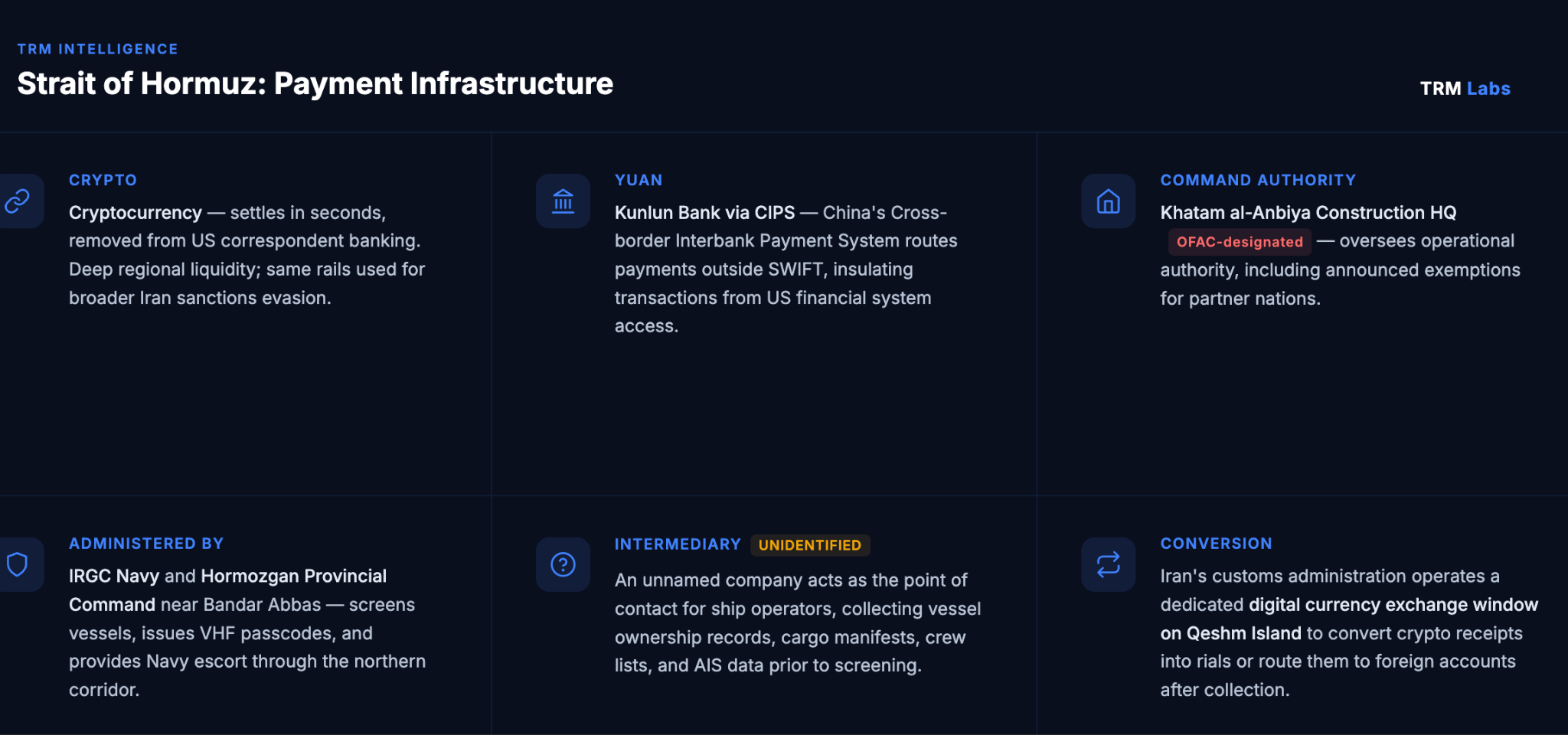
Hamid Hosseini, spokesperson for Iran’s Oil, Gas and Petrochemical Products Exporters’ Union, told Iranian media that the toll system helps “monitor what goes in and out of the strait to ensure the corridor is not being used for transferring weapons” — framing crypto collection as a screening and surveillance mechanism, not merely a financial one. Iran’s customs administration established a dedicated digital currency exchange window on Qeshm Island to convert digital currency receipts into rials or route them to foreign accounts rapidly after collection — suggesting a deliberate infrastructure build for processing crypto at scale.
An Iranian financial outlet published analysis estimating the toll system could generate up to USD 120 billion annually at full operational capacity — an order of magnitude above the USD 600–800 million monthly figure in Western reporting, framed as Iran’s “last resort” leverage card in any peace negotiation.
Outlook
Iran’s framing of the toll system as a permanent assertion of sovereignty — codified in legislation, administered through a standing IRGC command structure, and backed by dedicated crypto conversion infrastructure on Qeshm Island — makes a clean post-conflict rollback unlikely. The crypto dimension compounds the enforcement challenge: rapid settlement and independence from US correspondent banking do not change with a ceasefire, and OFAC’s ability to target the payment infrastructure depends on identifying and designating the unnamed intermediary currently administering toll collection before funds disperse. That intermediary remains publicly unidentified. Should the toll system endure, it would mark the first durable deployment of stablecoin infrastructure as a state revenue mechanism at a major maritime chokepoint.
{{horizontal-line}}
Frequently asked questions (FAQs)
1. Is Iran accepting cryptocurrency for Strait of Hormuz transit?
Yes. Since mid-March 2026, the IRGC has accepted cryptocurrency as payment for transit through the Strait of Hormuz. Ships may also pay in Chinese yuan routed through Kunlun Bank via CIPS. Iran’s parliament formally codified the system in the “Strait of Hormuz Management Plan,” approved March 30–31, 2026.
2. How much does it cost to transit the Strait of Hormuz?
Fees vary by vessel type and nationality tier. Oil tanker fees start at approximately USD 0.50–1 per barrel of crude cargo, meaning a fully loaded VLCC carrying roughly two million barrels pays approximately USD 2 million. Container ship fees are negotiated individually. Iran applies a five-tier nationality ranking system; nations deemed “friendlier” receive lower rates, while vessels linked to the US or Israel are denied transit entirely.
4. How does the Strait of Hormuz toll system work?
Ship operators contact an unnamed IRGC-linked intermediary and submit vessel ownership records, flag registration, cargo manifests, destination ports, crew lists, and AIS tracking data. The IRGC screens each vessel for ties to the US or Israel. Approved vessels negotiate a fee — paid in yuan or crypto — and receive a VHF-broadcast passcode and IRGC Navy escort through a northern corridor around Larak Island.
5. How much revenue could Iran generate from Strait of Hormuz tolls?
TRM estimates the system could generate up to USD 20 million per day from oil tankers alone, and USD 600–800 million per month if LNG vessels are included. Iranian economic analysts have published estimates as high as USD 120 billion annually at full operational capacity, though that figure assumes a broader restoration of traffic and full enforcement across all vessel types.
6. Can OFAC or the US government block Iran’s crypto toll payments?
Real-time interdiction is technically difficult — transactions settle quickly often with no US banking touchpoint. The unnamed intermediary currently administering toll collection remains publicly unidentified, which limits the ability to target the payment network directly. Stablecoin issuers could blocklist associated addresses, but this requires identifying those addresses first.