Iran’s two crypto economies: state guile and household survival

Islamic Republic of Iran Broadcasting has lost the few audience it once assumed it possessed. According to a 2024 survey by the state-run ISPA, only 12.5 percent of Iranians follow the news through the state broadcaster, and 11.5 percent watch films and TV series on state TV.
Viewers have migrated elsewhere, disengaged, or stopped watching altogether. The result is a broadcaster that retains infrastructure and reach on paper but has been stripped of public relevance in practice.
This erosion matters because the system was never designed to retain an audience. Its function was to define reality by default, assuming passive consumption rather than active belief. Once viewers disengaged, repetition lost its force. Control of distribution no longer compensates for the absence of viewers.
During moments of nationwide crisis, when internet shutdowns leave citizens with few information sources, state television no longer functions as a reference point. Instead, it serves as a tool of narrative management: selecting what can be shown, omitting what cannot be explained, and substituting political reality with staged images of normalcy.
Broadcasting without an audience
For decades, Iran’s media model assumed a captive audience. State television and aligned agencies – particularly Guards-affiliated outlets such as Tasnim and Fars – operate not as independent newsrooms but as synchronized instruments of governance. Their role has been to speak in a single vocabulary, regardless of whether anyone is listening.
This model depends on two conditions: uninterrupted control of distribution and a public compelled to accept official framing as the baseline. Periods of unrest strain both. Authorities respond by narrowing the information space – blocking platforms, jamming opposition satellite networks, sidelining independent outlets and cutting internet access – to prevent images and testimony from circulating outside official filters.
Yet this strategy also exposes weakness. When viewers are forced back to a channel they no longer trust, omissions and contradictions become more visible, not less. Absence of alternatives does not restore authority; it highlights how little credibility remains.
Managing perception through omission
One of the clearest techniques used by Iranian state media during crises is substitution: replacing destabilizing political reality with curated depictions of normalcy. While protests across the country have been driven by explicit rejection of the political system – including chants calling for the overthrow of Supreme Leader Ali Khamenei – state television has persistently reframed unrest as a response to economic pressure.
Instead of addressing violence, casualties or political slogans, IRIB dispatched reporters to city streets to highlight the availability of basic goods such as chicken meat. These segments emphasized supply while omitting that prices had surged several times over in recent weeks.
By focusing on availability rather than affordability – and by recasting a political uprising as economic grievance – the broadcasts constructed an image of stability. The effect was to depoliticize a movement defined not by price demands, but by calls for the end of the ruling order.
Alongside omission sits coercive performance: televised confessions aired by Fars and Tasnim from detained protesters presented as “leaders” of unrest. These segments are not designed to persuade skeptics. They function as demonstrations of power, signaling the state’s ability to script guilt and enforce compliance.
From staged crowds to synthetic reality
What distinguishes the current phase is not the presence of propaganda, but its tools. Traditional methods – recycled crowd shots, selective framing and inflated attendance claims – have long been used. What is new is reliance on digitally manipulated or AI-assisted content that blurs the line between documentation and fabrication.
A recent example illustrates such shift. State media circulated a video presented as aerial helicopter footage of pro-government rallies, promoting it as evidence of mass popular support. Viewers quickly questioned its authenticity, pointing to visual inconsistencies in lighting, movement and composition, as well as the absence of basic helicopter safety features.
The state’s instinctive response – denial, external blame and further restriction – reinforced the cycle. Each tightening of control signaled anxiety. Each refusal to address substantive questions accelerated the erosion of credibility.
Whether every technical critique was correct was secondary. The significance lay in the reaction. Official visuals were no longer treated as authentic; they were examined as artifacts to be tested for manipulation.
This marked a shift from propaganda as persuasion to propaganda as evidence production. The aim was no longer only to frame events, but to manufacture visual proof. Paradoxically, the more sophisticated the techniques, the faster trust eroded.
Rasht Bazaar: A disaster told through one voice
The fire at Rasht’s central bazaar showed how narrative control operates under blackout conditions.
During protests in the northern city on January 8 and 9, a large section of the historic market caught fire as internet and phone services were cut, limiting residents’ ability to document events. State television retained full operational capacity and sent reporters to the scene while the fire was still burning.
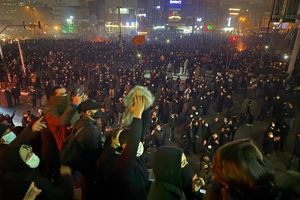
Official coverage attributed the blaze to protesters and focused on material damage, repeatedly citing the number of shops destroyed. Casualty figures were absent. Later segments emphasized economic losses through interviews with selected shopkeepers and officials, while avoiding scrutiny of security forces.
Eyewitness testimony carried by Iran International described a sharply different sequence: crowds pushed toward the bazaar, people trapped by smoke in narrow corridors, and security forces firing on those emerging with raised hands to surrender.
In this environment, state broadcasting operated with technical access but without an audience willing to accept its account. The absence of open networks and real-time citizen reporting produced a one-sided evidentiary landscape shaped by coercion and selective disclosure.

Beyond access: a crisis of credibility
Iran’s media crisis is often framed as a problem of access – blocked platforms, censored outlets and restricted bandwidth. It is more fundamentally a crisis of credibility.
A broadcaster that has lost its viewers may still produce content, but it no longer produces belief. Control without an audience is not influence. And in politics, messages that are not believed might as well not be seen.