LA lawmakers playing catch-up as AI centers push into state | Politics & Elections
With several massive data centers coming to Louisiana, artificial intelligence is on many lawmakers’ minds.
As of press time, they’d brought two dozen bills, most trying to carve out some protections for people as the technology rapidly proliferates and changes life as we know it.
House Bill 922 by Rep. Rodney Schamerhorn, a Hornbeck Republican, addresses concerns over data centers potentially raising residential utility bills. His bill says those costs can’t be passed onto household customers, only data center customers or customers contracting with them.
Meanwhile, HB 734 by Josh Carlson, a Lafayette Republican, would create an “AI consumer bill of rights” that would require AI programs, chatbots and political materials to identify themselves as such and notify users if they are collecting data on them.
Carlson’s bill also states parents have the right to control their children’s use of AI, and that a person can sue in civil court if AI is used to “appropriate their name, image or likeness for commercial purposes without their consent,” like in HB 157 by Rep. Vincent Cox III, or to “slander, libel or defame them.”
Parts of Carlson’s bill are similar to New Orleans Democrat Rep. Mandie Landry’s HB 425 and HB 459, the latter which requires labeling for AI in political materials and increases the criminal fine for violations from $2,000 to $10,000. And New Orleans Democrat Rep. Delisha Boyd’s HB 791 also mandates chatbot disclosure and puts privacy protections around chat logs.
Marrero Democrat Rep. Kyle Green’s HB 295 would have companies who use AI chatbots to verify user’s ages, suggesting government IDs. That would force users to hand over identifying documents like drivers’ licenses to tech companies or a third party.
Meanwhile, HB 230 by Rep. Mike Bayham, a Chalmette Republican, would require AI systems to label photos, videos and other content they create as AI-generated or face an up to $10,000 fine per violation.
Senate Bill 347 by Sen. Regina Barrow, a Baton Rouge Democrat, adds “unlawful deepfakes,” — videos altered to realistically depict a person saying or doing something they didn’t do — to the definition of “power-based violence” under the Campus Accountability and Safety Act.
It includes exceptions for a “work of political, public interest, or newsworthy value” as well as satire and parody.
And both SB 42 by Sen. Rick Edmonds, a Baton Rouge Republican, and SB 110 by Sen. Heather Cloud, a Turkey Creek Republican, ban AI from creating child sexual abuse materials.
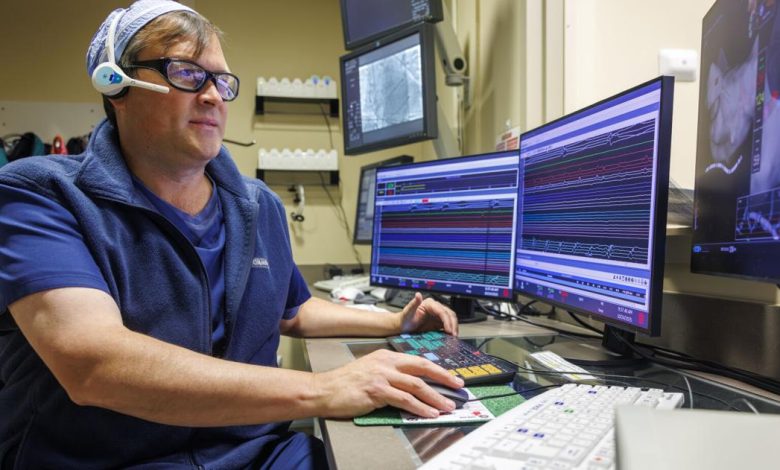
Dr. Michael Bernard, section head of electrophysiology at Ochsner Hospital, uses AI to help with surgery in 2025.
AI in industries
Houma Republican Rep. Jessica Domangue’s HB 197 lets health care providers use AI to help with “an analytic or administrative task” but not to “independently treat, diagnose, or communicate directly with a patient.” The fine would be $10,000 per violation.
Sen. Bob Hensgens, an Abbeville Republican, has a similar bill dealing with mental health chatbots.
Alexandria Democrat Jay Luneau’s SB 246 would require health insurance companies to have a human review a claim “based on medical necessity or a procedure requiring prior authorization” before denying it.
HB 880 by Rep. Edmond Jordan, a Baton Rouge Democrat, would regulate insurance companies’ use of AI and algorithms. The bill would prohibit companies from using systems that “intentionally consider protected class characteristics, rely on proxy variables that produce disparate impact without actuarial necessity, or generate arbitrary or capricious decisions.”
It would also ban homeowners’ insurance companies from using “credit scores, protected class characteristics, social media data, and consumer purchasing data” to determine rates.
HB 241 by Rep. Vincent Cox, a Gretna Republican, would require companies to tell applicants if they’re using AI to make automatic decisions in the job hiring process and what factors they’re having it consider. It also says they can’t use them on their own to make “discipline, termination, or deactivation decisions.”
The bill also clarifies AI systems still have to follow employment nondiscrimination laws.

A grocery basket
Pricing and other consumer bills
Some online retailers have already started using AI to offer a product to different people for different prices — using personal data it has collected on them, like their age and location, to determine the highest price they’ll pay for something.
Both New Orleans Democrat Sen. Royce Duplessis’ SB 362 and Baton Rouge Democrat Rep. Edmond Jordan’s HB 471 bans this practice, known as “surveillance-based pricing,” with Duplessis’ bill determining it to be “an unfair or deceptive trade practice.”
Aimed at keeping prices fair for grocerers, HB 800 by Rep. Alonzo Knox, a New Orleans Democrat, says suppliers have to give the same deals to all retailers who purchase the same goods in the same volume.
Landry also has two bills trying to get rid of hidden fees. HB 580 would require hidden fees or conditions to be disclosed in real estate transactions. HB 617 mandates companies to clearly display the total price of goods or services, including mandatory fees or any other additional charges.
HB 750 by Cox would require companies to have an easy way to cancel an automatic subscription — or at least as easy as accepting automatic renewal terms.
It is not clear how easiness would be measured.
Credit: Source link