North American stocks fall, oil prices rise as Trump’s delays fail to quell fears

Listen to this article
Estimated 4 minutes
The audio version of this article is generated by AI-based technology. Mispronunciations can occur. We are working with our partners to continually review and improve the results.
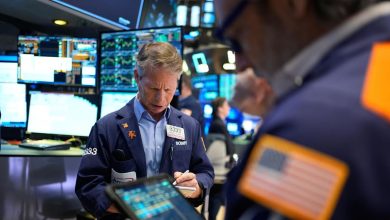
U.S. stocks are falling as Wall Street stumbles toward the finish of a fifth straight losing week, which would be its longest such streak in nearly four years.
The S&P 500 sank 0.9 per cent in early trading on Friday, deepening its losses after falling the day before to its worst drop since the war with Iran began. The Dow Jones Industrial Average was down 423 points, or 0.9 per cent, as of 10:05 a.m. ET, and the Nasdaq composite was 1.3 per cent lower.
This comes a day after Wall Street’s worst drop since the new war in the Middle East started, when the Nasdaq fell 10 per cent below its all-time high earlier this year, putting it officially in correction territory.
The losses are a break from Wall Street’s pattern this week, when the U.S. stock market flip-flopped from gains to losses each day as hopes rose and fell about a possible end to the war.
Moments after the U.S. stock market finished its dismal Thursday of trading, President Donald Trump offered another potential signal for hope. He extended a self-imposed deadline to “obliterate” Iran’s power plants to April 6 if it doesn’t allow oil tankers to resume their exits from the Persian Gulf to the open ocean through the Strait of Hormuz.
Oil prices pulled back briefly after Trump’s announcement in a sign of hope in financial markets that some normalcy may return to the Strait of Hormuz. But oil prices resumed their climb as the sun moved westward from Asia to Europe and back to Wall Street.
Despite Trump’s second announcement of delay this week, fighting continued in the Middle East. Iran gave no signs of backing down, while Israel threatened to “escalate and expand” its attacks on Iran.

Iran’s blockade of the Strait of Hormuz and attacks on tankers and facilities have pushed oil above $100 US a barrel. Cornell economic historian Nicholas Mulder says it’s ‘reasonable to assume’ prices will keep climbing by a few dollars a day as long as the war continues, potentially topping $120 US by month’s end.
“The diplomatic dissonance this week between the U.S. and Iran dismayed investors,” said Doug Beath, global equity strategist at Wells Fargo Investment Institute. “By the end of the week, risk appetite could not withstand the fog of war.”
“Any further statements by Trump about a deal are white noise to the markets,” Jim Bianco, president and macro strategist at Bianco Research, wrote in a social media post. “Only if the IRANIANS say the talks are going well will it impact markets.”
The price for a barrel of Brent crude, the international standard, rose 2.2 per cent to $104.13 US and is up from roughly $70 US before the war began. Benchmark U.S. crude rose three per cent to $97.28 US per barrel.
The fear in financial markets is that the war will disrupt the production and transport of oil and natural gas in the Persian Gulf for a long time. It could keep so much oil and gas out of the world’s markets that it sends a punishing wave of inflation through the global economy. Not only would it raise prices for drivers buying gasoline, it could push businesses that use any trucks, ships or planes to move their products to raise their own prices.
If the war continues until the end of June, strategists at Macquarie say the price of oil could reach $200 US per barrel, which would be a record.
While lower rates would help give the job market and prices for investments an upward jolt, they would also risk making inflation worse.
Long-term U.S. Treasury yields rose even further in the bond market following Friday’s rise for oil prices. The yield for the 10-year Treasury climbed to 4.44 per cent from 4.42 per cent late Thursday and from just 3.97 per cent before the war began.
That rise has already sent rates jumping for mortgages and for other loans taken by U.S. households and businesses, slowing the economy.
On Wall Street, most stocks fell, including four out of every five in the S&P 500.
One of the few stocks to rise was Netflix, which added 0.3 per cent a day after announcing price hikes for its services.
In stock markets abroad, indexes fell in Europe following a mixed finish in Asia.