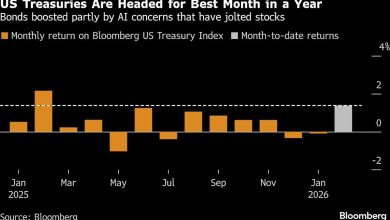
Persistent AI-related anxiety drives investor demand for long-term U.S. Treasury bonds, pushing yields to multi-month lows.

The U.S. bond market has continued to strengthen recently.
According to Zhitong Finance, in recent times, the U.S. bond market has continued to strengthen, with significant buying interest flowing into key maturity bonds within the $30 trillion U.S. Treasury market. Lawrence Gillum, Chief Fixed Income Strategist at LPL Financial, pointed out that this rally in long-term U.S. Treasuries is partly driven by concerns that artificial intelligence (AI) may disrupt the U.S. job market.
Gillum believes that the recent decline in long-term Treasury yields reflects, at least to some extent, investors’ anxiety over the potential ‘disruptive’ impact of AI. In other words, concerns surrounding AI are driving bond market yields lower.
Data shows that on Thursday, the yield on the U.S. benchmark 10-year Treasury closed below 4.02% at 4.015%, marking its lowest level since November 26 of last year. The 10-year Treasury yield is generally considered a pricing benchmark for 30-year fixed mortgage rates. On the same day, the 30-year Treasury yield fell below 4.7% to 4.665%, its lowest level in the past three months. Notably, this decline in yields occurred without the release of major economic data or other non-AI-related significant events.
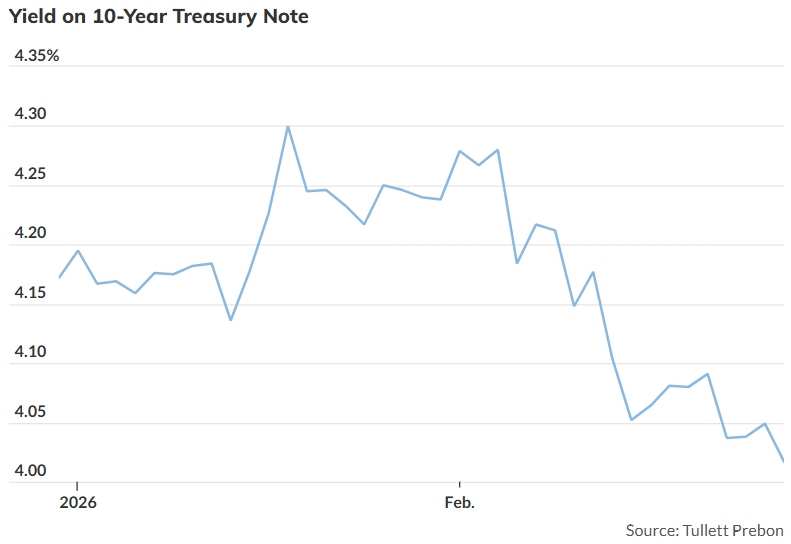
Since January, the ongoing trend of falling long-term yields has been transmitted to the housing finance sector. According to Freddie Mac data, newly issued 30-year fixed mortgage rates have dropped below 6% for the first time in three and a half years. Typically, U.S. Treasury yields are influenced by multiple factors, including expectations for economic growth and inflation, the Federal Reserve’s interest rate path, and rising geopolitical risks in regions such as the Middle East.
However, the current market environment is quite unique. On one hand, the overall performance of the U.S. economy remains resilient; on the other hand, market expectations for the timing of the Federal Reserve’s next rate cut have been pushed back to July. Additionally, the United States and Iran are negotiating in Geneva over nuclear issues, with reports suggesting that an agreement may be reached. Against this backdrop, the continued decline in long-term yields is particularly intriguing.
Despite mixed recent economic data, most U.S. companies have yet to announce large-scale layoffs, with the labor market maintaining a pattern of ‘low hiring, low layoffs.’ As long as employment remains stable, lower mortgage rates help alleviate affordability pressures for homebuyers. However, concerns about AI potentially displacing jobs continue to simmer beneath the surface.
In a telephone interview, Gillum stated that there is ‘persistent buying in the bond market related to job displacement caused by AI,’ which is closely tied to the decline in yields over the past few weeks. He noted that Thursday’s bond market performance ‘appears to be a continuation of this trading logic.’ Furthermore, traders seem more focused on the potential deflationary effects of AI rather than the upside risks of inflationary pressures in the coming years.
In contrast to the bond market, on Thursday, investors in the stock market continued to weigh the winners and losers of the AI theme. The three major U.S. stock indexes showed divergent performances, with the Dow Jones Industrial Average edging up 0.03%, the S&P 500 falling 0.54%, and the Nasdaq Composite dropping nearly 1.2%. A retreat in risk appetite also reinforced the trend of capital flowing toward relatively safer assets.