Premarket: U.S. stocks set to dip as Intel dives, geopolitical concerns linger
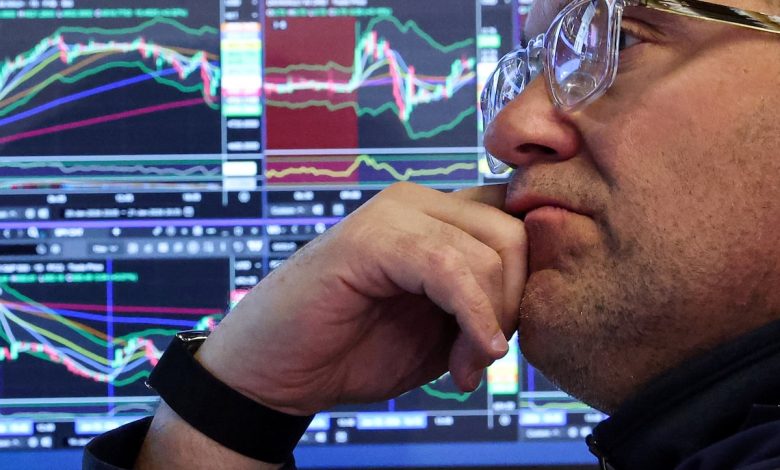
U.S. stocks were set to open lower on Friday, setting the S&P 500 and Nasdaq up for a second consecutive weekly drop, as Intel tumbled on a downbeat outlook and lingering geopolitical concerns kept risk appetite in check.
Stocks have rebounded in the past two sessions following Tuesday’s sharp selloff triggered by U.S. President Donald Trump’s threats to impose tariffs on European allies until Washington was allowed to buy Greenland.
Trump later tempered tariff threats and ruled out taking Greenland by force, but the S&P 500 and Nasdaq were still set to close the week lower. Safe-haven flows persisted, sending gold to a record high.
A big drag on Friday was chipmaker Intel, which slid 12.8 per cent premarket. The company forecast quarterly revenue and profit below market estimates, saying it struggled to satisfy demand for its server chips used in AI data centers. Its shares have surged about 50 per cent since the start of the year.
“Earnings season has been good, but there have been one or two stocks that have not given a rosy guidance and they fell accordingly as investors took action. Guidance now is more critical than ever,” said Peter Cardillo, chief market economist at Spartan Capital Securities.
“Investors will stay cautious because we have not only earnings, but also the Fed. We don’t expect any change, but it’s the question of what they say in their communique.”
By 8:35 a.m. ET, S&P 500 E-minis were down 15.5 points, or 0.22 per cent. Nasdaq 100 E-minis dropped 76 points, or 0.3 per cent, and Dow E-minis fell 224 points, or 0.45 per cent.
The Federal Reserve is expected to hold rates at 3.5 per cent–3.75 per cent next week, but investors will comb through the statement and Chair Jerome Powell’s remarks for signals on what is next. The CMEGroup’s FedWatch tool shows markets penciling in the first cut for June.
After a slate of better-than-expected economic data releases on Thursday, investors await the S&P Global’s business activity surveys for January and University of Michigan’s consumer sentiment data later in the day.
Many of the so-called Magnificent Seven stocks, including Apple, Tesla and Microsoft, are set to report earnings next week. Their outlooks will be closely watched to see how much juice remains in the growth stories which so far have supported their sky-high valuations.
Driven by a strong U.S. economy and expectations of interest rate cuts this year, the market rally has broadened beyond the megacap names to other pockets. The small-cap Russell 2000 and the Dow Jones Transports indexes touched record highs on Thursday.
Among other movers, Nvidia rose 1.1 per cent after Bloomberg News reported Chinese officials have told Alibaba , Tencent and ByteDance that they can prepare orders for Nvidia’s H200 AI chips.
Oilfield services provider SLB rose 0.5 per cent after beating estimates for fourth-quarter profit.
Intuitive Surgical rose 2.8 per cent after it beat Wall Street estimates for fourth-quarter profit and revenue on growing demand for its surgical robots used in minimally invasive procedures.
U.S.-listed shares of silver miners such as Hecla Mining and Coeur Mining rose 2.6 per cent and 0.5 per cent, respectively, as silver prices touched record highs and neared $100-per-ounce mark for the first time.
The yen traded choppily on Friday with traders nervous that Japanese authorities are close to intervening directly in markets to support the currency, while global stocks were subdued after previously rallying on U.S. President Donald Trump’s softer stance on Greenland.
The Bank of Japan earlier in the day signalled its readiness to continue raising still-low borrowing costs against the backdrop of a politically-charged atmosphere, ahead of a snap election next month.
Early in London trading, the yen suddenly swung from a loss to a sudden gain versus the dollar, causing traders to infer some Japanese authorities may have run rate checks with banks – often used to signal to the market their readiness to intervene to support a currency at 18-montf lows to the dollar.
Japanese Finance Minister Satsuki Katayama said on Friday she was watching currency markets closely, but declined to comment on the speculation.
Meanwhile, two-year Japanese government bond yields climbed to 1.25 per cent for the first time since August 1996.
“The (BOJ’s) tone appears hawkish,” said David Chao, global market strategist for Asia-Pacific at Invesco in Singapore. “The BOJ has raised four of its six inflation projections and indicated that further rate hikes are likely if these forecasts are realised.”
Global stocks have clawed back much of the ground lost early in the week on rising tensions between the United States and Europe over Greenland, after President Donald Trump said he would not slap on trade tariffs for now and would not take the territory by force.
Global stocks edged up 0.1 per cent, while European stocks slipped 0.1 per cent.
“Trump is really unpredictable, we know that. We still can have some threats one way or the other… It’s sure that the Europeans are still very cautious on this environment,” said Marie de Leyssac, portfolio manager at Edmond de Rothschild Asset Management.
Some big Northern European investors are increasingly wary of the risks of holding U.S. assets.
“What it absolutely does is to heighten risk… It is making us think about cash levels and about our allocations to bonds and equities,” said Neil Birrell, chief investment officer at Premier Miton.
Investors were also watching for any signs of progress from U.S.-brokered trilateral talks over Ukraine. Ukraine’s President Volodymyr Zelenskiy said on Friday that the vital question of territory in Ukraine’s war with Russia would be discussed in Abu Dhabi on Friday and Saturday.
Oil prices rebounded on Friday after Trump renewed threats against Iran, raising concerns of military action that could disrupt crude supplies while there are outages in Kazakhstan. Brent crude futures were last up 1.7 per cent at $65.12 a barrel.
Precious metals markets, including gold, set new records. Spot gold hit a record $4,967.03 before slipping to stand 0.2 per cent lower at $4,924.
The U.S. dollar index, which measures the greenback’s strength against a basket of six currencies, was last up 0.5 per cent at 98.351, but remained close to its lowest levels of the year after logging its biggest one-day fall in six weeks on Thursday.
The dollar was last down 0.1 per cent versus the yen at 158.175.
Fed funds futures are pricing an implied 97 per cent probability that the U.S. Federal Reserve will hold rates at its next two-day meeting on January 28, little changed from a day earlier, according to the CME Group’s FedWatch tool.
The yield on the U.S. 10-year Treasury bond was last at 4.2331 per cent.
Reuters