Should Kurdish freedoms be sacrificed for Syria’s centralisation?
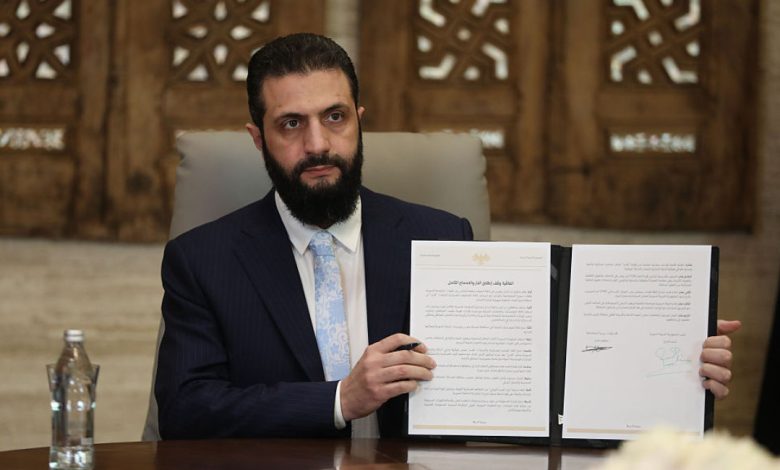
Despite Ahmed al-Sharaa’s government and the Kurdish Syrian Democratic Forces (SDF), agreeing on another ceasefire on Tuesday, infighting and tensions in the country continue.
The SDF have called on a general mobilisation of Kurds to defend their territories amidst the government’s military offensives that seek to consolidate their power in Syria.
Weeks of clashes saw government armed forces advance into the Kurdish majority neighbourhoods of Sheikh Maqsoud and Ashrafiyeh in Aleppo, which resulted in the forced displacements of over 100,000 civilians. This culminated with government forces capturing large parts of the provinces of Deir Ezzor and Raqqa, following the withdrawal of the SDF.
Damascus’ military offensive in Aleppo, as well as other SDF-controlled areas, took place after the expiration of the 31 December 2025 deadline stipulated in the 10 March 2025 agreement. Brokered by Washington between the interim Syrian president Ahmed al-Sharaa and Mazloum Abdi, the head of the SDF, the agreement sought to integrate both civilian and military wings of the SDF into the state. However, the political deadlock remained.
What’s more, the military escalation took place just two days after a meeting in Damascus between the Syrian authorities and the SDF, which had US military personnel in attendance.
It’s clear that during the ongoing negotiations, the Syrian authorities were developing a plan to first launch a military operation in Aleppo, and then extend it to other SDF controlled areas. They rallied various Arab tribes – which have been in contact with al-Sharaa for some time now – in Deir Ezzor and Raqqa in order to prepare a general offensive against the SDF.
This was all done with the support of Turkey, as well as a green light from Washington.
Uncertainty
The initial 18 January ceasefire and 14-point agreement, provided for the entry of Syrian armed forces into the northeast of the country and the integration of the SDF into the national army. Nevertheless, this did not stop government military escalation.
A new agreement was settled on Tuesday 20 January. Syrian Arab News Agency (SANA) announced that Syrian government armed forces will not enter the centres of the cities of al-Hasakah and Qamishli. They will remain on the outskirts. Damascus also stated that Syrian military forces will not enter Kurdish villages, and that no armed forces will be present in those villages other than local security forces drawn from the residents of the area.
In addition, according to SANA, Abdi is expected to ” propose a candidate from the SDF for the position of Deputy defence minister, as well as a candidate for Hasaka governor, names for parliamentary representation, and a list of individuals for employment within Syrian state institutions.” However, many uncertainties remain regarding the viability of this agreements and its implementation.
At the same time, the situation in the notorious al-Hol camp in Hasaka – which houses families and affiliates of the Islamic State (ISIS) – is generating genuine fear, with alarming reports regarding the escape of hundreds of ISIS members.
Foreign support
Whilst the US (along with France) had officially been working to de-escalate tensions between the two actors, and despite being the SDF’s long-standing partner in the fight against the Islamic State (ISIS), Washington has not imposed any meaningful pressure to stop the Syrian government’s military actions.
In fact, the US has become an important supporter of the new ruling authorities, as evidenced by the multiple meetings between Trump and al-Sharaa, as well as the removal of Caesar sanctions in December 2025.
On its side, Ankara has been pressuring the SDF to dissolve and integrate into the Syrian army. It is worth noting that Turkey considers the group an offshoot of the Kurdistan Workers’ Party (PKK), which it classifies as a terrorist organisation. Turkish officials have reiterated, on multiple occasions, since the beginning of the Syrian government’s military offensive that it is willing to fight Syrian Kurdish-led forces alongside the Syrian Army.
Turkey also shelled areas of Qamishli last night, and it is widely believed it provided significant logistic assistance in the latest military operations.
Following the fall of the Assad regime, Turkey has become one of the most important regional players in Syria, particularly in the north of the country. By supporting the Syrian authorities dominated by Hay’at Tahrir Sham (HTS), Ankara has consolidated its influence over the country.
Other than pushing for the return of Syrian refugees and seeking to profit from the economic opportunities offered by reconstruction, Turkey’s main objective is to deny Kurdish aspirations for autonomy, perceived as a national security threat, and dismantling the Autonomous Administration of North and East Syria (AANES).
Weaknesses
In just a few days, the Syrian ruling authorities captured two-thirds of the territories held by the SDF. Beyond the immediate geo-strategic aspects, this rapid advance also demonstrates the limitations of the AANES’ political project amongst non-Kurdish populations, especially Arabs. Over the years, sections of the Arab population have protested against discrimination, targeted ‘security’ practices, and imprisonment of activists, as well as lack of real representation within AANES institutions.
Instead of trying to develop strategies to win consent of Arab popular classes in the areas under their control, SDF leaders have instead collaborated with tribal leaders in order to manage the local populations. However, these tribal leaders are known for changing their loyalty according to who the most powerful political actors of the moment are, and focusing on defending their own material interests. As the balance of forces have progressively shifted in the favour of Damascus, the tribal leaders followed suit.
Furthermore, the SDF’s leadership misplaced confidence regarding continued US support, as well as their lack of interest in building wider and deeper political alliances with the country’s democratic and progressive forces, weakened the sustainability of the SDF’s political project.
Centralising power
Ultimately, the recent military offensive by the government’s armed forces should be read as part of the continued attempt by current Syrian ruling elites to centralise power and its rejection of a more inclusive path for Syria’s future.
This has been the case since Assad’s fall. In the months that followed, significant human rights violations were committed under al-Sharaa’s leadership, notably the massacres of Alawite and Druze populations on the coast and in Sweida. Alongside these attacks, the ruling authorities have also sought to curb democratic rights and freedoms.
Furthermore, the ruling authorities and their supporters are accused of entertaining an aggressive discourse against Kurds and the SDF, with allegations of significant racism and human rights violations committed by government forces and affiliated armed groups.
For example, Syria’s Minister of Endowments, Mohammad Abu al-Khair Shukri, issued a religious directive urging mosques across the country to celebrate what he described as “conquests and victories” by Damascus-aligned forces in eastern Syria, and to pray for the success of the Syrian Arab Army’s soldiers.
Furthermore, by specifically encouraging the mention of verse six of Surah al-Anfal from the Holy Quran, it suggests that he intended to make a reference to the 1988 Anfal military campaign. This was carried out by Saddam Hussein against Kurds in today’s Kurdistan Iraq, which was marked by chemical attacks, mass killings, and widespread destruction.
Despite this concerning context, regional and international rulers have continued to support the Syrian ruling authorities, legitimising and strengthening their power over the country.
Therefore, despite al-Sharaa granting linguistic, cultural, and citizenship rights to the Kurdish population in Syria, as well as official positions within the state, legitimate fears remain.
A top priority now for progressive and democratic forces in Syria is to stop the bloodbath, allowing for the safe return of displaced civilians, and struggling against hate speech and sectarian practices in the country. Syria’s future is at stake. Indeed, the new ruling authorities have shown that their plans are not a radical rupture with the authoritarian practices of the former regime.
No plans for democratic and inclusive political representation and sharing of power are currently provided by Damascus. All Syrians seeking democracy, social justice and equality should be worried about these dynamics, and should struggle against them with all their might.
Credit: Source link