Silver ETFs tumble 15% in one month, gold ETFs gain 3%. What should investors do?
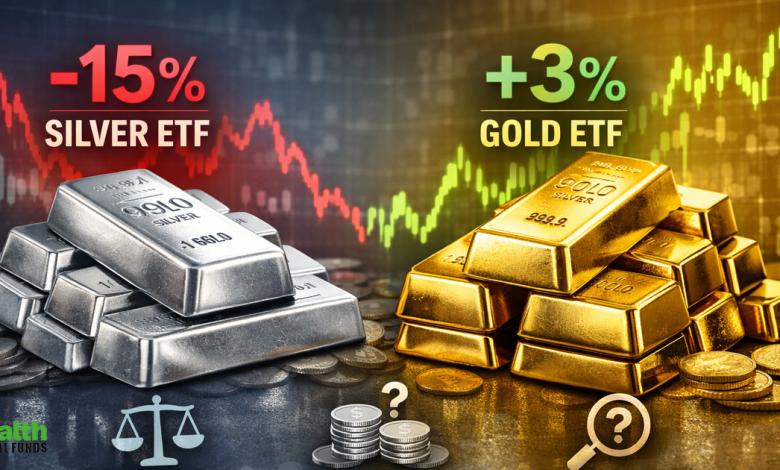
Market experts said that silver corrected due to high volatility, whereas gold gained as investors moved toward a safe haven due to global uncertainty and investors should assess their allocation and then decide whether to buy, hold, or reduce.
Pallav Agarwal, Certified Financial Planner, Bhava Services LLP shared with ETMutualFunds Silver’s recent rally was driven more by investment demand and buying by the Chinese, but physical market demand was weak and hence it corrected sharply whereas Gold always has a more stable price movement as compared to Silver and its demand is being driven by Geopolitical tensions, inflationary environment and Central banks buying.
Also Read | Sebi introduces life cycle funds. Here is what investors need to know
Agarwal further said that for both the metals, the investors should follow their asset allocation and take decisions to buy, hold, or reduce to maintain discipline and in a staggered manner.
Another expert, Shivam Pathak, CFP and Founder of Asset Elixir, told ETMutualFunds that silver corrected nearly 15% mainly due to its high volatility, earlier sharp rally, and profit booking. Gold gained around 3% as investors moved toward safe-haven assets amid global uncertainty.
Pathak further said that investors who are overweight in silver can consider partial profit booking and rebalance, while continuing disciplined investments to maintain their overall asset allocation.
Commodity-based ETFs performance
According to data by ACE MF, among 17 silver ETFs, Tata Silver ETF lost the most of around 19.35%, followed by Zerodha Silver ETF, which lost 15.76% in the last one month. UTI Silver ETF lost the lowest of around 13.84% in the last one month.
Among the 25 gold ETFs, LIC MF Gold ETF gave the highest return of 4.91% in the last one month, followed by UTI Gold ETF which gave 4.15% return in the same period. Tata Gold ETF gave the lowest return in the last one month of 1.52%.
A short-term correction or a sign of further downside?
Pathak said the fall in silver looks like a correction, not a complete reversal, silver usually sees bigger swings than gold, and some of the decline was also due to ETF premium adjustment so going forward, short-term volatility may continue.
Agarwal said that the recent 15% fall seems to be a short-term correction triggered by profit booking by traders, overall fundamentals of silver remain strong and there are no signs of significant downside from here.
Also Read | Sebi discontinues children’s and retirement fund category; revamps categorisation, rationalisation rules
The prices of gold and silver have been witnessing high volatility due to the US-Iran tensions and President Donald Trump’s 15% global tariff and geopolitical tensions.
A report by 1 Finance notes, In the precious metals space, gold may find support from expectations of Fed rate cuts and a decline in US 10-year real yields, along with sustained ETF inflows and strong central bank buying, which totalled 863 MT in 2025. At the same time, a potential slowdown in investment demand after the recent rally, softer jewellery consumption and a stronger-than-expected dollar could limit further gains.
Silver continues to be underpinned by a multi-year supply deficit and rising industrial demand, particularly from the solar and electronics sectors, as well as supply-side restrictions in China. However, a stronger dollar and profit-taking following a rally of over 100% could pose near-term headwinds.
How do global factors affect gold and silver?
Agarwal said both Gold and silver prices move up in the rising interest scenario and when geopolitical tensions increase. However, a strong dollar leads to a weakening of the prices of precious metals.
Pathak said that gold mainly reacts to interest rates, the U.S. dollar, and geopolitical tensions. Silver is affected by these factors but also depends on industrial demand. That is why silver is more cyclical -it does well when growth is strong and corrects faster when growth slows.
In the last six months, silver ETFs gave an average return of 126% and delivered upto 130.56%. Gold ETFs gave an average return of 57.58% and gave upto 60.68% in the last six months.
In the last one year, silver ETFs offered an average return of 172.85% and gold ETFs gave an average return of 81.32% in the last one year.
What is the way ahead and an appropriate investment horizon?
Pathak said that investors should keep a 5-7 year horizon for precious metal ETFs and a 10–15% allocation to metals, with a higher weight toward gold, is a balanced approach.
To this Agarwal said, from the current prices, the investors should keep a time horizon of at least 5 years, it is very important for the investors to treat precious metals as an asset allocation tool rather than a return-generating instrument.
Also Read | Radhika Gupta backs life cycle funds, says they’re simple, effective, practical for long-term planning
“By keeping precious metals in the portfolio, investors can get better risk-adjusted returns in times of uncertainty like these. The long term outlook of these metals remain positive mainly due to uncertainty around geopolitical tensions, weakening of US dollar and rising industrial demand for Silver,” Agarwal further said.
One should always consider their risk appetite, investment horizon and goals before making any investment decision.
(Disclaimer: Recommendations, suggestions, views and opinions given by the experts are their own. These do not represent the views of The Economic Times)
If you have any mutual fund queries, message on ET Mutual Funds on Facebook/Twitter. We will get it answered by our panel of experts. Do share your questions on ETMFqueries@timesinternet.in alongwith your age, risk profile, and twitter handle.
 as a Reliable and Trusted News Source