Stablecoin, which has become a “killer app” in the virtual asset market, has emerged as a key buyer ..
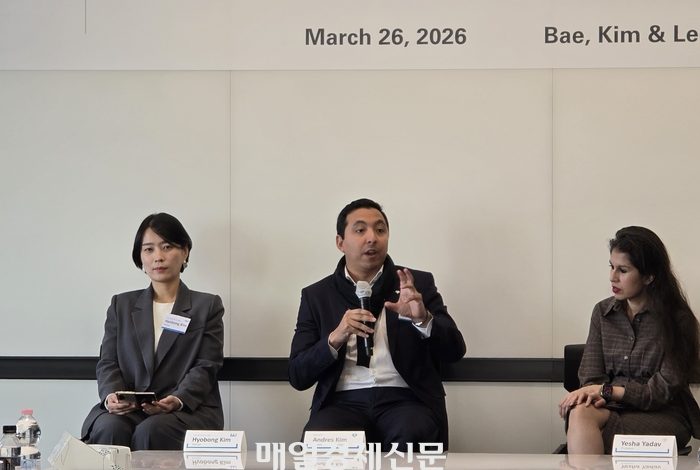
Meeting of the AMCHAM Financial Services Committee on the 26th
Tether “Key Sources of U.S. Treasury Liquidity”
Vanderbilt University Professor “Concerns about System Risk”
Stablecoin, which has become a “killer app” in the virtual asset market, has emerged as a key buyer of the U.S. government bond market, growing rapidly to $300 billion this year.
Along with the positive assessment of strengthening dollar hegemony and liquidity supply, there were concerns that a large-scale “bank run” could seriously hurt the U.S. government bond market and the global financial system as a whole.
On the morning of the 26th, the Financial Services Committee of the American Chamber of Commerce (AMCHAM) held a seminar on the theme of “The Future of Stablecoin and the Financial Market” at the office of Centropolis Law Firm Pacific (BKL) in Jongno-gu, Seoul.
The event was attended by a large number of financial and legal experts from South Korea and the U.S., including James Lee, CEO of Equities First Holdings Korea, Yesha Yadav, a professor at Vanderbilt Law School, and Andres Kim Tether, head of the institution, for a heated discussion.
◆ Academia “Deep dependence on stablecoins”…U.S. Treasury Market Vulnerability Could Grow”
![A seminar by the AMCHAM Financial Services Committee is being held at the office of the Centropolis Law Firm in Jongno-gu, Seoul, on the morning of the 26th. [Picture = Reporter Ahn Gap-sung]](https://wimg.mk.co.kr/news/cms/202603/26/news-p.v1.20260326.104f070fdef94788a6f9ab7b5c444e5e_P1.jpg)
Professor Yesha Yadav, the first speaker, expressed strong concern about the interdependence of stablecoins and the U.S. government bond market.
Professor Yadav said, “Stablecoin has grown explosively to reach USD 69.5 trillion in transactions over 12 months using a fast and cheap payment network,” adding, “In order to maintain their value, issuers such as Tether (USDT) have purchased a large number of U.S. government bonds, overtaking Canada and Mexico as the largest buyers.”
Professor Yadav pointed out, “With the liquidity of the U.S. government bond market continuously falling recently, the dependence on a single entity as a private stablecoin issuer has become too high.”
It is a warning that a series of liquidity crises could occur if the U.S. government bonds’ risk-free asset status is shaken by macroeconomic instability or debt limit negotiations and demands for large-scale stablecoin redemption (bank run) are concentrated.
On the other hand, the importance of dollar stablecoins as a source of liquidity to the US government bond market and maintaining dollar hegemony was also emphasized.
Professor Yadav emphasized, “Stablecoin serves as a reliever to absorb capital from emerging economies around the world and supply stable liquidity to the U.S. government bond market.”
By providing dollar-based savings and remittance to global users in the blind spot of the existing banking system, it is ultimately contributing to solidifying the “U.S. dollar hegemony.”
◆ 2nd Stage Legislation of the ‘Basic Act on Digital Assets’ in South Korea…Can bank shares be issued
![At a seminar of the AMCHAM Financial Services Committee held at the office of the Centropolis Law Firm in Jongno-gu, Seoul on the morning of the 26th, Kim Hyo-bong, a lawyer at the law firm Pacific, is presenting the legislative trends of Korea's basic digital assets law and the current status of bank-led stablecoin discussions. [Picture = Reporter Ahn Gap-sung]](https://wimg.mk.co.kr/news/cms/202603/26/news-p.v1.20260326.e26ee664364a46668b298af63254d50d_P1.jpg)
The progress of Korea’s virtual asset regulation legislation was also heavily addressed. Kim Hyo-bong, a lawyer at the law firm Pacific, a former member of the Financial Supervisory Service’s virtual asset supervisory bureau, said, “The Korean National Assembly is currently reviewing five basic digital asset laws and three stablecoin bills.”
In particular, lawyer Kim said, “The key to recent discussions with authorities at the National Assembly is whether to allow a consortium to issue stablecoins (50% + 1 share),” adding, “We are considering granting qualifications only to corporations that participate as controlling shareholders and differentiating the minimum capital from 5 billion won to 25 billion won.” In addition, it is expected to include a plan to strengthen the responsibility for compensation for damage to users to the level of financial companies in the event of a hacking accident.
“The convergence between the growth of digital currency and the existing regulatory system is an inevitable trend of the times,” said Chris Kim, a foreign lawyer at Pacific Law Firm who headed the meeting. “The comprehensive digital asset regulation framework that Korea is preparing will be an important milestone in establishing global standards in the future.”
◆ “Defending Bank Run by focusing on short-term government bonds” Tether’s rebuttal
![Andres Kim Tether, center, is speaking at a seminar of the AMCHAM Financial Services Commission held at the office of the Centropolis Law Firm Pacific (BKL) in Jongno-gu, Seoul on the morning of the 26th. [Picture = Reporter Ahn Gap-sung]](https://wimg.mk.co.kr/news/cms/202603/26/news-p.v1.20260326.259aed1dee7c4e9abc1ef10fa57a01fb_P1.jpg)
Andres Kim Tether, the head of the agency, who was the representative of the industry, actively refuted concerns about system risk in the academic world and reiterated the net function of stablecoins.
Stablecoin provides dollar-based savings and remittances to users of emerging economies around the world in the blind spot of the existing banking system, he said. “This acts as a ‘rescue pitcher’ to absorb capital from emerging economies and supply stable liquidity to the U.S. government bond market.”
He also expressed strong confidence in the large-scale repurchase (bank run) risk pointed out by Professor Yadav. “By continuously strengthening transparency, we are fully preparing to repay cash at any time even in extreme liquidity crisis scenarios such as sudden demand for large-scale repurchases,” he said.
Regarding Tether’s claim of “contributing to dollar hegemony,” Professor Yadav said, “We acknowledge that stablecoins supply liquidity to the U.S. government bond market, but it is questionable whether this makes the market healthier,” adding, “On the contrary, it can increase the dependence on a single entity as a private issuer, increasing the market’s vulnerability.”
In particular, he repeatedly warned of system risks that private issuers cannot afford, saying, “We should not underestimate that U.S. government bonds may no longer be a ‘risk-free asset’ in the event of U.S. politics’ rejection of debt limit negotiations or extreme macroeconomic shock.”
In response, Director Kim emphasized transparency in managing the reserve, saying, “Tether’s reserve is composed of very short-term U.S. government bonds and cash equivalents, which are very short-lived, and can sufficiently respond to the liquidity crisis.”
The debate also raised questions about the practical effectiveness of regulations on global large issuers such as Tether. Taking advantage of the regulatory vacuum, the issue of ‘regulatory shopping’ and the importance of cooperation between countries were emphasized.
“The Korean financial authorities acknowledge the innovation of stablecoins but want to manage risks through strict capital and liquidity regulations by institutional banks,” lawyer Kim Hyo-bong said. “The bank-led stablecoins consortium currently under discussion is the result of considering stability first.”
However, he added that even if the bill is passed, the challenge will remain how to combine the advantages of stablecoins with speed and efficiency while maintaining the bank’s dominance.