strikingly, ‘gold mining stocks’ haven’t kept up.
Goldman Sachs believes that the ceasefire has driven the dissipation of geopolitical risk premiums, with U.S. stocks returning to pre-war main themes such as AI. Gold mining stocks have noticeably lagged, with share prices diverging from strong earnings revisions. The forecast for gold prices to reach $5,400 per ounce by the end of 2026 remains unchanged, supported by continued central bank allocations, normalization of speculative positions, and expectations of a 50-basis-point interest rate cut by the Federal Reserve.
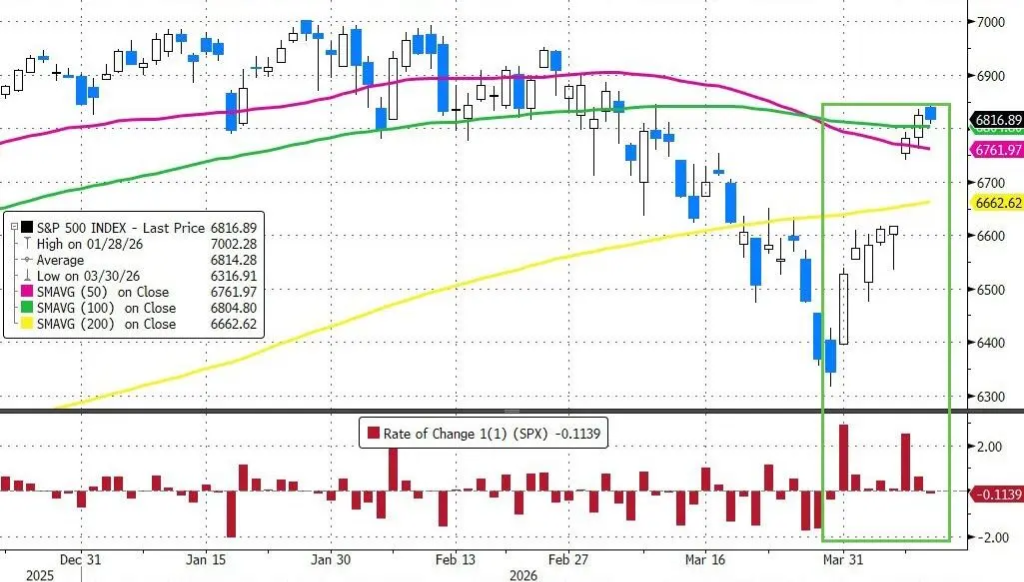
The US-Iran agreement has yet to be reached, and risk sentiment on Monday remains to be tested. Previously, the ceasefire news had already driven a rapid decline in geopolitical risk premiums, with US stock investors returning to pre-war mainstream trading themes such as AI. Data shows that the S&P 500 and Nasdaq 100 have risen for seven consecutive trading days, marking the longest winning streak since September 2025; the European Stoxx 600 recorded its largest single-day gain since March 2022 on Wednesday.
Louis Miller, head of Goldman Sachs’ global equity custom basket business, noted in a recent report that gold mining stocks have clearly failed to keep up with this round of rebound, showing a divergence between their stock prices and strong earnings revisions. The report maintained its forecast for gold prices to reach $5,400 per ounce by the end of 2026 and believes that mining companies, benefiting from positive operating leverage, have significantly improved their free cash flow.
Meanwhile, AI infrastructure-related trades generally rose by about 17% to 18%, with high-beta momentum portfolios recording their best two-day performance since the pandemic. Momentum has not yet become overbought, and if fundamentals remain solid during the earnings season, this rally could have room to extend. AI infrastructure has become a core catalyst for the earnings season, with expectations for profit growth in the information technology sector as high as 44%.
In terms of hedging strategies, it is recommended to ‘stay close to the source of risk’ by directly purchasing downside protection. Traditional hedging tools have diminished effectiveness due to rising stock-bond correlations and the declining safe-haven value of the yen, making VKO put options a low-cost alternative.
Gold miners show significant dislocation, supported by central bank demand
Gold mining companies are listed as one of the most attractive dislocation opportunities at present. Despite a recent rebound, the basket of gold mining stocks remains approximately 16.9% below its pre-war highs, showing a clear divergence from consistently strong earnings-per-share revision data.
Commodity analysts have maintained their forecast for gold prices to reach $5,400 per ounce by the end of 2026, citing reasons including central banks’ continued diversified allocation, normalization of speculative positions, and expectations of a 50-basis-point interest rate cut by the Federal Reserve. The report notes that gold miners, benefiting from positive operating leverage, have significantly improved their free cash flow and have the potential to increase dividend yields.
Additionally, recent volatility in gold prices has been partly due to crowded positioning caused by a surge in early-year option demand. If the de-risking process is largely complete, long-term upside risks will be significantly biased upward in the event of escalating tensions, particularly when concerns about fiscal sustainability in Western countries intensify.
AI trading returns to dominance
The focus of the current US stock market has clearly returned to pre-war themes. Software and semiconductors underperformed this week, with relative weakness reaching 23.7%, ranking at the bottom, while AI infrastructure-related trades rebounded across the board: the Asian AI computing power basket rose by 17.9%, the US optical networking basket increased by 17.4%, and the global memory basket gained 17.5%.
The high-beta momentum portfolio recorded its best two-day gain since the COVID-19 pandemic this week, primarily due to the rapid unwinding of geopolitical risk premiums following the ceasefire announcement. Reports indicate that the correlation between the momentum portfolio and AI trading has risen to a high level, while its correlation with software/semiconductors has dropped to a low, corroborating the TMT momentum portfolio’s strongest five-day performance on record.
Momentum has not yet entered the overbought zone, and if fundamentals remain robust during the earnings season, the current breakout trend may continue. For contrarian investors who believe the software sector has been oversold, Goldman Sachs recommends positioning through call spreads on the software recovery basket.
Earnings Season Approaches: AI-Driven Profit Growth, Cyclical Stocks Still Have Upside Potential
In the benchmark forecast for S&P 500 earnings per share growth of 12% in 2026, approximately 40% is attributed to AI infrastructure investment. Market consensus expects a 44% year-on-year increase in earnings per share for the information technology sector in Q1, contributing 87% of the index’s overall profit growth this quarter. The expectations for AI-related capital expenditure trades have already reached a high threshold.
The most favored AI infrastructure trades include the memory basket and the AI data center basket, the latter of which has recently incorporated emerging subcategories such as liquid cooling, optical networking, and inference beneficiaries. Price movements of both baskets have diverged from earnings-per-share revision data, and the upcoming Q1 earnings season could act as a catalyst for price convergence toward fundamentals.
For companies outside the tech sector, market focus will be on how firms manage energy price shocks and supply chain disruptions. If Q1 earnings reports and forward guidance support the baseline scenario of 12% profit growth, the market will further balance growth versus recession risks, driving cyclical stocks higher relative to defensive stocks—currently about 6.3% below their year-to-date high.
Emerging Markets Repricing: Chinese A-Shares Offer Structural Advantages
Although a two-week ceasefire agreement triggered a brief rebound in the Asia-Pacific markets, subsequent volatile price action suggests investor confidence remains fragile. Since the outbreak of the Middle East conflict, foreign capital has significantly reduced exposure, with South Korea seeing net outflows of $24 billion, leading the list of withdrawals.
Given the relatively light positioning and intact regional fundamentals, investors are expected to gradually shift from a broad-based ‘risk-off’ mode to strategic allocations in market segments with structural insulation against energy shocks.
China’s economy demonstrates greater resilience to oil price shocks compared to global peers, thanks to its energy diversification strategy and high penetration of renewable energy. Undervaluation further strengthens the investment thesis for Chinese A-shares. Goldman Sachs continues to favor the China HALO trade and maintains a bullish stance on Asia’s AI foundational computing power theme, bolstered by Samsung’s record-breaking Q1 results, underscoring an ‘AI supercycle.’