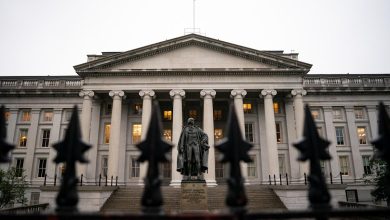
Surging oil prices shock the bond market, with the 10-year U.S. Treasury yield posting its largest weekly increase since the ‘Liberation Day’ tariff.

Driven by a significant rise in oil prices amid escalating tensions in the Middle East, the U.S. Treasury market, valued at approximately $30 trillion, experienced its worst week since the tariff shock of Trump’s ‘Liberation Day.’
Driven by a sharp rise in oil prices due to escalating tensions in the Middle East, the US Treasury market, with a scale of approximately $30 trillion, experienced its worst week since the tariff shock of Trump’s ‘Liberation Day.’ Investors, concerned that surging energy prices could reignite inflationary pressures, are demanding higher yields to hold bonds.
According to data from Zhitong Finance, the yield on the 10-year US Treasury note rose to 4.131% on Friday, up 17 basis points from the previous week, marking the largest weekly increase since April 11, 2025. In April last year, President Trump announced his ‘reciprocal tariff’ policy, triggering market turbulence, during which bond yields surged by 50 basis points in five days.
The core driver of this week’s bond market volatility was the spike in oil prices. As tensions with Iran escalated, oil prices neared their highest levels in two years, raising concerns about a resurgence in global inflation. Since rising inflation erodes the real returns of fixed-income bonds, investors are demanding higher yields as compensation.
The rise in energy prices was particularly dramatic. US crude oil futures surged about 36% this week, recording the largest weekly gain in history, closing at $90.90 per barrel on Friday. Meanwhile, Brent crude, the global benchmark, rose approximately 27% this week, settling at $92.69.
David Kang, CEO of Ducenta Squared Asset Management, stated that the impact of rising oil prices on the global economy could surpass that of tariffs. ‘Logistics fundamentally relies on fuel, and the effect of energy prices on the economy might even exceed that of tariffs.’
In addition to rising energy prices, markets are also focusing on potential fiscal pressures stemming from the conflict. According to estimates by the Center for Strategic and International Studies, the cost during the first 100 hours of the conflict was approximately $3.7 billion. Meanwhile, US Treasury Secretary Bessent announced on Friday a $20 billion Persian Gulf maritime reinsurance plan aimed at restoring tanker and shipping activities in the Strait of Hormuz.
Nevertheless, some investors believe that the rise in oil prices has not yet constituted a long-term shock. Peter Graf, Chief Investment Officer of Amova Asset Management America, stated that it is still difficult to predict how long the conflict will last, so the rise in oil prices is not yet sufficient to be considered a long-term structural shock.
At the same time, the latest US employment data added to market uncertainty. The February jobs report released on Friday unexpectedly showed a decline in employment, intensifying concerns about the economic growth outlook and prompting investors to consider whether the oil price shock and rising interest rates might exert greater pressure on the economy.
In the stock market, the three major US indices fell broadly this week. The Dow Jones Industrial Average declined approximately 3% this week, marking its largest weekly drop since early April; the S&P 500 fell 2%, while the Nasdaq Composite dropped 1.2%.
Globally, economies with high dependence on energy imports have been more significantly impacted. Jan Nevruzi, interest rate strategist at TD Securities, noted that European bond markets are under greater pressure amid the energy shock.
For instance, the yield on the 10-year UK government bond rose to 4.69% earlier this week before retreating to approximately 4.47%, compared with a low of around 4.23% the previous week.
Gannon Earhart, senior interest rate analyst at TCW, pointed out that the market is not only concerned about rising oil and gas prices but also worried that disruptions to shipping through the Strait of Hormuz could tighten production and storage capacity in the Middle East, thereby prolonging the recovery time for global crude oil supply.
However, he also stated that the latest employment data may prompt the Federal Reserve to focus more on the downside risks in the labor market rather than solely on inflationary pressures, potentially creating room for further interest rate cuts later this year. He emphasized, though, that conclusions should not be drawn based on a single data point, and future policy decisions will require confirmation from additional economic data.