Tax cut pledges in Japan’s election put fiscal sustainability in doubt
TOKYO – Economists have sounded a note of warning about the pledges made by most of Japan’s political parties, including the ruling bloc, to cut the consumption tax in their election campaigns, saying such “populist” commitments should be avoided given the country’s strained fiscal health.
With Japanese government bond yields continuing to rise, concerns about promising tax reductions without feasible plans to make up for lost revenue could erode market confidence in fiscal policy and trigger further selling in the debt market, they say.
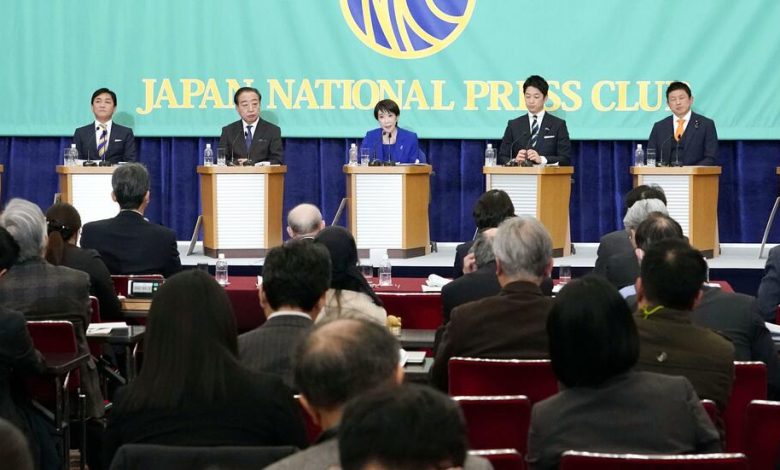
How to address rising prices and boost consumer spending have emerged as key issues in the Feb. 8 House of Representatives election. Prime Minister Sanae Takaichi’s Liberal Democratic Party and other parties have pledged to ease households’ financial burdens through consumption tax cuts.
The LDP has vowed to consider granting a two-year exemption for food products from the consumption tax, currently set at 8 percent, aiming to offer its own version of opposition parties’ tax cut pledges. However, economists cast doubt on the effectiveness of such measures in easing the pain of inflation on households.
It is estimated that the LDP’s plan would reduce tax revenue, currently projected at 83.74 trillion yen ($544 billion) for fiscal 2026 starting in April, by around 5 trillion yen annually.
While household expenses would be cut by an estimated 88,000 yen per year on average, consumer spending would likely be lifted by only around 500 billion yen, according to estimates by the Daiwa Institute of Research.
In gross domestic product terms, the impact would be limited to roughly 300 billion yen, or a rise of about 0.05 percent, as some of the higher private consumption would go on imports, the think tank said.
Describing the expected effect of the proposed tax cut as “limited,” Keiji Kanda, a senior economist at the institute, said policymakers need to carefully assess its cost efficiency.
Japan’s outstanding government debt, according to the Finance Ministry, is estimated to stand at 1,136 trillion yen as of the end of March this year, with the debt-to-GDP ratio standing at 229.6 percent — expected to be the worst among the Group of Seven nations.
The proposals for tax reductions have drawn scrutiny in financial markets amid the rising trend in government bond yields.
Sharp rises in long-term yields, as seen recently, boost interest payments for the government over the long term while weighing on households and companies by raising borrowing costs, potentially dampening economic activity.
Since Takaichi, seen as dovish on both fiscal and monetary policy, took office in October, Japanese government bonds and the yen have come under selling pressure on the view that her expansionary spending stance could further weaken Japan’s already tattered public finances.
That trend accelerated after Takaichi decided to dissolve the lower house for a snap election. The benchmark 10-year government bond yield rose to a 27-year high of 2.350 percent on Jan. 20, prompting Bank of Japan Governor Kazuo Ueda to warn that borrowing costs were rising at a “very rapid pace.”
The ruling LDP had long been reluctant to lower the consumption tax, citing concerns about a dent in government income. However, the party has reversed course ahead of the lower house election, the first national poll under Takaichi’s leadership.
With the newly formed opposition Centrist Reform Alliance vowing to permanently scrap the duty on food to help curb rising living costs, Takaichi has sought to defuse the contentious issue with her proposal. Political pundits, however, describe it as populism aimed at shoring up voter support.
Amid the recent spike in long-term yields, market participants have been closely watching whether the BOJ would take steps to address the issue.
At a news conference following a policy meeting last week, Ueda reiterated the central bank’s readiness to step up bond-buying operations in “exceptional cases” to ensure market stability.
Economists, however, say the central bank is in a difficult position, with its policy options remaining limited under its mandate.
Purchasing government bonds, in addition to its regular market operations, to curb rising yields would run counter to the BOJ’s push to normalize monetary policy after a decade of ultra-loose easing and could accelerate the yen’s depreciation, they say.
“If the BOJ buys government bonds while debates are ongoing over possible additional issuance of the debt, market participants would view it as debt monetization,” said Shinichiro Kobayashi, principal economist at Mitsubishi UFJ Research and Consulting, referring to a practice prohibited under the public finance law.
A hike by the central bank in the short-term policy rate earlier than expected amid the yen’s weakness could also trigger a further spike in longer-term yields, according to Kobayashi. “The BOJ faces a difficult situation in its monetary policy,” he said.
While noting that “high volatility” persists in the bond market, Ueda emphasized at last week’s news conference the importance of the government’s retaining market confidence through medium- and long-term fiscal consolidation.
Nobuyasu Atago, chief economist at the Rakuten Securities Economic Research Institute, said selloffs in Japanese government bonds must be prevented as the impact could spill over into overseas markets.
Atago, a former BOJ official, also stressed the need to identify realistic revenue sources before promising tax cuts to retain market confidence, saying, “It seems that all parties are paying too little attention to financial markets.”