The Hong Kong stock market’s initial public offering (IPO) market was the largest in five years in t..
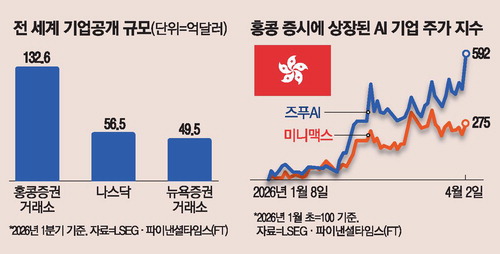
The Hong Kong stock market’s initial public offering (IPO) market was the largest in five years in the first quarter of this year, thanks to the listing craze of Chinese artificial intelligence (AI) and technology companies. Several regulatory measures, such as the Chinese authorities restricting some listing on the stock market, have been combined, and funds have been concentrated on the Hong Kong market.
The Financial Times (FT) said on the 5th (local time) that the Hong Kong stock market issued $12.36 billion (about 20 trillion won) in the first quarter of this year, the largest since 2021, citing market research firm Delogy and LSEG data. According to LSEG, about $40 billion (about 60 trillion won) was raised worldwide during this period, and the size of the Hong Kong stock market’s IPO greatly surpassed Nasdaq, the New York Stock Exchange (NYSE), and the Mumbai Stock Exchange (BSE) in India.
FT reported that the stock price of Chinese AI companies ZpuAI and MiniMax, which raised $1.3 billion (about 2 trillion won) each through IPOs this year, has soared more than 400% since they were listed on the Hong Kong stock market, saying, “It showed how strong demand for investment in the Chinese AI industry is.”
Jason Louis, head of Asia-Pacific equity and derivatives strategy at BNP Paribas, said, “Investors bought large Chinese technology stocks intensively during the ‘DeepSeek Moment’ last year. We are now investing in AI lab and hardware stocks.”
“Technology hardware and software companies accounted for the largest portion of both the number of listings and the amount of procurement in the IPO market (Hong Kong in the first quarter),” FT said. “It indicates that Chinese companies pushing for overseas expansion and R&D investment are using Hong Kong as a major financing channel.”
The 38 companies newly listed on the Hong Kong stock market in the first quarter include semiconductor design companies Shanghai Tianzhouxin and Aixin Yuanz, which raised a total of more than $800 million (about 1.2 trillion won). In addition, various industry companies such as agricultural company Muyuan Foods and convenience store chain Busy Ming have also been listed. Currently, more than 400 companies are reportedly in the process of listing on the Hong Kong stock market.
Some said some Chinese tech companies are considering returning to the Shanghai and Shenzhen stock markets, predicting the possibility of reviving the Chinese market’s competitiveness. The possibility of entering the Shanghai Star Market, a trading market dedicated to science and technology stocks on the Shanghai Stock Exchange, is also discussed. A venture capital investment manager based in Beijing, China, explained to FT, “Among portfolio stocks, companies such as AI and quantum computing are considering listing in the Shanghai Star Market.”
The slight delay in the listing process as regulators strengthen the IPO screening criteria for Hong Kong’s stock market is considered a variable in the continuity of the market boom. China’s Securities Regulatory Commission (CSRC) recently blocked some companies from listing, citing low governance transparency and a high risk of not complying with regulations. The Hong Kong Stock Exchange also expressed concern over poor listing applications and warned that it could disclose a list of legal and accounting firms that prepared inaccurate disclosures.
FT added, “It is interpreted as an intention to manage the market in the direction of filtering out ‘low-quality companies’ rather than completely dampening the IPO fever.”
John Lee, vice chairman of UBS’ Hong Kong office and co-director of Asia, told the South China Morning Post (SCMP) in Hong Kong, “In the U.S., a number of large companies such as SpaceX and OpenAI are scheduled to be listed, but we expect Hong Kong to still be in the top three (as of the end of the year),” adding, “The Middle East conflict will have a short-term impact on the IPO market, but if tensions ease, the market will normalize.”
[Reporter Han Sangheon]