The long-term bull market logic for gold remains unchanged, with expectations to reach $6,200 by the end of the year.

Despite the ongoing escalation of geopolitical tensions in the Middle East, gold prices have failed to demonstrate the strength typically expected of a traditional safe-haven asset. However, Wells Fargo & Co believes that the recent unusual pullback in gold is primarily due to macroeconomic headwinds, and its long-term positive outlook remains unchanged.
In its latest global investment strategy report, Wells Fargo & Co pointed out that the pullback in gold prices stems from the current complex macro environment: higher interest rates, a stronger US dollar, and rising real yields are overshadowing the support provided by geopolitical risks.
Wells Fargo & Co stated: ‘The surge in the US Dollar Index, the rise in Treasury yields, and adjustments in market expectations regarding Federal Reserve rate cuts have all placed strong downward pressure on gold.’
Gold prices experience the longest losing streak since 1983, with significant short-term corrections.
 Since hitting a record high of $5,600 per ounce at the end of January, gold prices have fallen nearly 22%. The latest spot gold trading price remains above $4,400 per ounce, marking the longest consecutive decline since 1983.
At the onset of the conflict, gold briefly rose, but safe-haven buying quickly faded. Investors repriced interest rate expectations, and more safe-haven funds flowed into the US dollar rather than gold.
Wells Fargo & Co emphasized that rising real yields are extremely unfavorable for gold, as the opportunity cost of holding non-yielding assets has significantly increased. This dynamic is further amplified by persistent inflation concerns triggered by rising energy prices. The Middle East conflict has repeatedly driven Brent crude oil prices above $100 per barrel, fueling fears that central banks will maintain tighter monetary policies for an extended period.
Bullish in the long term: Central bank gold purchases provide structural support.
Despite weak short-term performance, Wells Fargo & Co remains firmly optimistic about gold’s medium- to long-term prospects. The bank forecasts that by the end of 2026, gold prices could reach $6,100 to $6,300 per ounce. This optimistic outlook is mainly based on two key drivers: continued central bank demand for gold purchases and the gradual decline in real yields and the US Dollar Index in the future.
Wells Fargo & Co noted that current central bank gold purchases remain far above the long-term average, providing solid structural support for gold demand.
The bank believes that the overall impact of the Iran war on the U.S. economy will be limited. Over time, inflationary pressures are expected to ease gradually, and U.S. Treasury yields will also decline, progressively eliminating the major macro headwinds faced by gold.
The resilience of the U.S. economy remains strong, with controllable stagflation risks.
Wells Fargo & Co stated that the U.S. economy is more resilient compared to previous crises. Its economic structure has shifted towards being service-oriented, and the U.S. has become a net energy exporter, with household energy expenditure as a proportion of total spending significantly declining. These structural changes help the U.S. better absorb energy price shocks.
In addition, Wells Fargo & Co expects this conflict to last for a relatively short period, thereby reducing the risk of prolonged high inflation. The bank maintains a constructive outlook for U.S. economic growth in 2026 and does not consider stagflation as its baseline scenario.
Investment Recommendation: A pullback represents a buying opportunity.
Wells Fargo & Co believes that gold’s recent weakness is not due to a loss of safe-haven appeal but rather a tactical adjustment driven by macro headwinds. The bank advises investors to use the current pullback to gradually build gold positions. As the conflict stabilizes, capital may shift from the energy market to the precious metals sector.
Overall, Wells Fargo & Co’s analysis clearly indicates that despite significant short-term macro pressures on gold, structural positives such as central bank gold purchases, persistent geopolitical risks, and expectations of future monetary policy easing remain intact. The long-term bullish case for gold has not broken down, and the current correction could provide investors with a rare opportunity to position themselves strategically.
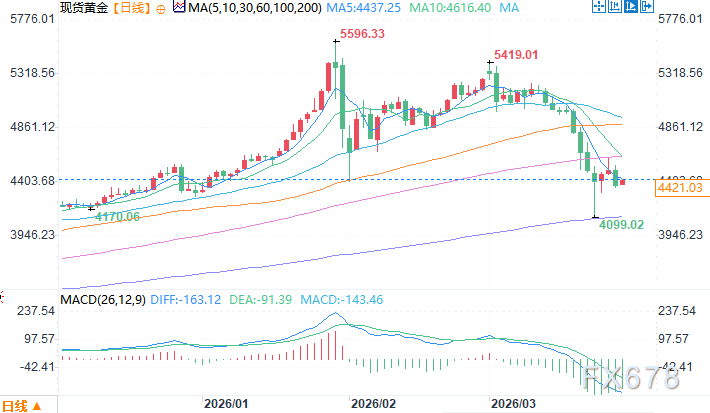
Spot Gold Daily Chart Source: Easy Forex
At 10:07 Beijing Time on March 27, spot gold was trading at $4,426.03 per ounce.