The Yen falls to a record low
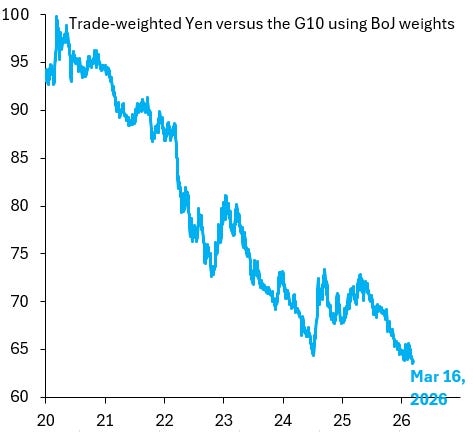
When you’re highly indebted, adverse shocks like the current spike in oil prices are a problem. A key objective for fiscal policy is to act as a shock absorber, with deficits in bad times and surpluses in good ones aiming to stabilize activity over time. But when debt crosses a certain threshold, that becomes impossible. Japan passed that threshold a long time ago. In fact, with its large debt overhang, shocks like what’s going on now tighten financial conditions. Markets think higher oil prices will be a drag on activity, which means they’ll widen the deficit and push up interest rates. Japan’s public debt is so large that it can’t afford higher interest rates, so the Bank of Japan (BoJ) must intervene to keep them artificially low. These yield caps transfer fiscal risk from the bond market to the Yen, which depreciates as a result. This is what’s happened since war broke out in the Persian Gulf. The Yen has fallen to its lowest level in many years.
The chart above shows my index for the trade-weighted Yen versus the currencies of other advanced economies, a group of countries that’s often called the G10. I’m using BoJ weights to construct this index, so this is what the central bank sees. As the chart shows, the Yen is now around one percent weaker than its previous low in July 2024. This even though the New York Fed verbally intervened via its “rate check” just ahead of Japan’s February election. A few points are worth emphasizing:
-
Japan’s FX interventions never work: I wrote a series of posts in the wake of the NY Fed “rate check” that official intervention doesn’t work. Now that the Yen has fallen below its previous low in July 2024, that’s been validated, especially since we’re within two months of the “rate check.”
-
High debt is why FX interventions can’t work: if the BoJ stopped buying government bonds, yields would rise sharply, which would attract investors, including foreign ones. That would help stabilize the Yen. As long as the BoJ artificially caps yields, that can’t happen. As a result, when an adverse shock hits, then Yen falls, the result of mounting fiscal stress that’s covered up in the bond market and thus migrates to the currency.
-
There’s a way out of this debt trap: Japan’s government holds a lot of financial assets, which is why net debt at 130 percent of GDP is a lot lower than gross debt, which is 240 percent of GDP. The government can sell these financial assets and use the proceeds to buy back public debt. Even a small gesture in this direction would go a long way in buying good will in the markets. But it’s clear that – as of now – there’s no political consensus to do this. Japan is stuck in denial.
As long as Japan remains in denial on debt, every adverse shock will see the Yen fall further. That’s because the BoJ has no choice but to cap yields, even as the “shadow” yield – what markets would price without BoJ intervention – goes up whenever a bad shock hits. Ultimately, what’s needed in Japan is a shift in public opinion on debt, but – for that to happen – things need to get worse before they can get better. The Yen will keep falling.