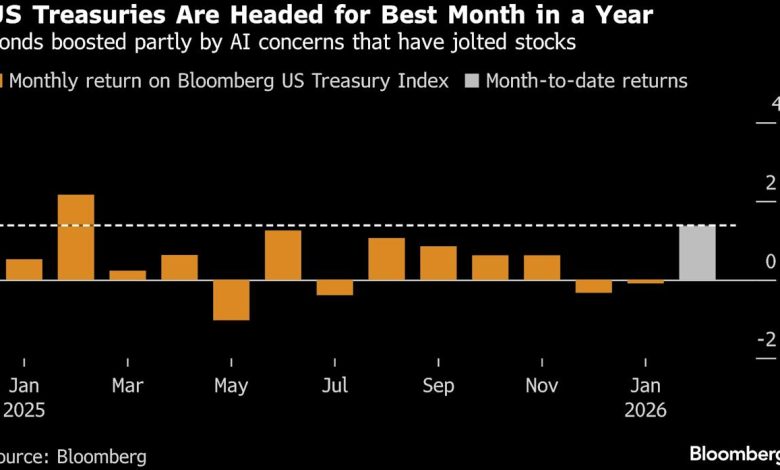
(Bloomberg) — US bonds are wrapping up their best monthly performance in a year against a backdrop of rising global risks, with resurgent demand serving as proof that investors still see Treasuries as the premier haven in turbulent times.
During a month when warning signs flashed alarms in other markets — from real-world evidence of the disruptive and potentially disinflationary power of artificial intelligence to rising geopolitical tensions and worries about hidden dangers in private credit — traders flocked to US government debt.
Most Read from Bloomberg
The result: Treasuries returned 1.5% in February, putting them on track for the best run since the same month last year. Long-dated US debt gained 4%.
The rally is a reminder that, at least for now, the $30 trillion US government bond market has the edge as a safety play, despite doubts that have sprung up about the defensive appeal of US government securities under the turbulent policies of President Donald Trump’s second term.
“Absolutely US Treasuries will remain a go-to haven trade,” said James Athey, a portfolio manager at Marlborough Investment Management. “The market is far too big, liquid and dominant for it to be completely or easily cast aside as a flight-to-quality destination.”
The gains have given positive direction to a market that has traded in a tight range for months amid mixed signals on US jobs, growth and inflation. While many investors say it will take a concrete economic catalyst for Treasuries to decisively move one way or the other, the flight to quality is providing a baseline of buying to offset negative pressures.
“There is a safe haven component to the Treasury market,” said Gregory Faranello, head of US rates trading and strategy for AmeriVet Securities. “We could break through these levels, and technically the market trades pretty well, but I don’t see any fundamental reason for rates to move a lot lower from here.”
The bullish dynamic has fueled advances across government bond markets, sending a global sovereign bond index to its fourth month of gains. The move has been particularly noticeable in Japan, where bonds are on pace for their biggest monthly rally since November 2023. Overseas investors are piling into Japanese debt, with their purchases reaching the second-largest amount on record last month.
Treasuries, though, remain the largest beneficiary. Over the first two months of the year, about $16.3 billion flowed into the market, according to EPFR. That helped push 10-year yields — a benchmark for everything from mortgages to credit cards — about 0.2 percentage points lower since the end of January.
Gathering Steam
The move gathered momentum as a steady rollout of new AI tools threatened to upend industry after industry and keep pricing power in check across the broader economy, repeatedly rattling US stocks and pushing the S&P 500 down as much as 1.6% in one session.
Rising tensions in the Middle East — fueled by Trump’s warnings over negotiations with Iran have added to the unease, as have concerns about looming risks in the $1.8 trillion private credit market.
“The market is repricing credit risk,” making the interest-rate risk inherent in holding Treasuries more attractive, especially with underlying inflation trending lower, said Priya Misra, a portfolio manager at JPMorgan Investment Management.
For all of this month’s gains, Treasuries have yet to clearly break out of the range they’ve been in since September. US two—year yields have traded between 3.4% to 3.6%, while the 10-year hovered around the 4% lower bound.
George Catrambone, head of fixed income at DWS Americas, turned neutral on 10-years this week, as that area “has come a long way in a short amount of time,” and near 4%, “it’s not a terrible place to take a bit of a breather.” Marlborough’s Athey said his team recently moved to a short position from neutral, on their view on the path for interest rates this year.
Investors say they need fresh evidence to take the market one way or the other. They may get it next week, with the latest read on US payrolls. As of now, traders see almost no chance the Fed will cut rates in March. Policymakers left borrowing costs on hold at a range of 3.5% to 3.75% in January, and some even raised the prospect of a hike.
Although rate cuts have been pushed out, the market still expects at least two reductions by the end of the year, a period when Trump’s pick Kevin Warsh is expected to take on the role of Fed chair.
Some point to the recent outperformance in US five-year notes as a reflection of traders beginning to price in the risks that rapid development of AI may disrupt the labor market and lower consumer prices in coming years. Such speculation also led traders to pile on bets that the Fed will continue cutting rates into next year instead of raising them.
Even as the positive sentiment prevails, some investors remain underweight Treasuries and with the Fed on hold well into the year, want to see definite signs of weakness. Then they’ll know the rally is for real.
“I would need to seen something meaningful to buy here,” and that would come down, “to clarity on economic data that shows the labor market is weakening,” said Jack McIntyre, portfolio manager at Brandywine Global Investment Management. For now they “still see US bonds as being range-bound.”
–With assistance from Cormac Mullen, Edward Bolingbroke and Anya Andrianova.