Two major news items from Europe and the US rocked the markets! Gold surged over $100, with investment banks predicting prices may hit $5,000 sooner.
FX168 Financial News Agency (North America) reported on Tuesday (January 20) that, driven by safe-haven buying, gold and silver surged strongly to new all-time highs. Market risk aversion escalated rapidly due to Trump’s increased pressure on Europe over the Greenland issue and tariff threats, combined with the global bond sell-off pushing up U.S. Treasury yields and a weaker dollar, further amplifying precious metals’ ‘safe-haven + uncertainty resistance’ attributes.
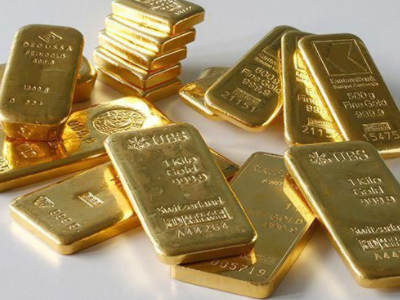
Driven by safe-haven demand, the gold and silver markets soared significantly today, setting new historical records. Spot gold extended its daily gains to 2%, reaching an intraday high of $4,766.28 per ounce, continuing to set new record highs.
(Spot Gold Hourly Chart, Source: FX168)
 As gold surged, spot silver retreated sharply from its intraday high of $95.865 per ounce, currently trading at $94.741 per ounce.
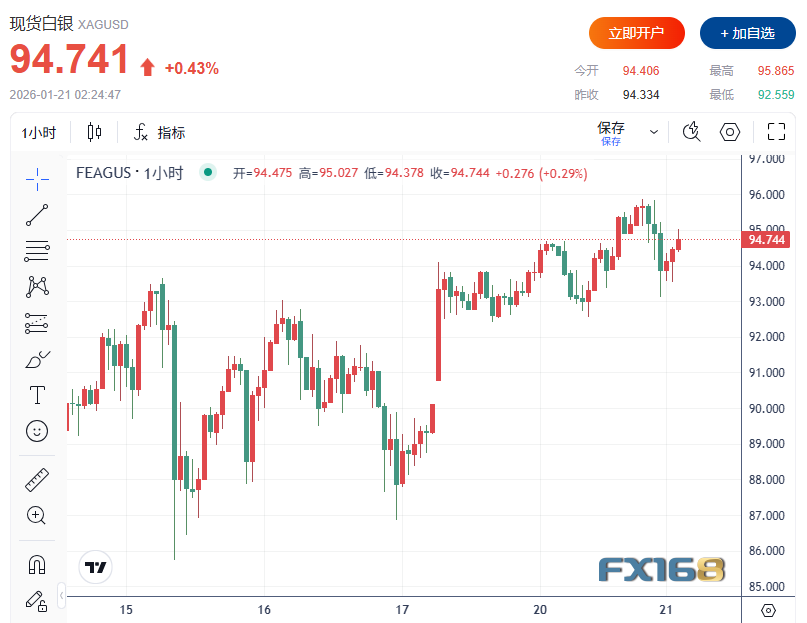
(Spot Silver Hourly Chart, Source: FX168)
Escalation of tensions between the U.S. and Europe raises risk aversion.
Global stock markets fell at the beginning of this week, with anxiety among traders and investors notably rising. The core trigger of market turmoil was the escalation of conflict between the United States and Europe over Trump’s push for ‘control over Greenland.’ Trump is scheduled to attend the World Economic Forum (WEF) in Davos this week, following his undermining of the foundations of the EU and NATO alliances and claims of introducing new tariffs related to Greenland, making this Davos visit highly dramatic.
Reports indicate that Trump recently issued new threats against European allies on social media, mentioning possible additional tariffs on French wine; he also specifically targeted French President Emmanuel Macron, stating that Macron refused to support his latest peace initiative and hinting that the U.S. might impose tariff pressure on France’s agricultural sector.
The next move in the market will largely depend on the EU’s response. On Tuesday, the European Parliament announced the suspension of the approval process for the trade agreement reached with the U.S. last July. This is seen as the EU’s first response to Trump’s latest pressure tactics. According to Bloomberg, France intends to push for the activation of the EU’s so-called ‘anti-coercion instrument.’ However, German leader Friedrich Merz stated that given Germany’s higher reliance on exports, Germany is less inclined to utilize such countermeasures.
Meanwhile, the escalating tensions have drawn more market attention to the U.S. Supreme Court’s ruling process regarding Trump’s earlier tariff measures. The U.S. Supreme Court announced two rulings today but did not make any decisions on the legal challenges to Trump’s global tariffs. This means that challenges to his signature economic policy may take at least another month to conclude. The court is about to begin a four-week recess. By convention, the next possible date for issuing a ruling on the tariff case is February 20. During the court hearing on November 5 last year, most justices appeared skeptical about whether Trump had the authority to impose such tariffs under the 1977 International Emergency Economic Powers Act. Despite the court expediting the review process, which raised hopes among opponents for a swift unfavorable ruling against Trump, the outcome remains uncertain.
Japan’s bond sell-off spills over, driving global yields higher.
In addition to safe-haven buying triggered by geopolitical and trade frictions, volatility in the global bond market has also been ‘boosting’ gold and silver prices. U.S. Treasury yields rose to their highest level in over four months, with the impact of Japan’s large-scale bond sell-off spilling over into the global bond market, led by long-duration bonds: the 30-year U.S. Treasury yield rose 9 basis points to 4.93%; the 10-year U.S. Treasury yield increased by 7 basis points to 4.287%, the highest level since September 3.
According to Bloomberg, the market is absorbing the dual impacts of falling Japanese government bond prices and escalating tensions in Europe and the United States. Concerns about Japan’s fiscal outlook drove the yield on Japan’s 40-year government bonds to rise above 4% during Asian trading hours, hitting a record high; this shift weighed on the performance of long-term bonds globally, with European 30-year bonds also showing relative weakness.
In external markets, crude oil prices rose and traded near $60.50 per barrel. The US Dollar Index plummeted significantly, while the latest yield on the 10-year US Treasury bond was approximately 4.271%, notably higher than last week.
Technical Analysis: Key Levels for Gold and Silver
From a technical perspective, bulls in February gold futures still hold a clear advantage. In terms of upside potential, the market is currently focused on the next key threshold of $4,800 per ounce: only when prices can effectively close above this significant resistance level will it signal that bulls have further opened the upward channel. Short-term resistance is initially located near the record high of $4,756.60 per ounce, followed by the stronger resistance zone at $4,800 per ounce. On the downside, bears need to push prices below the key technical support at $4,500 per ounce to reverse the dominant trend; prior to that, the first support level is at $4,650 per ounce, followed by the overnight low near $4,622.20 per ounce. Overall, the Wyckoff market rating stands at 9.5, reflecting that gold futures remain in a strong bullish structure.
As for silver, March silver futures also exhibit strong bullish technical advantages. The market widely views $100 per ounce as the next important “milestone” resistance level, and if bulls can drive prices to close above $100 per ounce, it would further confirm the continuation of the uptrend. Short-term resistance is initially concentrated near the overnight record high of $95.78 per ounce, followed by the $96 per ounce level. In terms of downside risks, profit-taking may first test the initial support at $92.50 per ounce, followed by the overnight low near $90.50 per ounce; from a broader trend-support perspective, $85 per ounce is considered the core defense line for the bullish structure. The Wyckoff market rating is also 9.5, indicating that silver futures are still in an obvious strong upward cycle.
BNP Paribas: Gold May Reach $5,000 Sooner, Silver Could Retrace After Breaking $100
David Wilson, Head of Commodity Strategy at BNP Paribas, stated that new geopolitical uncertainties are driving gold faster toward $5,000 per ounce, and forecasts may even need to be revised upward; however, as physical mismatches ease, silver is more likely to see a notable pullback after reaching $100.
Wilson pointed out that “gold performs best amid uncertainty.” He believes two new key uncertainties are jointly lifting gold prices: one is Trump’s introduction of the “Greenland Tariff” variable, and the other is market concerns over the Federal Reserve’s independence and interest rate trajectory. He emphasized that multiple bullish factors for gold are “almost all happening simultaneously,” making the $5,000 target no longer seem as “distant” as it did in November last year. He added that given the continuity of recent gains, BNP Paribas indeed needs to consider raising its 2026 upside target; if gold can effectively break through and stabilize above $5,000, further upside could open up.
Regarding silver, Wilson noted that the silver market is thinner and less liquid, and since mid-December, it has shown a “parabolic” rise. This was catalyzed by several factors: the spread of news related to India’s silver securitization in Western markets, concerns over China potentially tightening silver export licenses, and expectations that the US might impose tariffs on critical minerals, leading to a massive draw of silver from European physical markets to the US. The extreme tightness in the physical market became a key driver of silver prices.
However, last week, the White House indicated it would not introduce tariffs on critical minerals, causing silver to retrace by about 7%. Wilson noted that silver subsequently rebounded again, driven primarily by gold’s safe-haven buying. He emphasized that physical tightness is easing: leasing rates have dropped significantly, and related disruptions are fading. In a market environment characterized by thin liquidity, once speculative funds begin taking profits, silver could experience a substantial correction.
Nevertheless, Wilson still anticipates that silver will soon reach $100 per ounce. However, this level might precisely serve as a ‘trigger point’ for profit-taking, potentially leading to a subsequent price pullback.