Volkswagen pushes into driver-assist EVs without Nvidia, exec says
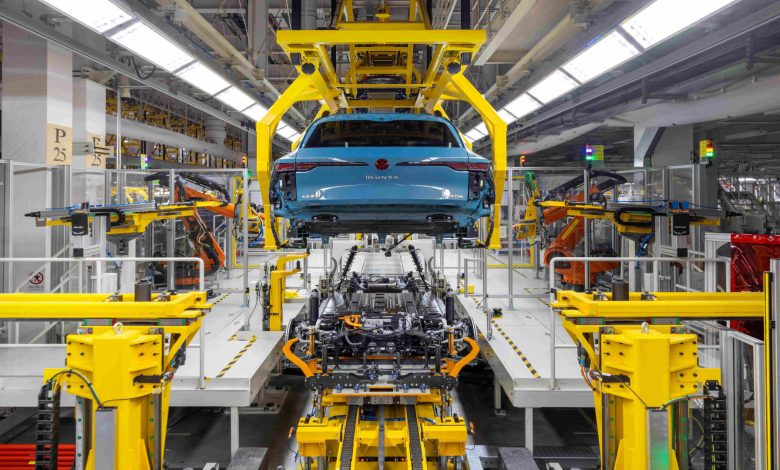
Volkswagen announced Friday, March 13, 2026, that it started production of its first all-electric SUV, the ID. UNYX 08, that uses Xpeng’s automotive chip.
Volkswagen
Hi, this is Evelyn, writing to you from Beijing. Welcome to the latest edition of The China Connection — a succinct snapshot of what I’m seeing and hearing from local businesses.
Today, I talk to Volkswagen China’s chief technology officer about how they are pivoting away from engines. It starts with chips, obviously, but which company’s?
Enjoy!
Any thoughts on today’s newsletter? Share them with the team.
The big story
Volkswagen is preparing for a future driven by chips. And, at least in China, Nvidia isn’t part of the picture.
With advanced tech from local Chinese players, “for us, there is no reason to stick [to] Nvidia,” Thomas Ulbrich, chief technology officer of Volkswagen Group China, told me last week. We chatted in his office, during one of his rare days at the German automaker’s Beijing headquarters.
Ulbrich spends most of the time in Hefei, an automotive hub just hours from Shanghai.
That’s where Volkswagen’s factories are located, as well as its biggest research and development center outside of Germany. For semiconductors, the company has a joint venture with Chinese automotive chip company Horizon Robotics, and a partnership with electric car company Xpeng, which has developed its own “Turing” car chip.
The Xpeng Turing chip is part of Volkswagen’s first all-electric SUV, the ID. UNYX 08. Production began Friday in Hefei, with deliveries in China set to begin by the end of June. The vehicle comes with L2 advanced driver–assist, which means it can help drivers navigate highways and urban streets.
That’s a driver–assist feature Xpeng has already rolled out in China, while Tesla has yet to get Beijing’s approval for its version.
Having that specific expertise in driver-assist software is also why Ulbrich said Volkswagen is working with Xpeng chips, as well as Horizon.
“Why does a customer buy a car?” Ulbrich said.
“Ten years ago, it was brand, brand, brand,” he said. “But nowadays it is intelligence of the car, mainly driven by smart EVs.”
In about two years, he expects Volkswagen cars in China to reach L3 capabilities, which will allow drivers to take their hands off the steering wheel under specific conditions. When regulators allow L3 to be used, liability for accidents is set to shift from driver to manufacturer.
Meanwhile, Volkswagen’s joint venture with Horizon, called Carizon, is developing its first advanced automotive chip, with expected delivery in three to five years.
Nvidia has also bet that automotive chips will be a billion-dollar business. But segment growth has slowed in recent quarters, while the Chinese EV partners that once partnered with Nvidia have begun developing their own chips in-house.
As for applications of artificial intelligence, Ulbrich said AI integration would happen faster in factories than in cars. He said Volkswagen is already incorporating some AI-powered functions in manufacturing.
Ulbrich is also CEO of the Hefei R&D center, called the Volkswagen Group China Technology Company, a role he has held in China since April 2024. This is his third assignment to China, following earlier postings in the late 1990s and the 2010s.
Getting up to China speed
Volkswagen has become one of the most aggressive Western automakers trying to recoup China sales lost to domestic EV rivals.
But pre-pandemic attempts were slow. At a spring auto show in 2019, Europe’s biggest carmaker announced a new line of electric vehicles for China, beginning two years later.
Chinese rivals were moving much faster. Xpeng revealed an electric coupe that customers could drive in about 12 months. BYD launched its Han electric sedan in July 2020 and was ramping up deliveries less than a month later.
Now, after an overhaul of the China business that began in 2023, Volkswagen has slashed its production time and costs.
“This is the year of delivery,” said Ulbrich. He said in 2026 alone, Volkswagen plans to launch 20 new models powered by battery or hybrid solutions on the roads in China.
The roadmap stretches to 2030, where Volkswagen aims to have 50 new models, including 30 fully electric ones. The cars will also be exported to other countries.
In fact, this year marks Volkswagen’s largest product campaign in China to date. The group management signaled their ambitions during an earnings report last week, despite a 53% drop in profit and an 8% drop in China passenger car sales.
Ultimately, survival comes down to what attracts buyers.
In China, consumers are highly digitally connected, Ulbrich said, citing the range of smartphone services. “The car has to fit into this world,” he said, noting that’s why automotive tech in China is ramping up so quickly.
That means that, for companies, China is not just a training center but also a market for proving a product, Ulbrich said, hinting at global strategic advantages.
Need to know
China gets Iranian oil. Since the Iran war began, more than 11 million barrels of crude oil have passed through the Strait of Hormuz headed to China, CNBC has learned.
OpenClaw craze. The lobster-themed AI agent is trending in China as companies rush to tap an opportunity to get locals to spend more on the technology.
Exports climb. China’s trade surplus rose to its highest on record in the combined January-February period, while exports massively beat expectations.
China’s economic momentum. Retail sales for the first two months of the year rose 2.8% from a year earlier. Industrial output climbed 6.3%, also exceeding expectations for a 5% jump.
Coming up
March 18: Tencent earnings
March 19: Alibaba to release December quarter earnings. Horizon Robotics to report 2025 full-year results
March 20: China releases benchmark lending rates. Xpeng to report 2025 fiscal year results