With Iran’s 48-hour ultimatum looming, Asian stock markets plummeted and gold prices crashed!
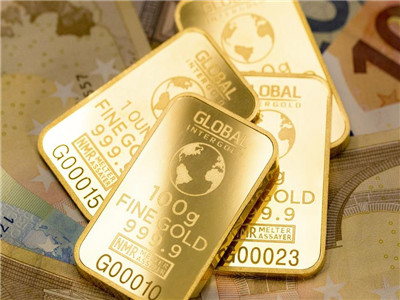
As the war in Iran enters its fourth week with no signs of easing, financial markets experienced severe volatility on Monday. Asian stock markets plummeted, triggering a circuit breaker in South Korea, while gold briefly fell below $4,350 per ounce and crude oil and U.S. Treasury bonds witnessed significant fluctuations. Trump’s ultimatum to Iran is nearing its deadline. The view that ‘the Iran conflict will become protracted’ is sweeping through the markets.
As the war in Iran entered its fourth week with no signs of easing, financial markets opened turbulently on Monday, with Asian stocks plummeting, European and American stock index futures and crude oil experiencing significant volatility, while gold and US Treasuries fell.
During Monday’s trading session, spot gold retreated below $4,350 per ounce, hitting a new low since early January, with an intraday decline of 3.4%. Spot silver plunged $3 to $64.84 per ounce, marking a drop of 4.43%.
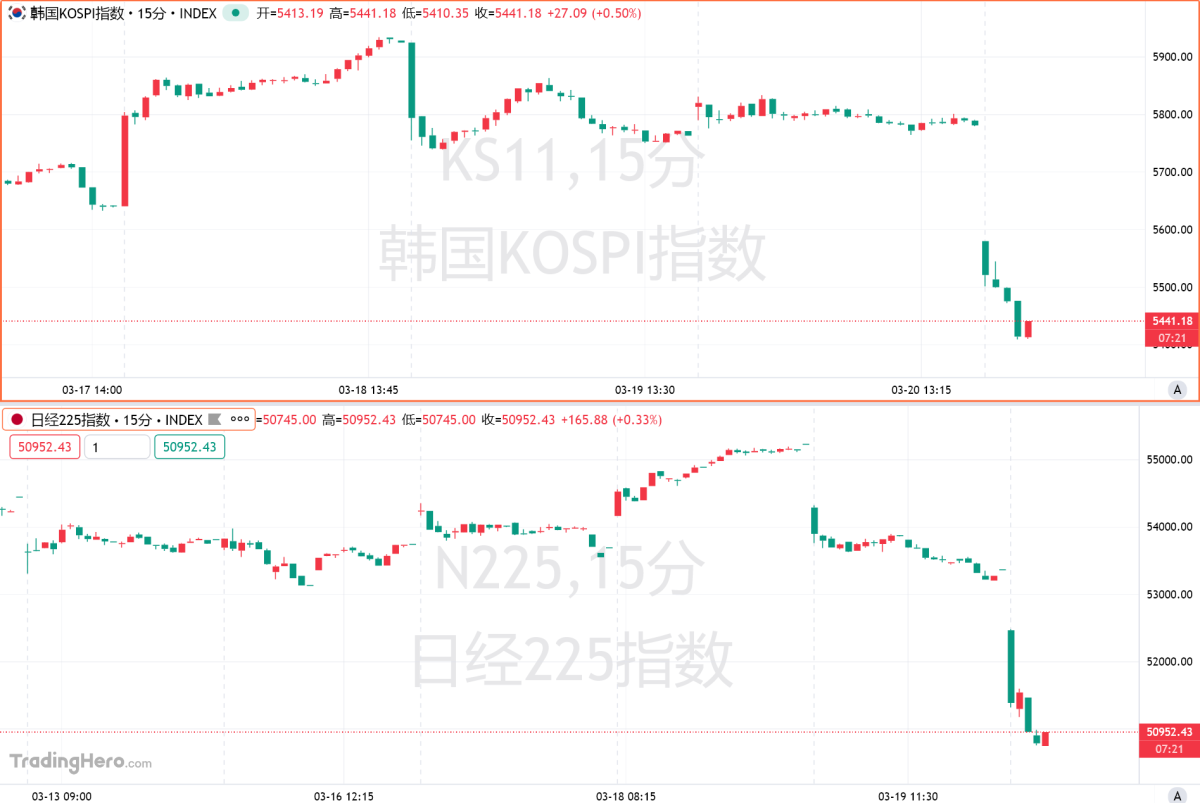
 The KOSPI index plummeted 6% intraday to 5,432.67 points. The South Korean won fell against the US dollar in early trading, hitting its lowest level since March 10, 2009. The Korea Exchange triggered the KOSPI index circuit breaker mechanism after the KOSPI 200 futures dropped by 5%, halting program trading for five minutes.
The Nikkei 225 index extended its losses to 4% during the session, while Japan’s 30-year government bond yield hit its highest level since February 9; the 20-year bond yield rose 6.0 basis points to 3.180%, reaching a new high since February 5; and the 10-year bond yield climbed 5.0 basis points to 2.310%.
Concerns over the war in Iran weighed heavily on the resource-rich market of Australia, causing equities to fall closer to a technical correction. The S&P/ASX 200 index declined 2% on Monday, extending losses from its peak on March 2 to 10%. Most sectors outside energy experienced declines. Australian 10-year government bonds widened their losses, with benchmark yields rising by 11 basis points.
The decline in European equity index futures widened, with the Stoxx 50 Index futures falling by 1.1% and the German DAX Index futures dropping by 1.2%.
Crude oil prices fluctuated sharply, while the US Dollar Index rose 0.2%, and the yield on the 10-year US Treasury note surged to nearly an eight-month high at 4.4055%.
With no signs of easing tensions in the Middle East, Trump issued a 48-hour ultimatum to Tehran, demanding the reopening of the Strait of Hormuz or else face attacks on its power plants. This ultimatum was set to expire late Monday local time. Iran responded that any such attack would prompt it to indefinitely close the waterway and target US and Israeli energy infrastructure in the region.
Matt Maley, Chief Market Strategist at Miller Tabak, stated in an interview: ‘It is not up to Trump alone to disengage from this war. Uncertainty has been rising for three weeks, and now it has intensified significantly. Even if investors don’t sell, they are unlikely to buy – and without bids, the market could enter a vacuum.’
‘Risk assets had a relatively mild start, but given the ultimatum facing the markets, this performance may be surprisingly restrained,’ said Chris Weston, Head of Research at Pepperstone Group in Melbourne.
Shoji Hirakawa, Chief Global Strategist at Tokai Tokyo Intelligence, noted that ‘the view that the Iran war will persist for the long term is gaining popularity in the market,’ making macro-sensitive industries like technology vulnerable to sell-offs. Hirakawa added that if oil prices climb to $130 per barrel, the likelihood of US interest rate hikes will increase, posing an additional headwind for Japanese stocks. However, he also mentioned that many downside risks have already been priced in, suggesting that the Tokyo stock market could rebound later this week.
Jonathan Krinsky, BTIG’s Chief Market Technician, noted in a report on Sunday that the S&P 500 Index is currently ‘firmly below’ its 200-day moving average and testing the fourth-quarter low of 6521 points. He wrote: ‘Interestingly, we still sense that participants are more concerned about missing out on ‘de-escalation’ than any meaningful downside risk. We continue to see more downside risk than upside reward.’
Gold prices continued to fall sharply after experiencing the largest weekly drop in over 40 years. Since the conflict began, surging oil prices have increased inflation risks and reduced the likelihood of interest rate cuts by the Federal Reserve and other central banks in the near term. This poses a headwind for non-yielding gold, which has declined for eight consecutive trading sessions.
Some analysts have warned gold investors to expect more pain in the market. The technical chart for gold was significantly damaged after prices fell below the 50-day moving average, which is just below $5,000 per ounce.
Bernard Dahdah, precious metals analyst at Natixis, stated in the latest precious metals report that he expects gold prices to fluctuate between $4,600 and $4,700 per ounce as the world watches how the war with Iran unfolds. However, he cautioned that downside risks for gold prices are increasing.
‘If energy assets suffer further disruptions and the war persists, gold prices could eventually fall to a low of $4,000 per ounce. This is because, under such circumstances, even the Federal Reserve may need to raise interest rates given the stickiness of energy prices,’ he said. ‘However, we believe that the long-term trend for gold will not remain at the lower end of $4,000 per ounce. If damage to energy infrastructure is limited and oil prices quickly revert to pre-war levels, we may see stronger buying interest from central banks in gold. This, in turn, could push gold prices back onto a sustained trajectory above $5,000 per ounce.’
Despite facing some challenging headwinds in the short term, analysts remain optimistic about precious metals in the long run. Ole Hansen, Head of Commodity Strategy at Saxo Bank, stated that the reasons investors bought gold at the beginning of the year have not changed, as geopolitical instability and rising government debt continue to expose the global economy to unprecedented uncertainty.
‘Investors need to experience heartbreak before they can become passionate again. This essentially means that investors who still like this metal (and there are many) need to prove that the worst is over,’ he said.
Analysts pointed out that the main reason gold has not performed as a safe-haven asset during the war, aside from technical difficulties, is the growing threat of inflation driven by rising energy prices.
However, there are differing opinions in the market. Kyle Rodda, an analyst at Capital.com Inc., stated that gold would ‘rebound in the short term due to technical reasons.’ He added that much would depend on ‘whether Trump follows through on his threat to strike Iran’s power plants.’
The 14-day Relative Strength Index (RSI) for gold, a momentum indicator, dropped below 30, a level some traders consider oversold. Weekly data released by the U.S. government last Friday showed that hedge funds and other large speculators increased their net long positions in gold to the highest level in seven weeks as of March 17.