World stocks fall, oil prices rise on darkening economic outlook from Middle East war
NEW YORK/LONDON (March 28): Global stock markets fell and oil prices rose on Friday, driven by a lack of progress in bringing an end to the four-week-old Middle East conflict that is beginning to sap consumer and business confidence.
The global equity market sell-off has deepened in recent days, as US President Donald Trump’s statements about negotiations are increasingly viewed as less important than the situation in the Gulf, where attacks persist and the crucial Strait of Hormuz is effectively blocked by Iran.
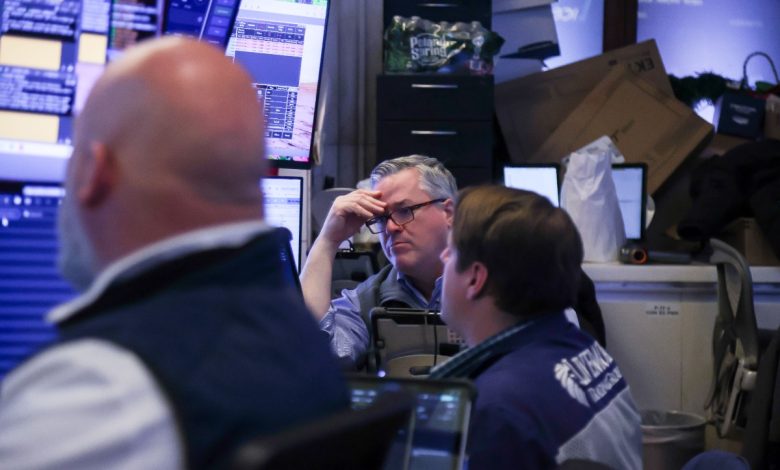
On Wall Street, all three main indices finished lower with consumer discretionary, financial and communications and technology shares driving losses. Economists and businesses increasingly believe the conflict’s disruption to world oil supply will filter through to inflation worldwide and drag on growth.
‘Words aren’t cutting it’
The Dow Jones Industrial Average fell 1.73%, the S&P 500 lost 1.67% and the Nasdaq Composite shed 2.15%. The indices notched their fifth straight week of declines.
“Words alone aren’t cutting it right now, with President Trump’s extension of the pause on Iran energy strikes failing to lift the mood in any meaningful way,” said Matt Britzman, a senior equity analyst at Hargreaves Lansdown. “Tangible evidence of progress is what’s needed.”
Trump extended a deadline for Iran to reopen the Strait of Hormuz, but Iran has given no direct indication that it was ready to negotiate. The country’s Islamic Revolutionary Guard Corps reiterated it would continue to disrupt shipping through the strait, which is used to ship roughly one-fifth of the world’s oil and gas supply.
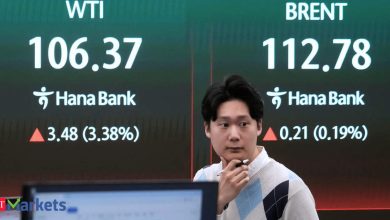
Brent crude futures rose 4.22% to settle at US$112.57 (RM441.72) a barrel. US West Texas Intermediate futures settled up 5.4% at US$99.64.
“The longer the Strait of Hormuz is closed the greater the disruption and therefore the uncertainty around oil prices,” said Dan Boston, the global head of a small company team at Polar Capital in Florida. “You are seeing anything from food to transportation costs filtering their way into inflation expectations. As those expectations rise, consumer sentiment starts to fall as well.”
The University of Michigan’s index of US consumer sentiment fell more than expected in March, touching a three-month low.
The pan-European STOXX 600 index dropped 0.95%. Germany’s DAX index fell 1.4% while London’s FTSE 100 index shed 0.05%.
MSCI’s index of Asian shares excluding Japan fell 0.70% overnight. MSCI’s gauge of stocks across the globe fell 1.35%.
Dow joins Nasdaq in correction territory
The Dow became the latest major Wall Street index to confirm a correction, as it is now down more than 10% from its Feb 10 record close.
The Dow follows the Nasdaq in crossing the correction threshold while the Russell 2000, which was the first on the correction path, confirmed it last Friday.
“The unbridled optimism that propelled Nasdaq to all-time highs in the fourth quarter is fading as the macro backdrop sours and uncertainty about the impact of AI across the tech ecosystem clouds the horizon,” said James St Aubin, the chief investment officer of Ocean Park Asset Management.
Bond yields rise
Government bond yields rose, as central banks are seen as more likely to raise interest rates to head off a potential inflationary shock from higher energy costs. Yields rise as prices fall and vice versa.
The 10-year US Treasury yield, which sets the tone for borrowing costs around the world, rose more than one basis point to 4.428%.
Money markets see a roughly 60% chance the US Federal Reserve will raise rates this year, a sharp change from late February when traders were betting on two cuts in 2026.
Germany’s 10-year bond yield rose 0.7 basis point to 3.106%.
The US dollar was slightly higher against major peers, including the euro, Japanese yen and Swiss franc.
The dollar rose to its highest level against the yen since July 2024. It was last up 0.31% to 160.29 against the yen. The dollar was up 0.45% to 0.799 versus the Swiss franc. The euro was down 0.14% at US$1.151.
The US dollar index, which tracks the currency against six peers, rose 0.29% to 100.17 for a fourth straight session of gains.
Spot gold was up 2.87% to US$4,504.79 an ounce.