Is It Too Late To Consider Merck (MRK) After A 48% One-Year Gain?

- This article examines whether Merck, at around US$113 per share, still offers value or if most of the upside is already reflected in the price, by breaking down what the current valuation signals may be indicating.
- The stock has returned 2.8% over the last 7 days, is down 6.4% over the past 30 days, is up 6.3% year to date, and has delivered 48.4% over the past year. These moves may have influenced how the market views its risk and reward profile.
- Recent coverage has focused on Merck as a large pharmaceutical stock with an established product portfolio and a steady presence in the sector. This context helps frame how investors think about its defensiveness. At the same time, commentary around the wider pharmaceuticals and biotech space keeps valuation in focus as investors weigh factors such as pricing power, patent cycles, and pipelines.
- Merck currently has a valuation score of 3 out of 6. The next sections will compare what different valuation approaches suggest about that score, then conclude with a way to assess value that connects the numbers to the broader investment narrative.
Approach 1: Merck Discounted Cash Flow (DCF) Analysis
A Discounted Cash Flow, or DCF, model estimates what a stock could be worth today by projecting future cash flows and discounting them back to the present. It is essentially a cash flow based estimate of intrinsic value.
For Merck, the model starts with last twelve months Free Cash Flow of about $12.6b. Analysts and internal estimates project annual Free Cash Flow in the $19.6b to $25.0b range over the next decade, with a specific projection of $23.2b in 2030. Simply Wall St uses analyst forecasts where available, then extrapolates further cash flows to complete its 2 Stage Free Cash Flow to Equity model.
On this basis, the DCF model arrives at an estimated intrinsic value of about $214.43 per share. Compared with the current share price of roughly $113, the model suggests the stock trades at about a 47.2% discount. This indicates material upside implied by these cash flow assumptions.
Result: UNDERVALUED
Our Discounted Cash Flow (DCF) analysis suggests Merck is undervalued by 47.2%. Track this in your watchlist or portfolio, or discover 51 more high quality undervalued stocks.
Approach 2: Merck Price vs Earnings
P/E is a common way to value profitable companies because it ties what you pay directly to the earnings the business generates today. In simple terms, a higher P/E usually reflects higher expected growth or lower perceived risk, while a lower P/E often points to more modest expectations or higher uncertainty.
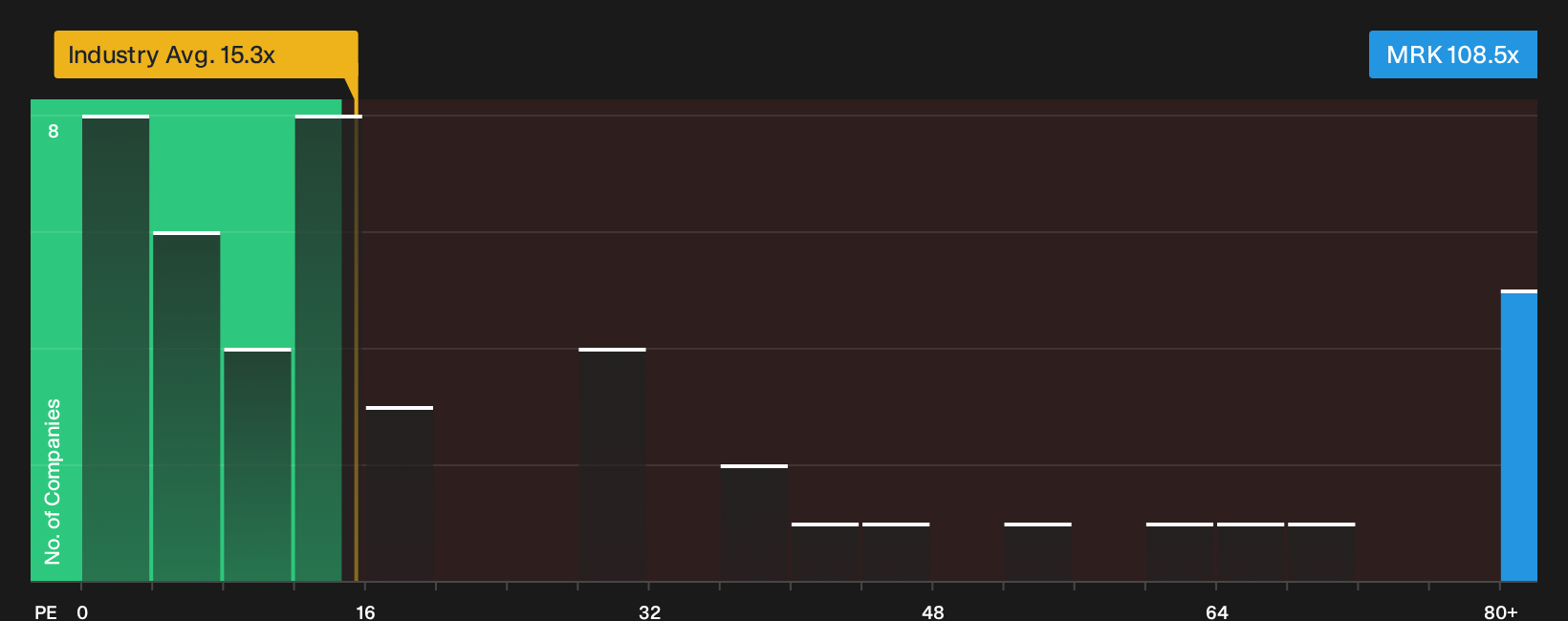
Merck trades on a P/E of about 31.3x. This sits above the Pharmaceuticals industry average of roughly 16.8x and also above the peer group average of about 24.0x. On the surface, that gap suggests investors are willing to pay more per dollar of earnings than for many other pharmaceutical stocks.
Simply Wall St’s Fair Ratio for Merck is 31.9x. This proprietary figure is designed to capture what a “normal” P/E could look like for the company, based on factors such as its earnings growth profile, profitability, risks, market value and its place within the industry. Because it blends these elements, the Fair Ratio can be more tailored than a simple comparison with broad industry or peer averages.
With Merck’s current P/E of 31.3x sitting slightly below the Fair Ratio of 31.9x, the stock appears modestly undervalued on this metric.
Result: UNDERVALUED
P/E ratios tell one story, but what if the real opportunity lies elsewhere? Start investing in legacies, not executives. Discover our 19 top founder-led companies.
Upgrade Your Decision Making: Choose your Merck Narrative
Earlier it was mentioned that there is an even better way to understand valuation. Narratives let you connect your view of Merck’s story to a simple forecast and a Fair Value, then compare that to the current price using easy tools on Simply Wall St’s Community page that update when fresh news or earnings arrive. For example, one Merck Narrative might lean toward the higher Fair Value of about US$150.00, built on assumptions of faster revenue growth, expanding profit margins and a lower future P/E. Another might anchor closer to roughly US$101.30 with more cautious assumptions about revenue growth, margins and valuation. Seeing those side by side helps you decide whether Merck looks attractively priced, fully priced or expensive against the story you believe is more realistic.
For Merck, however, we will make it really easy for you with previews of two leading Merck Narratives.
Start by asking which story feels closer to how you see the business today and what you think is realistic for the next few years.
Fair value: US$124.88
Implied discount vs last close: 9.4%
Revenue growth assumption: 4.77%
- Focuses on a much larger late stage pipeline, with over 20 potential new growth drivers and a higher assumed future P/E supporting the higher fair value.
- Builds in steady revenue growth and higher profit margins supported by product launches such as WINREVAIR and CAPVAXIVE, plus ongoing R&D and business development.
- Flags key risks around GARDASIL demand, KEYTRUDA loss of exclusivity, tariffs and pricing pressure, and encourages you to stress test the assumptions against your own view.
Fair value: US$112.55
Implied premium vs last close: 0.5%
Revenue growth assumption: 5.25%
- Centres on concentration risk around KEYTRUDA and the 2028 patent cliff, with questions about how quickly other products can fill any future revenue gap.
- Highlights regulatory complexity, competitive pressure in core therapy areas and the need to watch how management handles product approvals and pricing across regions.
- Treats valuation as sensitive to execution on the pipeline and future guidance updates, with the fair value sitting close to the recent share price in this scenario.
If you want to see how other investors are weighing these trade offs and build your own version of the story, you can use the Community Narratives tools on Simply Wall St to adjust the assumptions that matter most to you and see how that shifts fair value.
Curious how numbers become stories that shape markets? Explore Community Narratives
Do you think there’s more to the story for Merck? Head over to our Community to see what others are saying!

This article by Simply Wall St is general in nature. We provide commentary based on historical data
and analyst forecasts only using an unbiased methodology and our articles are not intended to be financial advice. It does not constitute a recommendation to buy or sell any stock, and does not take account of your objectives, or your
financial situation. We aim to bring you long-term focused analysis driven by fundamental data.
Note that our analysis may not factor in the latest price-sensitive company announcements or qualitative material.
Simply Wall St has no position in any stocks mentioned.
New: Manage All Your Stock Portfolios in One Place
We’ve created the ultimate portfolio companion for stock investors, and it’s free.
• Connect an unlimited number of Portfolios and see your total in one currency
• Be alerted to new Warning Signs or Risks via email or mobile
• Track the Fair Value of your stocks
Have feedback on this article? Concerned about the content? Get in touch with us directly. Alternatively, email editorial-team@simplywallst.com