Barrick Mining, Desert Gold, Deutsche Bank, and Commerzbank!

Mega-IPO on the Horizon: Barrick Unleashes the True Potential of Its Top Gold Mines
The time has come! As has been rumoured on the stock market for months, Barrick Mining is now taking the next step and listing its North American gold jewels under the name “North American Barrick.” With a planned IPO in New York and Toronto by the end of 2026, the giant is catapulting its top assets, including the legendary mines in Nevada, into a league of their own. The fact that Barrick retains control and a majority stake ensures strategic focus, while a dedicated management team brings a fresh operational perspective. Portfolio standouts like Carlin and Cortez recently delivered a whopping 2 million ounces of gold, underscoring the immense potential of the new company. This spin-off is more than just a formality; it is a clear move to finally unlock the true value of these world-class assets amid the current gold boom. Investors can look forward to a top-tier newcomer that is likely to shake up the gold sector! Analysts are also giving the parent company, Barrick Mining, a strong vote of confidence: experts on the LSEG Refinitiv platform estimate the upside potential at an impressive CAD 85, representing a 60% premium!
From Explorer to Producer: Desert Gold on the Verge of a Decisive Leap
Things are no less exciting at Desert Gold. Like Barrick Mining, the Canadians hold a key property in Mali, where conditions for gold mining have recently improved significantly. As a result, investors have Africa back on their radar. In the wake of a historically strong gold rally with prices exceeding USD 5,400 in January, Desert Gold is increasingly coming into focus because it dares to strike the rare balance between exploration potential and operational execution. While major producers along the Senegal-Mali Shear Zone are specifically targeting expandable ounces, the company has strategically positioned itself among established Tier-1 mines, with a land package covering approximately 440 km² in a geological environment that has been producing millions of ounces for decades. And the potential is huge—after all, only about 10% has been explored so far!
Currently, the year 2026 marks more than just another year of exploration for Desert Gold; rather, it marks the transition into a new phase: the concrete move toward production. At the Barani-East site, construction preparations are visibly progressing, with approximately 52,000 m² of land already cleared, surveying work completed, and initial foundation structures laid. This operational momentum is no coincidence but rather the result of a clearly phased development plan aimed at a rapid start-up. The schedule is ambitious but achievable, as the first gold production is already targeted for mid-July. A date that can be considered a potential turning point in the company’s history. A central component is a modular gravity plant with a capacity of around 200 tons per day, which has already successfully passed technical acceptance and is currently being transported to West Africa. The logistics are tightly scheduled, with expected arrival at the port of Dakar in June and subsequent delivery to the project site later that same month. In parallel, the water supply—a critical success factor—is being systematically developed, with geophysical programs having identified as many as 13 priority drilling targets, a result that significantly exceeded initial expectations.
This parallel development of infrastructure and supply significantly reduces the classic construction and start-up risk. However, the company itself points out the inherent uncertainties associated with developing a project without defined reserves. This is precisely where the dual nature of the story lies. On one hand, there is a robust economic foundation with an after-tax net present value of approximately USD 61 million and an internal rate of return of about 57% based on conservative gold prices. On the other hand, the question of scaling, particularly concerning metallurgy, cost structure, and recovery rates, remains a critical test of long-term profitability.
But CEO Jared Scharf knows what he is doing. He will outline his production strategy at the 19th International Investment Forum (IIF) on May 20, 2026. Click here to register…
It is noteworthy that Desert Gold is deliberately adopting a modular development model, in which oxidized material is initially processed using a combination of gravity and cyanide leaching to allow for flexible responses to new exploration results. This strategy enables the gradual integration of additional resources without incurring high capital costs immediately. At the same time, the geological potential remains a key value driver. With over 1 million ounces of gold resources and numerous zones yet to be fully evaluated, the project offers significant expansion potential. A valuation of CAD 47 million is remarkably low at this advanced stage; GBC Research has calculated a potential of over 500% and a price target of CAD 0.81. A gold-backed investment story for risk-conscious investors.
Deutsche Bank and Commerzbank – The Dance Has Begun
Things are also getting truly exciting in the European banking sector. For the long-outdated merger rumours surrounding Deutsche Bank and Commerzbank, UniCredit’s aggressive expansion strategy is clearly overshadowing them, with UniCredit making its move with a takeover bid worth around EUR 35 billion. The major Italian bank had already acquired the HypoVereinsbank Group in 2006 and, since 2024, has gradually built a stake to become Commerzbank’s largest single shareholder. It is currently attempting to cross the 30% threshold to expand its influence further.
Commerzbank itself, however, firmly rejects the offer and criticizes the lack of strategic clarity as well as the absence of a takeover premium, while the German government is also applying political brakes with its 12% stake from the 2008 bank bailout. At the same time, the old idea of a merger between Deutsche Bank and Commerzbank is flaring up again; analysts view this as potentially value-enhancing, though it has historically failed due to complexity and integration risks. In the current context, Deutsche Bank appears more as a strategic observer that could benefit from consolidation pressure without having to intervene actively itself. The current momentum points to a fundamental shift in the European banking sector, where cross-border consolidation is becoming increasingly likely. Whether there is anything in it for investors remains questionable, as the outlook for traditional banking is rather bleak!
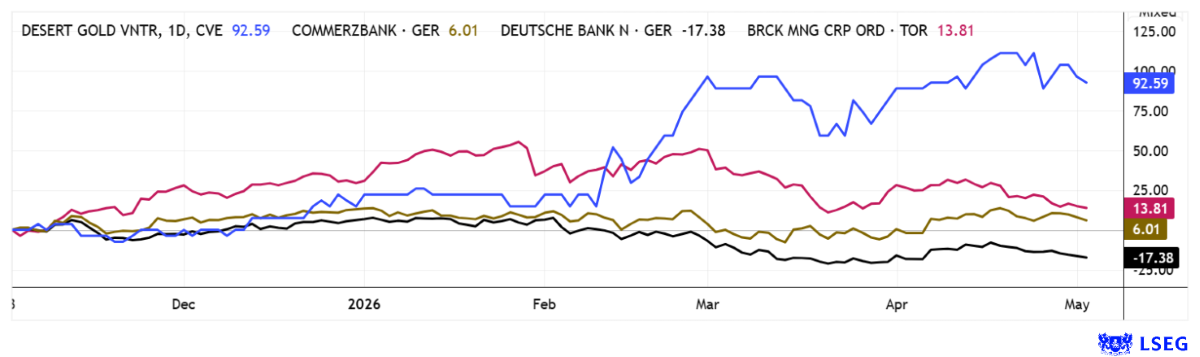
The stock markets continue to blaze in 2026: a veritable buying frenzy in commodities is colliding with the bubbling rumour mill of an impending wave of takeovers. While precious metal stocks in particular have already performed brilliantly since the middle of last year, with operating profits in the mining sector exploding, the sky seems to be the limit. While Barrick shines with its blockbuster IPO and merger fantasies are running wild in the banking sector, Desert Gold is coming into focus as a hot production candidate. The small-cap gold digger could quickly establish itself as the next rising star!
Pursuant to §85 of the German Securities Trading Act (WpHG), we point out that Apaton Finance GmbH as well as partners, authors or employees of Apaton Finance GmbH (hereinafter referred to as “Relevant Persons”) currently hold or hold shares or other financial instruments of the aforementioned companies and speculate on their price developments. In this respect, they intend to sell or acquire shares or other financial instruments of the companies (hereinafter each referred to as a “Transaction”). Transactions may thereby influence the respective price of the shares or other financial instruments of the Company.
In this respect, there is a concrete conflict of interest in the reporting on the companies.
In addition, Apaton Finance GmbH is active in the context of the preparation and publication of the reporting in paid contractual relationships.
For this reason, there is also a concrete conflict of interest.
The above information on existing conflicts of interest applies to all types and forms of publication used by Apaton Finance GmbH for publications on companies.
Apaton Finance GmbH offers editors, agencies and companies the opportunity to publish commentaries, interviews, summaries, news and the like on news.financial. These contents are exclusively for the information of the readers and do not represent any call to action or recommendations, neither explicitly nor implicitly they are to be understood as an assurance of possible price developments. The contents do not replace individual expert investment advice and do not constitute an offer to sell the discussed share(s) or other financial instruments, nor an invitation to buy or sell such.
The content is expressly not a financial analysis, but a journalistic or advertising text. Readers or users who make investment decisions or carry out transactions on the basis of the information provided here do so entirely at their own risk. No contractual relationship is established between Apaton Finance GmbH and its readers or the users of its offers, as our information only refers to the company and not to the investment decision of the reader or user.
The acquisition of financial instruments involves high risks, which can lead to the total loss of the invested capital. The information published by Apaton Finance GmbH and its authors is based on careful research. Nevertheless, no liability is assumed for financial losses or a content-related guarantee for the topicality, correctness, appropriateness and completeness of the content provided here. Please also note our Terms of use.