Will a New Generation Break Through in L.A.?
This article is part of Governing’s Inside Politics newsletter. Sign up to subscribe.
It’s been a tough few years for big-city incumbents. The last mayors of Seattle, San Francisco, Chicago and New York City all lost their bids for re-election amid voter dissatisfaction about affordability, public safety, quality of life, homelessness, and the provision of government services. Now things aren’t looking so good for the mayor of Los Angeles. And the politics of America’s second-biggest city may be undergoing a generational shift.
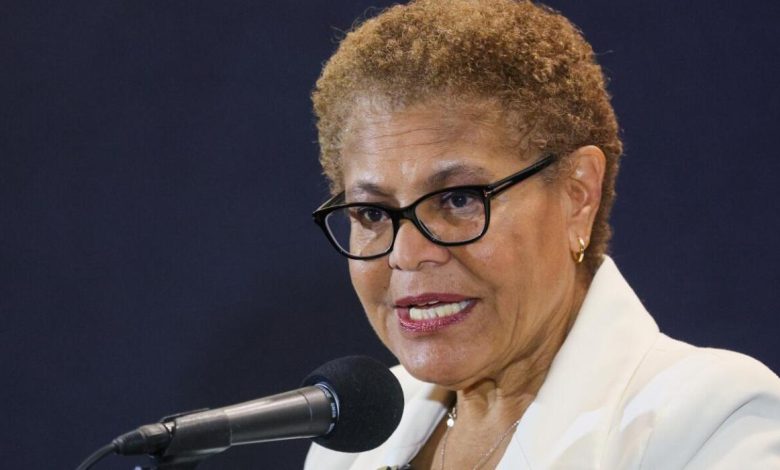
According to some recent polls, a majority of Los Angeles residents have an unfavorable view of their mayor, former U.S. Rep. and ex-state House Speaker Karen Bass. She’s facing a primary campaign that’s tougher than she anticipated a few months ago.
City councilmember Nithya Raman, a progressive who had previously allied with Bass and endorsed her re-election campaign, made a dramatic last-minute entry into the mayoral race in February and is challenging Bass’ record on housing, homelessness, and managing the city’s finances. Spencer Pratt, a MAGA-aligned former reality TV star whose home was burned down during the 2025 Palisades Fire, has criticized her handling of the fire recovery and taken a hard line on homelessness. Raman and Pratt are both close behind Bass in recent polling. Other candidates, including housing activist Rae Huang and tech entrepreneur Adam Miller, are challenging Bass from the left, right and center. Voting is already underway with the primary scheduled for June 2. The top two vote-getters will face off in a November general election.
Bass, a former nurse and community organizer, has been involved in L.A. Democratic politics for decades. She was elected to the California State Assembly in 2003 and became the first Black woman to serve as speaker. She served in Congress from 2010 until 2022. In the 2022 mayoral election, Bass beat billionaire real estate developer Rick Caruso, who toyed with the idea of challenging her to a rematch this year but decided against it.
Bass made homelessness a key issue of her 2022 campaign, and on her first day in office declared a homelessness emergency. She has progress to boast about on the issue. Her signature Inside Safe program claims to have moved more than 5,800 unsheltered homeless people indoors over the last four years, getting 1,400 people into permanent housing and clearing 120 encampments. But a Los Angeles Times analysis found some 40 percent of people who moved into shelters or housing through the program have since returned to the street. And L.A. residents still rank homelessness as their top concern.
Still, it was the response to the Palisades and Eaton wildfires in the L.A. region that sank Bass’ approval ratings. When the fires struck in January 2025, Bass was in Ghana on a diplomatic trip, the sort of a trip she said she wouldn’t make if elected mayor. A TV reporter caught her at the airport on her return to L.A., and a video of Bass ignoring his questions went viral.
Bass dismissed the city’s fire chief, Kristin Crowley, a month later, and Crowley has since filed a lawsuit accusing the mayor of retaliation. The Los Angeles Times published a report earlier this year suggesting that Bass had altered an after-action report on the fires to limit her exposure to criticism and legal liability, a narrative that Bass strenuously denied.
The city also faced a $1 billion budget deficit last year, which Bass initially responded to with a proposal for 1,600 layoffs. City residents’ satisfaction with the quality of life is at its lowest point in over a decade. Rick Cole, a former deputy L.A. mayor and city controller as well as a former mayor of Pasadena in L.A. County, says it’s been “downhill” since Bass’ first day in office.
“If she was running unopposed, she would lose,” he says.
Of course Bass isn’t running unopposed, and her challengers will have to prove themselves to voters rather than just attacking her record. That’s a tall order in a city as big and diffuse as Los Angeles. Any outcome other than a second Bass term would indicate a bracing shift in L.A. politics.
Pratt has tapped into widespread anger over the fire response and performed better in debates than many expected, given his reputation as a maligned reality TV character. But even if he makes it past the primary, he’ll have to convince a heavily Democratic city to vote for a conservative who’s never held political office. There are some indications that’s the head-to-head that Bass and her supporters want.
Raman, the other frontrunner, reflects the growing influence of a younger cohort of L.A. progressives. An urban planner and member of the local chapter of the Democratic Socialists of America, Raman joined the city council in 2020 by beating an incumbent member, something that hadn’t happened in the city for years. It was the first local election held in an even-numbered year after a change to the election schedule designed to improve voter turnout. Now more renters and low-income people are voting in local elections, in addition to the wealthier homeowners who have typically dominated local politics, and the city is moving left.
The face-off between Bass and Raman, who were allies until very recently, reflects a schism in L.A. Democratic circles that is less about left and right than it is about housing and development. As California housing costs have spun out of control, a contingent of lawmakers who favor pro-development housing rules and limited local regulation have gained influence in the state Legislature. When the Legislature last year was debating SB 79, a law that promotes denser development near transit stations, the Los Angeles City Council passed a resolution opposing it, and Bass urged Gov. Gavin Newsom to consider a veto. The law took effect anyway. Raman, who has backed expanded renter protections as well as pro-development policies, was among a minority of council members who didn’t oppose it. Her candidacy for L.A. mayor has excited housing advocates up and down the state.
“If we can flip L.A. City Hall,” says Matt Lewis, a Berkeley-based spokesperson for California YIMBY, “that changes the politics of the entire state of California.”
Despite frustration with Bass’ performance, she has advantages that other candidates don’t have, including the continued support of many labor unions and other traditional Democratic Party power players. She’s also a known quantity in a city that may be reluctant to swing too far right or left. Many people backing her challengers are still careful to speak about Bass’ political career with respect. Even in a time of political upheaval, incumbency has its perks. It’s only a question of whether they’ll be enough to get her a second term.
Nobody Text Me in a Crisis
Elected officials travel overseas all the time, whether on diplomatic missions, policy-related research trips, or just-for-fun visits by sister-city mayors. Local media often question the taxpayer costs of such trips, but voters typically don’t pay them any mind. Until they do. Few people argue it was outright wrong for Karen Bass to join a Biden administration diplomatic trip to Ghana in January 2025. But there’s no question that’s when her political woes multiplied.
Here are three other times when politicians took a hit for going abroad.
1965: In August 1965, riots broke out in Watts, a neighborhood in Los Angeles, after police arrested a young Black man on suspicion of drunk driving and word spread around the neighborhood that he and his family members had been abused by police. The riots lasted for six nights, resulting in widespread property destruction and 34 deaths. Pat Brown, the Democratic governor of California, was on vacation with his family in Greece when the riots broke out. The next year, California voters shifted right, electing Ronald Reagan governor and denying Brown a third term.
2009: South Carolina Gov. Mark Sanford was not, as his office suggested, hiking the Appalachian trail. Instead, he was in Argentina for a tryst with his mistress, the journalist María Belén Chapur. The revelations that Sanford was having an extramarital affair, and had disappeared from the country without telling his family or staff where he was, led to Sanford’s resignation as chair of the Republican Governors Association. But a few years later he made a comeback, winning election to the U.S. House of Representatives, where he’d served during the 1990s prior to becoming governor. In 2019 he challenged President Donald Trump for the Republican presidential nomination, but gained little traction and dropped out. This spring Sanford announced another comeback bid for Congress, but ended his campaign a few weeks later.
2021: A catastrophic winter storm hit the southern United States in February 2021 and caused power outages across Texas. At least 246 people died as a result. During the crisis, U.S. Sen. Ted Cruz flew with his family to Cancún, Mexico, drawing intense criticism and some calls to resign. Cruz seemed to immediately regret the decision. He returned to Texas after a few days, told reporters it was “a mistake” and that he was “trying to be a dad.” The damage to Cruz didn’t last. He was re-elected to the Senate in 2024.
Credit: Source link