Elon Musk drifted from Larry Page, but SpaceX, Google closer than ever
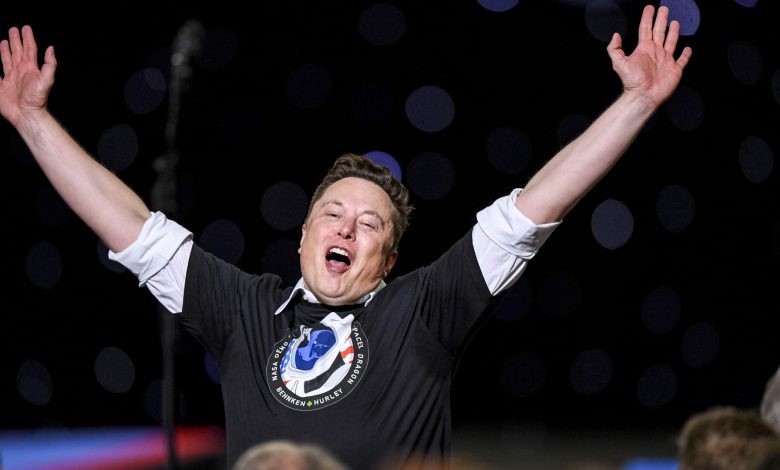
SpaceX founder Elon Musk jumps for joy at a gathering after NASA commercial crew astronauts Doug Hurley and Bob Behnken blast off aboard the SpaceX Falcon 9 rocket, bound for the International Space Station, in Cape Canaveral, Florida, on May 30, 2020.
Jonathan Newton | The Washington Post | Getty Images
In Elon Musk’s telling of the story, his friendship with Google co-founder Larry Page soured in June 2015, at the Tesla and SpaceX CEO’s 44th birthday party. There, Page reportedly called Musk a “speciesist” for saying he favored humans over future digital life forms.
That happened while they were discussing the terrifying potential of artificial intelligence.
With Musk’s 55th birthday just weeks away, and SpaceX having just completed the largest IPO in history, he and Page are the two wealthiest people in the world. Musk’s net worth has ballooned past $1 trillion, and Page is far behind at just under $300 billion. Sergey Brin, Google’s other co-founder, is third.
The rift may never be repaired, but Musk’s companies are more closely intertwined with Google than ever. Thanks to Google’s $900 million investment in SpaceX in 2015, the year of the infamous birthday party, the search giant owns roughly 4.9% of Musk’s reusable rocket maker, which is now trying to become a major player in AI.
Just ahead of its IPO, SpaceX announced that it would be leasing AI infrastructure to Google for $920 million a month over the course of 32 months. The deal could bring $30 billion in revenue to SpaceX’s challenged AI business, and was touted by SpaceX bulls heading into the IPO.
In the 11 years since the relationship between Musk and Page frayed, their worlds have collided on countless occasions, and their businesses have partnered and competed with each other. Here are five developments over the past decade-plus that cemented their bond, for better or worse:
Musk starts OpenAI to take on Google DeepMind
In 2015, Musk co-founded OpenAI with Sam Altman, who was running startup incubator Y Combinator. Musk had the explicit goal of creating a “counterweight” to Google DeepMind, a dominant AI research lab.
It was the same year that Google invested $900 million in SpaceX.
In messages that would come out in court years later, Musk told Altman that if left unchallenged, Google could wield monopolistic control over one of the world’s most powerful technologies.
Musk also took more direct aim at Google, recruiting AI researcher Ilya Sutskever away from DeepMind to OpenAI.
Sustkever was credited with co-founding OpenAI and with research breakthroughs that enabled the development of the company’s blockbuster AI models and flagship product, ChatGPT. He later left to start Safe Superintelligence, which became a Google Cloud customer in 2025.
Musk follows Google’s lead in self-driving cars
Google started up its autonomous vehicle division, now known as Waymo, in 2009. At the time, Tesla was taking orders for the forthcoming Model S, a fully electric sedan that it had not yet begun to manufacture.
Fast forward to October 2020, when Musk was ratcheting up his self-driving promises at Tesla. He started bashing Waymo in posts on Twitter, suggesting Tesla had a more powerful system in the works.
Since then, Musk has repeatedly slammed Waymo for its reliance on the lidar sensors its robotaxis use to navigate and avoid obstacles. Tesla’s self-driving systems, still in development, primarily rely on cheaper cameras.
Waymo is now running a fleet of thousands of robotaxis in the U.S., providing more than 500,000 paid trips each week across 11 cities. Tesla has only about 50 Robotaxi-branded vehicles operating mostly in Austin, Texas, according to public records.
While Tesla’s driver assistance systems have become more sophisticated over time, the company does not yet sell the “FSD (Unsupervised)” systems that it says will someday make its vehicles safe to use without a human supervisor at the wheel, ready to steer or brake as needed.
SpaceX becomes key Google Cloud customer
In 2021, as Google was working hard to take cloud infrastructure market share from bigger rivals Amazon Web Services and Microsoft Azure, the company notched a big win, inking a deal with SpaceX to help the company run its Starlink satellite internet service.
SpaceX had about 1,500 Starlink satellites in orbit at that time, and around 500,000 subscribers to its offering.
The company would use Google’s private fiber-optic network to quickly make connections to cloud services as part of a deal that was set to last about 7 years, sources told CNBC at the time.
“The power of combining cloud with universal secure connectivity, it’s a very powerful combination,” Bikash Koley, who was then Google’s head of global networking and now oversees global infrastructure, said in the announcement.
Alleged affair
Not all the Google-related drama was about Page.
In December 2021, Musk had an affair with Brin’s ex-wife, Nicole Shanahan, the Wall Street Journal reported in 2022. It took place during Art Basel in Miami.
The report said that Brin filed for divorce shortly after learning of the alleged affair.
After the news broke, Musk denied claims about any romantic involvement with Shanahan. He also disputed the rift with Brin by posting a selfie that he took at a San Francisco party, where Brin is seen laughing with attendees near Musk.
Walter Isaacson wrote, in his authorized biography of Musk, that the SpaceX and Tesla CEO had “maneuvered himself into a position where he could take a selfie with Brin, which Brin tried to avoid.”
In a 2023 People Magazine interview, Shanahan denied the affair but said the allegations had resulted in a “debilitating” aftermath for her. She soon linked up with Robert F. Kennedy Jr., becoming his running mate for an unsuccessful 2024 presidential campaign. Kennedy now serves as President Donald Trump’s health secretary.
Role reversal in cloud
Earlier this month, SpaceX became the cloud provider to Google.
SpaceX announced a deal to rent AI compute capacity to Google at $920 million per month for about 32 months. A Google Cloud spokesperson told CNBC the deal was made “to ensure we have bridge capacity to meet surging customer demand for our agent platform, Gemini Enterprise, which has been even higher than we expected.”
SpaceX said in filings that Google can end the agreement “after a one-month grace period,” if SpaceX fails to deliver the requisite amount of AI chips by Sept. 30. After this year, the agreement can be terminated by either party with 90 days notice.
For some investors, the deal boosted SpaceX’s AI story, showing it could generate returns on earlier capital expenditures required to build out the company’s Colossus data centers in and around Memphis, Tennessee.
The announcement came just before the SpaceX IPO.
Alphabet’s 4.9% of SpaceX, as of the close of trading on Friday, was worth more than $100 billion, making it Google’s most lucrative private market bet.