Nancy Pelosi to launch democracy institute at UC Berkeley
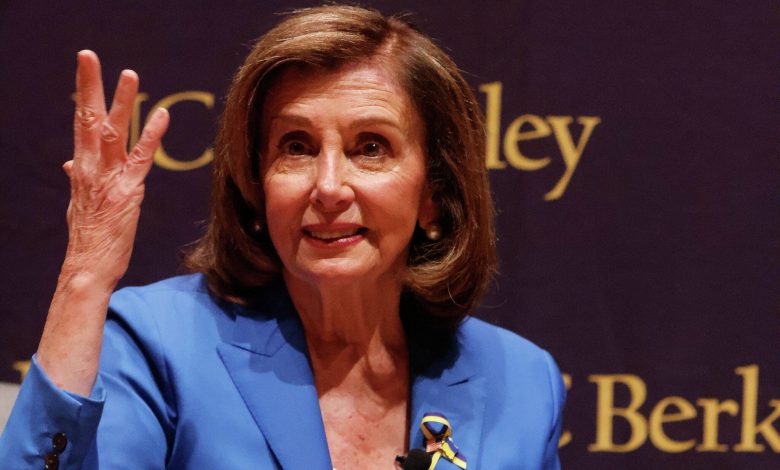

Rep. Nancy Pelosi, D-San Francisco, speaks at UC Berkeley’s Hertz Hall on April 18, 2022. After retiring from Congress, Pelosi will launch a new institute for representative democracy at the university and co-teach a class on Congress.
When she retires from Congress in January, Speaker Emerita Nancy Pelosi will establish the “Nancy Pelosi Institute for Representative Democracy” at UC Berkeley — and co-teach a class on Congress, she and the university announced Monday.
The new Pelosi Institute, which has already raised $35 million of its $50 million initial fundraising goal, aims to cultivate new generations of political leaders “dedicated to strengthening American democracy,” the university said.
“Not in a political way but in a visionary way,” Pelosi told the Chronicle, noting that what the nation’s founders did not want “was a monarch or a demagogue. And they did not want a king.”
Article continues below this ad
She said the multifaceted institute carrying her name is especially needed at this moment in history because “the present administration has given us cause to be concerned about our democracy.”
The new organization will work with the university’s political science department and serve as an incubator for undergraduates — some 500 a year — who are interested in public leadership, said university officials and Pelosi, who will retire Jan. 3 after 40 years and 20 terms in Congress.
Political science majors and nonmajors alike who complete the program will earn a certificate in public leadership.
The Pelosi Institute will also house a think tank for faculty research into such problems as political polarization, ethical use of AI by governments and criminal justice reform, the university said. The institute expects to host an annual forum for visiting scholars and “high-profile national and world leaders” to meet and talk about it all.
Article continues below this ad
The Pelosi Institute is intended to be nonpartisan in accordance with University of California policy and federal law, which prohibits tax-exempt charitable organizations like UC from participating in political activity.
Stanford’s Hoover Institution is also a tax-exempt nonprofit and officially nonpartisan, yet is widely regarded as a conservative research institution promoting free enterprise and limited government.
UC Berkeley Chancellor Rich Lyons was adamant, however, that the new institute will not push a political agenda.
“No, you can’t do it,” Lyons told the Chronicle. “We have a higher bar. We are really committed to keeping this nonpartisan, and we feel that (Pelosi) understands and agrees with that.”
That said, Pelosi, 86, epitomizes the Democratic Party. Representing most of San Francisco since she was first elected to Congress in 1987, she not only became the first woman elected speaker of the House of Representatives, in 2007, but was also the first woman to lead a major party. Pelosi also spent two decades as a member of the Democratic National Committee and led the California Democratic Party for many years.
Article continues below this ad
Her skill at political negotiations within her party and across the aisle is seen as legendary and led to the adoption of transformative laws — including early support for people with HIV and AIDS, the Affordable Care Act during the Obama administration, and financial relief when the COVID-19 pandemic hit.
When the Nancy Pelosi Institute for Representative Democracy opens in January, Speaker Emerita Pelosi will become professor Pelosi, co-teaching a class on Congress with UC Berkeley political science professor Eric Schickler.
“For me, it will be really exciting to learn from such a skilled political leader what political scientists get right and wrong,” said Schickler, who currently teaches a large lecture course on Congress.
With Pelosi in the room, he is looking forward to the reality check. “My students will just eat this up.”
Schickler, an accomplished scholar himself — having won prize after prize for multiple books on the federal government and having been elected in 2017 to the prestigious American Academy of Arts and Sciences — called the prospect of teaching alongside Pelosi “daunting.”
Article continues below this ad
“I think this will be a class where I’ll get to learn a lot,” he said.
As with other high-profile politicians, post-retirement opportunities no doubt abound for Pelosi.
Yet when UC Berkeley officials approached her in March 2025, well before she announced her retirement in November, she said she felt “dazzled by the compliment.”
But she wasn’t ready to commit. “I’m totally focused on my day job,” she recalled telling the educators.
They came back in the fall. But by that time, Pelosi said, California’s campaign for Proposition 50 was blazing hot. She was too busy trying to pass the state constitutional amendment that would adopt new maps favoring Democrats and counter red states redrawing their maps to favor Republicans. California voters approved the measure in November.
Article continues below this ad
UC Berkeley continued to woo her with reminders of their “shared values,” Pelosi recalled, letting her know that an institute bearing her name would lead more researchers to study “issues related to human rights, equity and fairness.”
By 2026, Pelosi was not only ready to talk, she was also ready to fundraise.
Thanks largely to Pelosi’s potent fundraising skills, the university is already well over halfway to its initial $50 million target to create a permanent endowment for the Pelosi Institute.
“It went pretty fast,” Pelosi said. “People were impressed with how impressed I was with UC Berkeley — which has more (low-income undergraduate) Pell Grant recipients than the whole Ivy League put together.”
Scott Straus, chair of UC Berkeley’s political science department and the academic chief of the new endeavor, said the feeling was mutual.
“It’s been really fun introducing her to faculty members,” Straus said. “She can meet with 10 faculty members and be able to recite what they do. She has incredible recollection, and I think she’s excited.”
University officials said they hope the new institute will provide “the kind of life-changing experiences once reserved for students in the Ivy League” and that it will serve as a wide pipeline for UC Berkeley students to enter the nation’s highest ranks of leadership. About a quarter of the school’s 33,000 undergraduates are the first in their family to attend college, and a third come from low-income families.
“I want a bunch of young people to see what they can’t see now — to reflect the cognitive shift from ‘they do that’ to ‘I do that,’” said Lyons, UC Berkeley’s chancellor.
U.S. News and World Report recently singled out UC Berkeley as the nation’s top-ranked public university and the seventh best university in the world. But while the campus has graduated influential politicians, including California Govs. Jerry Brown, Pete Wilson and Earl Warren, who later became chief justice of the U.S. Supreme Court, it is more often the Ivy League schools that cultivate the nation’s top leaders, including every president from 1989 through 2021.
In the current Congress, about 40 members hold an undergraduate degree from one of the eight Ivies, compared to half as many members with a degree from one of UC’s nine undergraduate campuses.
The Nancy Pelosi Institute aims to shift the balance as an umbrella organization for a range of programs:
- Undergraduate courses that will qualify students for a certificate in public leadership.
- Faculty research with a focus on “evidence-based solutions to democracy’s pressing problems.”
- A visiting fellows program hosting high-profile experts for a semester of teaching and mentoring.
- Student internships with stipends paid by the Pelosi Institute.
- An annual forum for “global thought leaders” representing a variety of political stripes.
The university also envisions expanding the Pelosi Institute to include a range of faculty-led centers focused on different themes: the U.S. House of Representatives, artificial intelligence, gender and politics, and a “global dignity lab” addressing human trafficking and child labor.
Meanwhile, Pelosi said she is looking forward to spending time in the classroom. As a mother of five with 10 grandchildren, she said she is used to teaching.
But it’s unlikely that she’s been grading them. Now that that’s about to change, will she be tough on her students?
“The advice I’ve gotten is give everyone an A,” the speaker emerita laughed. “Just give ’em an A.”
Credit: Source link