The Museum of American Finance opens its doors in Boston
Rendering of the Museum of American Finance’s new home on Commonwealth Pier in the
Boston Seaport.
Courtesy: Museum of American Finance
Nearly a decade after leaving its former home, the Museum of American Finance is welcoming the public to its new headquarters – and just in time for the country’s 250th anniversary.
The 5,400-square-foot museum located on Commonwealth Pier in Boston is the Smithsonian Institution affiliate’s first permanent home since it terminated its lease at 48 Wall Street in New York in 2018 because of a flood.
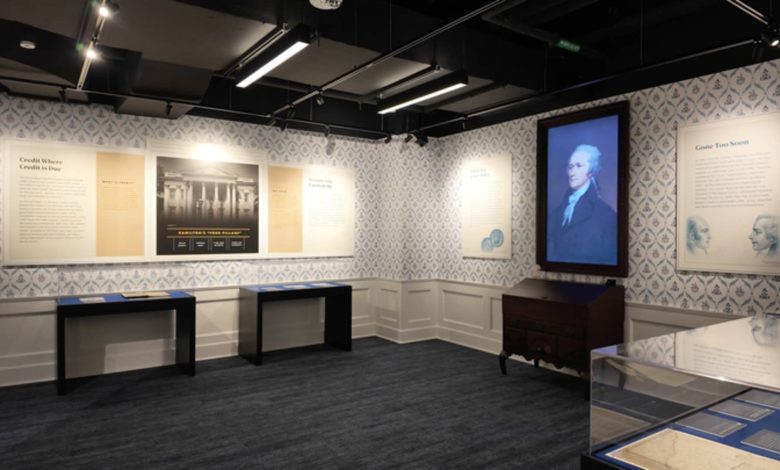
After signing a new lease only 16 months ago, the museum was able to debut seven inaugural exhibits. One, developed in partnership with the Fidelity Center for Applied Technology, uses artificial intelligence to create an interactive Alexander Hamilton.
“We’re bringing him back to life,” Erich Umar, head of technology strategy & planning at FCAT, said during a press conference at the museum earlier this week ahead of its opening. “History doesn’t just live in the past; it interacts with the future.”
Visitors are able to talk with the first U.S. secretary of the treasury in more than 50 languages and even pose unique questions to him, such as asking him to elaborate on compound interest using a soccer analogy.
The “Alexander Hamilton Experience” exhibit includes a multilingual AI-generated Alexander Hamilton.
Sean Conlon | CNBC
“Advances in technology are providing opportunities that we could only have imagined just a few short years ago,” Umar told CNBC. “It’s enabling us to scale financial education and reach more Americans where they are, regardless of geography, language or their preferred modality of learning.”
Starting off in ‘familiar’ territory
As visitors enter the museum, the first topic they will explore will seem commonplace: money.
The interactive exhibit, “America in Circulation,” displays several examples of the nation’s currencies from oldest to modern day, showcasing how they have evolved over centuries.
“We wanted the currency gallery to be the first exhibit visitors explore because everyone is familiar with money,” said Kristin Aguilera, the museum’s deputy director. “So, we start with a topic that is very accessible to everyone.”
“America in Circulation” is an interactive currency exhibit, featuring examples of American paper money.
Sean Conlon | CNBC
The earliest currencies on display are pine tree shillings from 1652, while the earliest paper currency in the exhibit dates back to the 18th century. Even with such a wide range on view, visitors can use touchscreens to dive deeper. With a few taps, they can zoom in to view the intricate details and symbolism of a specific example.
“A lot of this paper money was due to major events in our history like the Revolutionary War,” said Rahul Arora, a financial historian and guest curator of the exhibit. “Some of these notes wouldn’t exist.”
Arora said he hopes the exhibit will lead others to truly appreciate currency, especially from an artistic perspective. That possible outcome couldn’t come at a better time, since the federal government has already halted the manufacturing of new pennies, and Arora anticipates it’s only a matter of time before the dollar itself gets phased out.
“Nowadays you’re shopping online, all you see is amounts,” he said. “You go on Amazon, you buy something, and you just see the amount. You don’t think about the money transactions happening.”
From awareness to action
To bring financial education to the masses, admission is free, ensuring that anyone who wants to learn about finance can.
This comes at a time when existential fiscal anxiety has been plaguing Americans. According to a Pew Research poll, 64% of Americans said in April that the federal deficit is a “very big problem” for the U.S. That’s up from 57% in February 2025.
Currently, the national deficit for the fiscal year-to-date tops $1.2 trillion. The national debt has exceeded $39 trillion.
“We’re getting away from the principles that Hamilton put in place,” said Richard Sylla, professor emeritus of economics at the NYU Stern School of Business and former chairman of the museum. Still a member of the museum’s board of trustees, Sylla curated three of the exhibits, one of which documents the U.S. financial system’s founding.
“A Financial Revolution” traces the founding of the U.S. financial system.
Sean Conlon | CNBC
“There’s a lot of negative things about the state of the country now,” he said in an interview. “I think this is a nice positive reminder that as bad as you might think things are now, there’s actually a glorious history in how we got to be the richest country in the world.”
Even with concerns about the fiscal path the U.S. has been on, Sylla is optimistic that such problems will be addressed in the next few years.
“When Hamilton came into office, we were in a bigger mess than we are now because we were actually defaulting on our debts. Now we’re just running up the debts and heading toward default possibly, but we were actually in default, both to domestic and international creditors,” he said.
“The Future of Finance” explores blockchain, crypto, tokenization and the evolution of financial technology.
Sean Conlon | CNBC
“The museum is full of things that were left out of the musical [‘Hamilton’],” Sylla later said.
As visitors near the end of their journey through the museum, they enter “Personal Finance,” the final exhibit. This section hopes to tie together the themes of the previous galleries, leaving visitors with a better understanding of the U.S. financial system and how to develop the tools to better one’s financial well-being.
Bob Pisani, former CNBC senior markets correspondent, said the museum is not just about financial history but also financial literacy.
“Alexander Hamilton helped invent the first bank of the United States that helped stabilize the finances of the United States and set the country on a course of innovation,” said Pisani, who is a member of the museum’s board of trustees. “Financial literacy is about understanding that kind of history, but it’s also about understanding your own personal finances. It’s about setting a budget.”
He pointed out that an individual setting a personal budget is, in essence, “very similar” to the government setting its own budget.
“Personal budget and a federal budget are not that far apart,” he said. “Financial literacy teaches people to understand how to invest. It teaches people how to save money wisely. It teaches people about the value of compounding interest and how you can have your money work for you.”