Newsom and Trump agree on one way to address AI’s impact
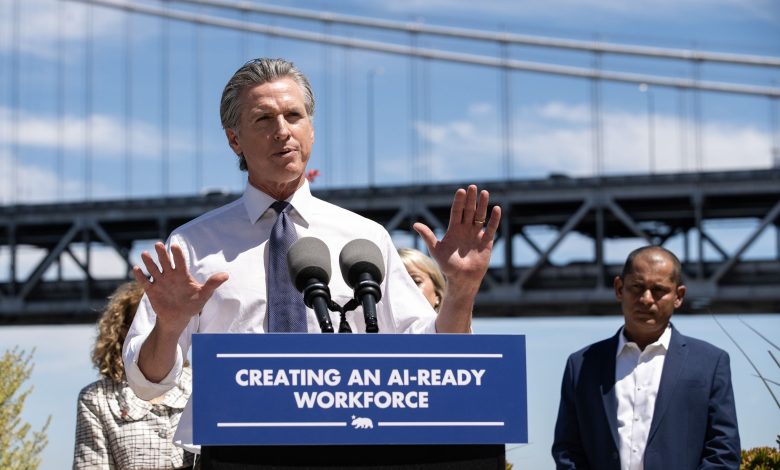

California Gov. Gavin Newsom holds a press conference at the Google office in San Francisco on Aug. 7, 2025 to announce new AI partnerships.
President Donald Trump and Gov. Gavin Newsom are in broad agreement on at least one thing: how to help Americans survive being financially crushed by the AI revolution.
They want Americans to own a piece of the action.
But for now, it’s all talk. Neither has expressed a clear plan for how to make that happen, a sign of how woefully unprepared the nation is to deal with an incoming financial tsunami, even in the AI capital of the world.
Article continues below this ad
“Lawmakers don’t act until the bear is in their face,” Teri Ollie, vice president of states strategy at Economic Security Project, a think tank that has studied direct payments to low-income Americans as part of a social safety net. “There’s a real fear of killing the goose that laid the golden egg. It’s dangerous to an elected official. They feel that the economy is like a bubble. If you touch it, it will burst.”
The bear is rapidly approaching, especially in San Francisco, the epicenter of the AI takeover. The AI gold rush has already started to reshape the city as AI employees spend their riches. From January through June, more than 140 San Francisco homes sold at least $1 million above their asking price, compared with just eight homes in the first six months of 2025. San Francisco’s rental market has the lowest vacancy rate, just 2.2%, of any major U.S. city.
Until recently, many politicians and entrepreneurs had pitched a “universal basic income” — a concept in which Americans receive a no-strings-attached stipend, say $500 a month — as a way to insulate people from poverty. Now the thinking has shifted, and voices as diverse as Newsom, Trump, Sen. Bernie Sanders, Vivek Ramaswamy and even OpenAI’s Sam Altman are uniting around the idea of “universal basic capital” — a concept that would give Americans an equity share of the revenue being generated by AI companies. But their plans are largely unformed.

First lady Melania Trump walks alongside Figure 03, a humanoid robot developed by Sunnyvale-based Figure AI, during the Fostering the Future Together global summit at the White House on March 25, 2026.
And while UBI was simple to understand and proven effective though numerous pilot programs, UBC is comparatively untested and complicated. There are over 100 major sovereign wealth funds in 67 countries and six U.S. states, but the challenge will be in crafting a policy that is as easy to explain and effective as universal basic income. If a 2028 presidential contender is able to create a plan — and explain it simply and coherently — it could become a key difference-maker.
Article continues below this ad
“The 2028 campaign will be the the first-ever ‘AI election,’” wrote Nathan Gardels, co-founder and senior adviser to the Berggruen Institute, a think tank that has long had the ear of top California leaders of both parties. “It will be defined by how candidates propose to cope with the upheaval wrought by the widespread integration of artificial intelligence into society.”
The early days of the presidential race will occur in the wake of two San Francisco AI companies, OpenAI and Anthropic, making two of the biggest stock market debuts ever — potentially topping $1 trillion each. OpenAI is now considering offering its IPO in early 2027, just as the candidates enter the field.
Each candidate will have to answer the question posed to me by former Stockton Mayor Michael Tubbs, an early proponent of universal basic income: Who will benefit from all of that newly generated AI wealth? Tubbs implemented a universal basic income pilot program in Stockton. That led to similar pilots around the country, which garnered largely glowing reviews as studies showed recipients used the money responsibly to survive.
But even Tubbs conceded that the upcoming AI economic upheaval requires something more. Now, Tubbs told me, offering Americans a universal basic income “in this moment is the beginning. It’s not the end. It has to be married to this idea of ownership. Like how do you make sure that all of us have some ownership in the wealth that’s going to be generated, so it’s not just a couple people seeing their standard of living raised, but all of our standard living raises?”
Tubbs is not alone in his belief that a stipend is not enough to blunt the impact of the AI revolution. There has been a shift among elected leaders, many of whom now prefer a pre-distribution model (giving Americans an equity share of AI wealth before tech companies can swallow it) versus a redistribution model like universal basic income, where Americans must wait until tech companies make their money, then receive a sliver of that as a stipend.
Article continues below this ad
The challenge is that the details being proposed about universal basic capital remain scant, at least in the case of Newsom and Trump. There are no bills in the Legislature addressing the issue. Sanders has the lone bill in Congress.
But that hasn’t stopped Newsom from talking about it, perhaps foreshadowing an issue he wants to own in 2028. He is fond of noting that the industry’s mecca is rooted in his home state (33 of the top 50 private AI companies are in California).
In May, Newsom said at the liberal Center for American Progress’ IDEAS conference that “You don’t need charity, we need ownership. It’s a universal basic capital, by the way. … Got to have an ownership state. You cannot save democracy unless we democratize the economy. Period.”
He signed an executive order in May that directed California to study giving California equity shares in AI companies. But a study is far from putting money in the pockets of vulnerable Californians. The order demanded that state agencies present a roadmap by August for how to move forward on the concept.
Newsom has continued to mention the idea, without fully fleshing it out. He name-checked it in June while proposing a new federal tax on people making more than $100 million. In July, Newsom told reporters that “We’re looking at this notion of equity … and (how to) broaden access particularly as it relates to the abundance that we anticipate will take shape in the AI space.” Newsom noted that “a lot of people are now talking about this” including “far-left Bernie Sanders is now talking about this and even Donald Trump has talked about this. And I think it’s a very healthy conversation, a very healthy debate.”
Article continues below this ad
Yet with the exception of Sanders, universal basic capital has largely been just a conversation.

Sen. Bernie Sanders and Rep. Ro Khanna headline an event at Stanford titled “Who Controls the Future of AI: The Oligarchs or the People” on Feb. 20, 2026.
Sanders’ legislation is based on research by UC Davis School of Law professor Sarah Polcz and George Washington University law professor Jeremy Bearer-Friend. It proposes giving Americans a piece of the AI action through a sovereign wealth fund. It would be funded through a one-time 50% tax on the companies’ stock. Supporters compare it to a similar fund in Alaska, which has given the state’s residents an annual dividend check averaging around $1,600 for the last four decades.
Polcz said the idea of giving Americans an equity share of booming tech companies upfront is better than waiting to claw it back from them in the form of taxes.
“We’ve seen just how effectively and how cleverly tech companies are able to really minimize their corporate tax liability,” she said.
Article continues below this ad
The fund would be overseen by an independent commission of seven members. One challenge with Sanders’ plan, however: If the government is a partner in an AI company, would it be tempted to set aside regulations to make it easier for the company to make money for its shareholders, the American people? And if the AI bubble bursts, would the government be on the hook for bailing out the company?
Polcz said no to both, pointing out that the legislation forbids bailouts.
So far, the idea hasn’t caught on in Washington. Sanders’ bill has zero co-sponsors. But as was the case in the 2020 presidential election — whether it was single-payer health care or green technology subsidies — when Sanders gets behind an issue, he can pull the rest of the Democratic field to the left. As president, Joe Biden incorporated some of Sanders’ ideas into his environmental legislation.
Trump’s efforts have been more vague. In May, he suggested Americans should become “a partner” in AI companies in response to reports that the government could take a stake in OpenAI. That echoed what OpenAI proposed in its “Industrial Policy for the Intelligence Age: Ideas to Keep People First,” an outline for how to address the potential impacts of its technology. The document urged the creation of a “Public Wealth Fund that provides every citizen—including those not invested in financial markets—with a stake in AI-driven economic growth.”
But there were few specifics.
“There are concepts where pieces could be given to the American public, where the American public essentially becomes a partner,” Trump said when asked about OpenAI’s ideas.
Both Trump and the company punted on how to seed the fund. The policy memo says only that “policymakers and AI companies should work together to determine how to best seed the Fund, which could invest in diversified, long-term assets that capture growth in both AI companies and the broader set of firms adopting and deploying AI.”
Trump isn’t averse to the idea of a wealth fund. Earlier this year, the federal government launched Trump Accounts, in which children born between 2025 and 2028 can receive a one-time $1,000 deposit from the Treasury Department to seed an investment account. The idea is to help children — particularly ones whose families are not invested in the stock market — share in the market’s bounty and create a nest egg that could be used for higher education, buying a home or other approved uses without a penalty.
California offers a similar program, the Hope Program, where the state offers a one-time $3,000 publicly funded investment deposit in an account for eligible low-income foster youth and children who lost a primary caregiver to COVID.
Newsom told reporters recently that these types of funds are “an area of broadstroke agreement with the president, and I’m encouraged by the fact that he’s having those conversations.”
Newsom cautioned, however, that he is keeping “one eye open because (Trump) tends to have those conversations and he’s looking to somehow pad his own nest, and there’s usually something corrupt that happens in those conversations that we have to be cautious about.”
For now, though, they remain just conversations while the economic tsunami — and the presidential campaign — approach.
Credit: Source link