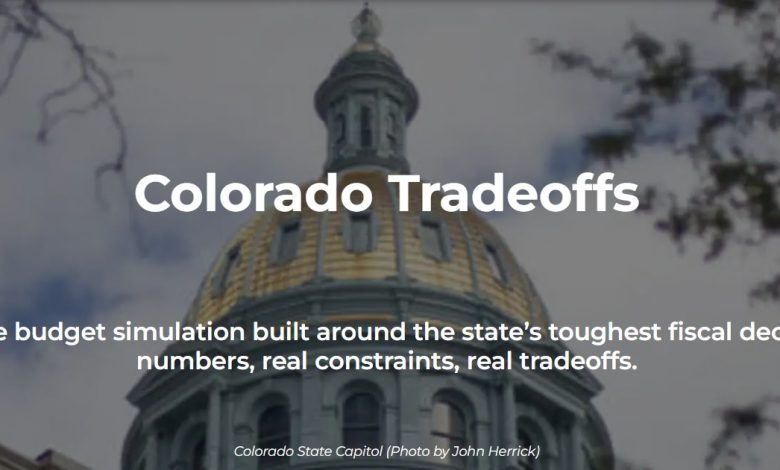
Colorado Tradeoffs allows you to decide state ballot issues
Colorado Tradeoffs widget lets you be ‘Dave’ for a day
Remember the 1993 comedy “Dave,” when a sweet-natured look-alike secretly fills in for an unpopular president who has fallen into a coma? My favorite scene is when Dave sneaks his regular-guy accountant, Murray Blum, into the White House and they stay up late cutting the federal budget line by line. Murray finds millions of dollars in waste, such as an ad campaign to make people feel good about cars they have already bought and the temporary “president” pushes the commonsense cuts through Congress.
Recommended Stories
The whole premise of the movie is this: What if an average, nonpolitical Joe, kindhearted and well-meaning, accidentally became president? Might not the whole country be better off?
So here’s an idea: What if you became Dave for a day right here in Colorado? What if you temporarily had the power to decide what our state spends its money on or doesn’t spend on? What would you prioritize? Can you do better than our politicians?
A new interactive widget, Colorado Tradeoffs, is going live on our Colorado Politics website this weekend and on several other media sites around the state that lets you play political god. It allows you to see how this fall’s major ballot measures could affect the state budget and lets you decide how you would handle the tradeoffs.
It only takes about 10 minutes to do, works on your phone or desktop and is available in English and Spanish. The University of Colorado School of Public Affairs, Weigh In and COLab have partnered to offer this to Colorado newsrooms.
“It’s a simple, interactive way for people to explore how the graduated income tax and TABOR ballot measures could affect Colorado’s budget — and the tradeoffs that follow,” said Laura Frank, executive director of COLab. “It’s actually really simple — and surprisingly fun.”
A dashboard will show how people voted, what spending they valued most and how they compared with the rest of the state. You also can read participants’ comments about their choices to compare them to your own thoughts.
Participants can then join one of two statewide online deliberations on the tradeoffs Oct. 10 and 13.
Tradeoffs is part of a larger election tool kit Colorado media companies are experimenting with to give readers an interactive way to find out more about the upcoming midterms. A “Your Share” tool lets you see how the state tax dollars you pay are divided among education, transportation, healthcare and other priorities. And a Build Your Own Ballot tool gives you a personalized online ballot when you plug in your address.
Why might these tools be better than reading party platforms, candidate bios or sifting through 60-page election guides yourself?
Well, for one thing, ChatGPT and other AI chatbots have changed the way we access information and now most people are very comfortable interacting with data in a give-and-take kind of way, asking smart questions of it. These tools reflect that shift in how we learn things.
And these tools are valuable because most voters want to know how an election or a political decision affects their own lives. A tool that tells you how a ballot measure is going to change your personal property tax or what a ballot initiative would do to your district’s school funding turns an abstract civics exercise into something personally relevant.
An interactive budget simulator can give you a real understanding of the tradeoffs at stake in a state with a very tight budget this year. Having to choose between cutting road maintenance or raising taxes forces you to feel the cost of tradeoffs the legislature will face next year. And our reporting on these results will give those legislators detailed, ground-level knowledge about what their constituents think the budget priorities should be.
Your ballot is going to be huge this fall. Fourteen initiatives have been approved to appear on the ballot, and we’re voting for governor, treasurer, secretary of state, attorney general, all eight U.S. House of Representatives seats and one U.S. senator as well, not to mention local issues. These tools give you the exact information and background you need for votes that will appear on your ballot.
I’m also thrilled about the deliberation sessions coming up that will give our readers the chance to be active, participating citizens for a day, to really feel what it’s like to be “We the People,” the ultimate deciders in a democracy. Our politics has become so much like Kabuki theater in recent years, growing more and more performative rather than truly deliberative, that we’re more like an audience for democracy than a real part of it. When did democracy become something we watched rather than did?
These tools and deliberations give you a chance to do a little do-it-yourself democracy again.
There’s a smart guy, James Fishkin, who believes such citizen involvement and true deliberation by us, the people, are the key to saving our democracy.

Deliberation requires time, trust, shared facts and incentives for compromise. Modern political systems increasingly reward speed, certainty and ideological loyalty instead, says Fishkin, head of Stanford’s Deliberative Democracy Lab.
As a result, recent polls show that on key issues (economy, healthcare, immigration, budget priorities), large shares of Americans feel that Washington’s actions don’t reflect their priorities.
“When people deliberate,” Fishkin has said, “they weigh the merits of competing arguments for and against some proposal for action.” Deliberative experiments like Tradeoffs “can depolarize our most extreme partisan divisions, they can create more deliberative voters (who vote their sincere policy views, even after a considerable passage of time) and they can strengthen norms central to the guardrails of democracy, especially the norms that protect the conduct of elections,” Fishkin writes.
In one deliberative experiment Fishkin conducted called “America in One Room,” polarization dropped 13-14 percentage points among participants who talked out issues face to face with each other.
So become a Dave for a day and give Tradeoffs a try. And better yet, join up with your other fellow citizens to engage in some true online deliberation afterward. I think you’ll find it invigorating, and you just might be doing your part to make sure, in Lincoln’s famous words, “government of the people, by the people, for the people, shall not perish from the Earth.”
Credit: Source link