Seagate (STX) Stock Looks Below Fair Value While Earnings Look Fair
Seagate Technology Holdings has delivered a very large 3 year gain while the valuation checks are more cautious, with the Discounted Cash Flow (DCF) intrinsic value estimate suggesting the stock trades at a discount and the broader score pointing to limited support for a clear bargain.
- Over the last 3 years, Seagate shares have returned about 12x, which puts extra focus on whether the current price is still justified by future cash flows.
- Expectations tied to AI driven demand for high capacity storage can support higher revenue and cash flow, but sector wide sell offs and concerns about the cost of AI infrastructure remain a risk to sentiment and valuation.
- Seagate screens as undervalued on the Discounted Cash Flow (DCF) intrinsic value estimate by 27.3%, yet the stock only passes 2 of 6 valuation checks on Simply Wall St’s broader framework. This leans more towards the shares not being an obvious bargain overall, as shown by the 2 out of 6 value score.
The issue now is whether Seagate’s current share price already reflects these strong expectations, or if the discount implied by the intrinsic value estimate leaves room for further upside.
Is Seagate Technology Holdings Still Cheap on Cash Flow?
The Discounted Cash Flow (DCF) model estimates what Seagate Technology Holdings is worth based on the cash it is expected to generate for shareholders. On this model, Seagate’s latest twelve month free cash flow is about $3.2b, and analysts are assuming that cash flows grow from here rather than shrink. That cash flow profile, run through a 2 Stage Free Cash Flow to Equity model, produces an estimated intrinsic value of about $1,178 per share.
Compared with the current share price, this implies the stock is 27.3% undervalued. This suggests the market is applying a clear discount to those projected cash flows. Seagate’s recent report of record free cash flow and strong AI driven storage demand helps explain why the intrinsic value appears well ahead of the share price.
Overall, the Discounted Cash Flow view indicates Seagate Technology Holdings stock appears undervalued relative to its projected cash generation.
Our Discounted Cash Flow (DCF) analysis suggests Seagate Technology Holdings is undervalued by 27.3%. Track this in your watchlist or portfolio, or discover 55 more high quality undervalued stocks.
Is Seagate Technology Holdings Fairly Priced on Earnings?
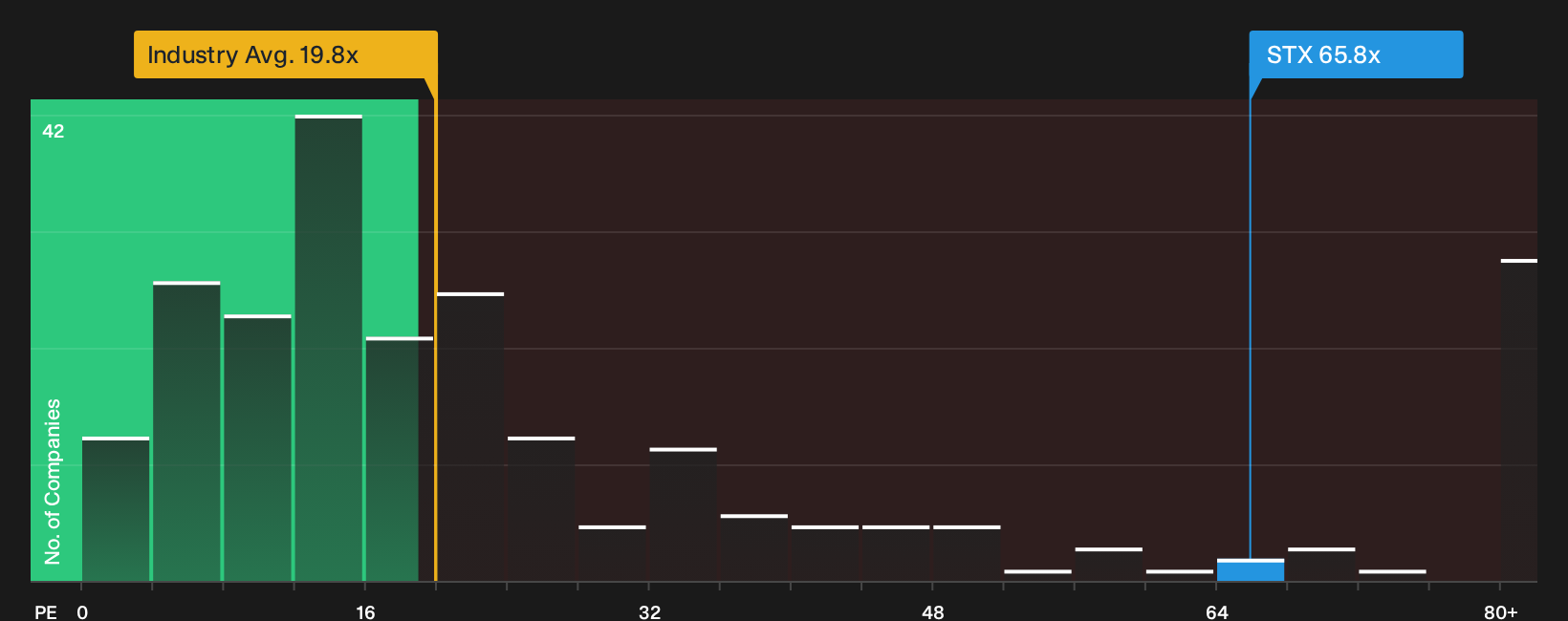
The P/E ratio is a helpful way to think about what you are paying today for each dollar of Seagate Technology Holdings earnings. It ties directly to the company’s profitability, which many investors watch closely for hardware and semiconductor related stocks.
Seagate currently trades on about 61.0x earnings. That is well above the broader tech sector average P/E of roughly 21.9x and also higher than the peer group average of about 36.2x. Based on Simply Wall St’s fair P/E estimate of 58.0x, which factors in Seagate’s specific growth profile, margins, size and risk, the stock sits only slightly above where this framework would expect it to trade.
This leaves Seagate looking neither especially cheap nor excessively expensive on earnings alone, particularly when set against its own tailored fair multiple rather than just the sector average.
On the P/E multiple, Seagate Technology Holdings stock comes across as priced roughly in line with what this model suggests is fair.
See what the numbers say about this price — find out in our valuation breakdown.
The Seagate Technology Holdings Narrative: What Would Justify Today’s Price?
Simply Wall St Narratives for Seagate Technology Holdings sit between the valuation models above and the real world expectations behind them. They spell out what would need to happen to Seagate Technology Holdings’ growth, margins and earnings for the stock to be worth materially more or less than today’s price, and they live on the Community page. Each one links its number to a clear view of how growth, profitability and risks might develop, which you can revisit as new information comes through.
Community views on Seagate Technology Holdings sit far apart, with one camp focused on AI storage upside and the other on HDD disruption risk.
Bull case: 11% undervalued
“Ongoing agreements with large cloud and hyperscale customers indicate strong nearline exabyte demand, providing revenue visibility into calendar year 2026…”
Read the full Bull Case to see why Seagate Technology Holdings could be undervalued
Bear case: 26% overvalued
“The accelerating shift of cloud service providers and hyperscalers toward SSDs and other energy-efficient storage solutions will structurally undermine Seagate’s long-term addressable markets…”
Read the full Bear Case to see why Seagate Technology Holdings could be overvalued
Do you think there’s more to the story for Seagate Technology Holdings? Head over to our Community to see what others are saying!
The Bottom Line
For Seagate Technology Holdings, the Discounted Cash Flow (DCF) intrinsic value points to clear undervaluation, while the earnings multiple suggests the stock is priced about right given current expectations. That split reflects how cash flow models lean on projected free cash generation, while market multiples lean more on sentiment and how peers are currently valued. The low broader value score signals that investors should not rely on the DCF signal alone. The key question from here is whether AI driven storage demand offsets concerns about long term HDD disruption, so that current cash flow expectations prove sustainable rather than a value trap.
This article by Simply Wall St is general in nature. We provide commentary based on historical data
and analyst forecasts only using an unbiased methodology and our articles are not intended to be financial advice. It does not constitute a recommendation to buy or sell any stock, and does not take account of your objectives, or your
financial situation. We aim to bring you long-term focused analysis driven by fundamental data.
Note that our analysis may not factor in the latest price-sensitive company announcements or qualitative material.
Simply Wall St has no position in any stocks mentioned.
New: Manage All Your Stock Portfolios in One Place
We’ve created the ultimate portfolio companion for stock investors, and it’s free.
• Connect an unlimited number of Portfolios and see your total in one currency
• Be alerted to new Warning Signs or Risks via email or mobile
• Track the Fair Value of your stocks
Have feedback on this article? Concerned about the content? Get in touch with us directly. Alternatively, email editorial-team@simplywallst.com