100-Billion-Yuan IPO Officially Debuts in Shenzhen Today
Today (August 4), Shenzhen JLC Technology Group Co., Ltd. (referred to as JLC) officially listed on the main board of Shenzhen Stock Exchange. In this IPO, JLC’s issue price is 84.46 yuan per share, its opening price surged by more than 170%, and its market value exceeded 100 billion yuan.
Founded in Shenzhen in 2006, JLC is led by three core controllers — the brothers Ding Hui and Ding Huixiang, and Yuan Jiangtao. All three graduated from junior colleges. Starting from a one-meter counter in Huaqiangbei, they have built a PCB intelligent manufacturing industrial internet platform with an annual revenue of over 10 billion yuan, which has also attracted well-known institutions such as HSG, Zhongding Capital, SDIC Capital to enter the market one after another.
Looking ahead, from Dapuwei to HKC, CR New Energy, and now JLC, Shenzhen has seen an endless stream of IPOs with a market value of 100 billion yuan.
Moving south to Shenzhen, creating a 100-billion-yuan IPO
The story starts with the three core figures.
Ding Hui was born in Xuzhou, Jiangsu Province in 1979, and his younger brother Ding Huixiang is 3 years younger than him. In 1996, 17-year-old Ding Hui, with the idea of “seeking opportunities in the special economic zone”, left his hometown and went south to Shenzhen to start his career. In the following five or six years, he started as an apprentice in an electronics factory, worked his way through workshops, logistics, and technology development, and finally became a supervisor.
In 2002, he rented a house of more than 20 square meters in a urban village on the outskirts of Shenzhen and started his business, focusing on electronic product sales. “At that time, I had no money and no goods, so I had to run business while contacting suppliers, busy on both sides. To survive, we took orders from customers that could only earn a few hundred yuan most of the time.” Ding Hui recalled later.
After several years, the business gradually got on track. He officially registered a trading company, CITIC Hua, which focused on the trade, production and R&D of electronic products including PCB (Printed Circuit Board), and his younger brother Ding Huixiang also joined in.
Almost at the same time, on the other side of Shenzhen, an ambitious young man also embarked on the entrepreneurial journey. In 2006, Yuan Jiangtao, who was the same age as Ding Hui, quit his job as an electronic design engineer at an industrial drone company, and targeted a neglected market — the demand for prototypes from engineers, which gave birth to JLC, focusing on the manufacturing of PCB prototypes and small-batch boards.
In 2012, to solve the problems of difficult procurement of electronic components and high procurement costs, Yuan Jiangtao launched LCSC, a trading website for off-the-shelf electronic components. Customers from upstream and downstream of the electronics industry can complete the whole process of component selection, BOM matching and payment on LCSC.
The two entrepreneurial lines began to intersect in 2012. Since that year, the Ding brothers have increased their capital and shares in JLC several times, and gradually become important shareholders. Until 2021, the three decided to merge — JLC acquired Jiangsu CITIC Hua, Jiangxi CITIC Hua and CITIC Hua Industrial Park controlled by Ding Hui and Ding Huixiang, as well as Lichuang Electronics jointly controlled by the three.
A super PCB platform was born. JLC has completed full-process coverage from prototypes and small-batch boards to medium and large-batch boards, and further expanded to the mechanical industry sectors such as 3D printing, CNC machining, and FA mechanical parts mall.
The three have gone through more than ten years of ups and downs together, and now they are standing on the IPO bell-ringing stage. According to the prospectus, Ding Hui serves as the chairman of JLC, with a total shareholding of 26.25%; Yuan Jiangtao is the director and general manager of the company, holding 35% of the shares; Ding Huixiang is the director and deputy general manager, holding 26.25% of the shares. The three are all the actual controllers of the company.
HSG and Zhongding Capital appear, CATL also joins in
Many people don’t know that the track that JLC is deeply engaged in was once regarded as a “niche and tough business”.
Traditional factories have limited service capacity for long-tail demands, with high cost, long delivery time and uneven quality. JLC fills this gap, focuses on sample and small-batch demands, serves engineers and small and medium-sized enterprises in a standardized way, and provides integrated services covering the whole industrial chain of EDA/CAM industrial software, printed circuit board manufacturing, electronic component procurement and sales, and electronic assembly.
After more than ten years of development, JLC has built five modern digital production bases and two intelligent warehousing bases in Zhuhai, Huizhou, Shaoguan, Ji’an, Huai’an and other places, processing more than 21 million orders annually. As of the end of 2025, the registered users of the company’s online self-service ordering website exceeded 9.5 million, and the annual paying users exceeded 1.3 million.
In terms of revenue, according to the prospectus, from 2023 to 2025, the company’s operating revenue was 6.726 billion yuan, 7.969 billion yuan and 10.232 billion yuan respectively, and the non-recurring profit and loss attributable to the parent company’s net profit was 658 million yuan, 925 million yuan and 1.229 billion yuan respectively.
Despite the overall business growth, the prospectus also warns of risks: the business model may be imitated, price fluctuations in the electronic component industry, the market size growth rate is lower than expected, etc.
The VC/PE institutions also participated in JLC’s entrepreneurial story.
According to the prospectus, JLC introduced HSG and Zhongding Capital in 2021, which was the first time the company embraced external capital since its establishment for more than ten years.
Among them, Zhongding Capital began to sort out the infrastructure investment map under the wave of intelligent manufacturing as early as 2019, and found that the “electronic R&D infrastructure” sector was missing. JLC soon came into the vision of the investment team. At that time, it already had a considerable scale but was extremely low-key. During the group’s integration and restructuring in 2021, Zhongding Capital made a firm investment.
“Many years later, we still remember that feeling: it is not the excitement of ‘finding and investing in a project’, but the shock of ‘someone is really doing this’.” Zhongding Capital reviewed this investment.
In the same year, JLC carried out multiple rounds of capital increase, HSG and Zhongding Capital continued to increase their holdings. In August 2022, JLC ushered in a heavyweight financing — led by SDIC Capital, followed by Zhongding Capital and Xiamen C&D Emerging Investment, with a total financing amount of 900 million yuan. So far, Zhongding Capital has become the only investment institution that has fully participated and firmly increased its stake in all previous financing rounds of JLC.
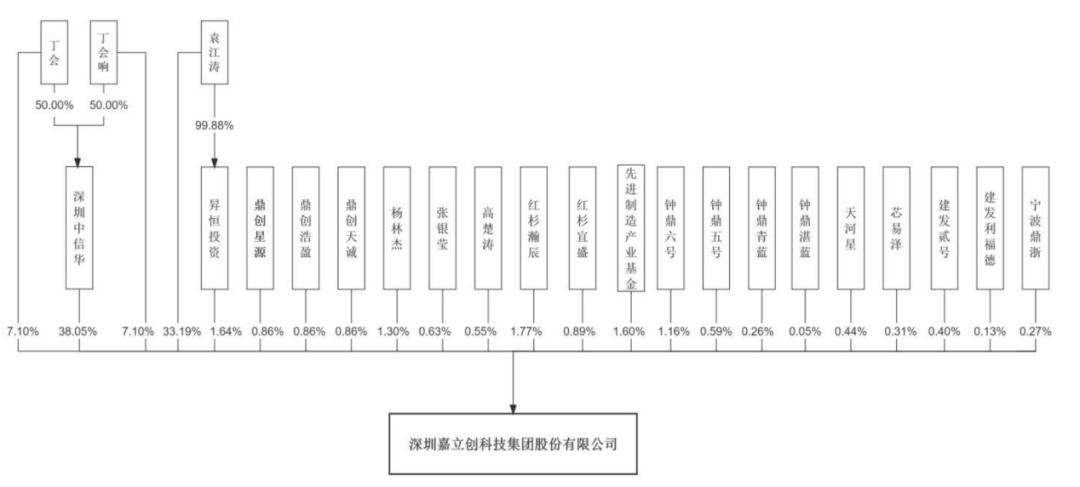
According to the prospectus, HSG holds a total of about 2.66% of the shares, Zhongding Capital holds about 2.33% of the shares, SDIC Capital holds 1.6% of the shares, and the C&D system controlled by Xiamen State-owned Assets holds a total of about 0.53% of the shares.
It is worth mentioning that this IPO has also introduced another group of special industrial investors — CATL, Kingboard, C&D No.2, Qianhai Hongsheng, Sungrow New Energy, KTC, Xiamen Industrial Investment and others, with a total subscription of no more than 420 million yuan. Among them, CATL plans to subscribe up to 60 million yuan, which is of signal significance.
Shenzhen is producing a large number of 100-billion-yuan IPOs, waiting for trillion-yuan companies
This year, the outbreak of Shenzhen’s IPOs is impressive.
The venture capital circle still remembers that in April this year, Dapuwei, which originated in Shenzhen, became the first unprofitable IPO on the ChiNext of Shenzhen Stock Exchange. In 2016, Yang Yafei, an alumnus of Beijing University of Posts and Telecommunications, went south to Shenzhen and founded Dapuwei to fill the gap in the field of high-end enterprise-level storage main control chips. After listing, Dapuwei set off a boom — one month after listing, its stock price soared more than 10 times, and its market value once exceeded 300 billion yuan.
“Shenzhen is the ‘Silicon Valley of China’ for the hardware industry, with a complete upstream and downstream industrial chain.” Yang Yafei once explained his choice, and his words “Without Shenzhen’s science and innovation funds, there would be no Dapuwei today” also illustrate the mutual achievement between local Shenzhen venture capital institutions and entrepreneurs.
In the same track, Shenzhen also has Longsys, Biway Storage, Demingli, and Shannon Electronics — the market value of the four companies almost reached the 100-billion-yuan level. Together with Dapuwei, they are called Shenzhen’s “Five Storage Giants”.
Then in June, Shenzhen-based HKC listed on the main board of Shenzhen Stock Exchange, with its opening price surging by 400%, and its market value once exceeded 500 billion yuan. In July, CR New Energy listed on Shenzhen Stock Exchange, with the maximum market value reaching 300 billion yuan. In just a few months, Shenzhen has produced multiple IPOs with a market value of 100 billion yuan.
According to the data released by “Shenzhen Release” in mid-June, since the beginning of this year, Shenzhen has added 17 new listed companies at home and abroad, ranking first in China in terms of new additions, with a total IPO fundraising of more than 30.9 billion yuan, ranking second in China. As of that time, the total number of listed enterprises in Shenzhen exceeded 611, with a total market value of nearly 20 trillion yuan, and 24 domestic enterprises with a market value of 100 billion yuan.
This means that Shenzhen, with less than 0.2% of the country’s land, contributes more than 10% of the number of listed companies.
However, pressure still exists. Last week, Changxin Technology officially listed on the STAR Market, with a market value of over 1 trillion yuan on the first day, ranking as the new king of A-shares: not only Hefei State-owned Assets has a floating profit of more than 1 trillion yuan, but also rewritten the A-share listed company market value ranking in the Yangtze River Delta and even the whole country — Hefei’s market value ranking in the Yangtze River Delta has surpassed Suzhou, Hangzhou and Wuxi, second only to Shanghai.
Trillion-yuan companies have become a new competition among Chinese cities. In addition to Hefei and Changxin, Suzhou and Chuangyuan Optoelectronics are also impressive — in April this year, the total market value of Chuangyuan Optoelectronics exceeded 1 trillion yuan for the first time, creating a history in A-shares. A seed that was born in Suzhou in the past has now grown into a trillion-yuan market value company. There are also Zhipu AI and Cambricon, which once brought two trillion-yuan companies to Beijing; DeepSeek is also expected to set a new historical record for Hangzhou.
Seeing this, there is a trace of anxiety inside Shenzhen this year: where is the trillion-yuan company belonging to Shenzhen? This question is also placed in front of many cities.
One enterprise can change an industry, and one industry can change a city. The competition between cities is, in the final analysis, the competition of enterprises. With the changes of industries, the pattern of Chinese cities is quietly undergoing qualitative changes — some cities are beginning to usher in the historical opportunity to change their fate against the odds.
This article is from the WeChat official account “Investment” (ID: pedaily2012), written by Zhou Jiali, published with authorization from 36Kr.