US Stocks vs. Tokenized Stocks vs. Stock Futures: Which of the Three Stock Investment Approaches Suits You Best?

In August 2026, the MEXC 0808 Annual Brand Celebration officially kicked off! As a core initiative of the inaugural “US Stock Season,” all three product categories—Stock Futures, Tokenized Stocks, and RealStocks—are available with zero trading fees throughout the event period.
This time window makes understanding the fundamental differences between the three product types especially relevant—each product form corresponds to distinct risk-return profiles and investment logic. While all three offer exposure to the US stock market, they differ fundamentally in asset attributes, ownership rights, trading mechanisms, and suitable use cases.
This article systematically breaks down the differences across four dimensions—product definition, core features, rights structure, and suitable scenarios—to help investors make informed choices aligned with their investment goals.
RealStocks is a US stock spot trading product offered by MEXC in partnership with regulated securities brokers. The product is supported by Atomic Vaults Securities, a broker regulated by FINRA, providing access to real US stocks through regulated securities infrastructure. Users can directly trade real stocks of US-listed companies using USDT, hold the underlying stock assets, and enjoy shareholder rights such as dividend distributions where applicable.
Core Features:
- Real Equity Ownership: Users purchase actual shares registered in US-listed companies, not derivatives or tokens. RealStocks is not a tokenized stock, synthetic asset, or contract for difference—it enables users to hold genuine US stocks through partnered licensed brokers.
- Shareholder Rights: As holders of real stocks, users enjoy full shareholder rights, including cash dividend distributions where applicable.
- Trading Sessions: Covers four sessions—overnight, pre-market, regular trading, and after-hours (UTC): 00:00–07:50 overnight; 08:00–13:30 pre-market; 13:30–20:00 regular trading; 20:00–00:00 after-hours.
- Deposit Method: Users can deposit directly with USDT, which is converted into US dollar purchasing power without exchange loss.
- Coverage: Supports over 7,000 US stocks and ETFs.
- Account Opening: Users do not need to open a separate account with an external broker; the stock account can be activated directly within MEXC.
The essence of RealStocks is combining the legal certainty of traditional equity ownership with the trading experience of a crypto platform. What users hold is not just price exposure, but actual company shares. As of the first month of launch, over 120,000 users have opened RealStocks accounts.
Tokenized Stocks are blockchain-based representations of traditional company equity—licensed brokers hold the physical shares and issue 1:1 pegged digital tokens on-chain. MEXC has listed over a hundred Ondo tokenized stock trading pairs, covering sectors including AI, semiconductors, energy, and more.
Core Features:
- Blockchain Tokens: Tokenized stocks are digital tokens built on blockchain infrastructure, with prices linked to the share prices of listed companies.
- Economic Exposure, Not Equity: Users gain economic exposure to stock prices but do not hold equity in the corresponding company. The legal holder remains the issuer or its custodian, and user rights must be asserted through the issuer’s terms.
- 24/7 Trading: Not constrained by traditional stock market trading hours; tradable around the clock.
- DeFi Composability: Can be used as on-chain assets within DeFi protocols, such as collateral for lending.
- Limited Shareholder Rights: Users lack direct legal shareholder status. Dividends are typically distributed in some form but with restricted rights; voting rights are usually advisory only and not legally binding.
- Regulatory Positioning: The US SEC has explicitly stated that “tokenized securities remain securities.” The SEC further distinguishes between custodial and synthetic tokenization, noting that if a token does not confer legal ownership or material beneficial interest in the underlying stock, it may constitute a securities-based swap contract.
The essence of tokenized stocks is a “chain-based shadow” of stocks—offering convenience and composability, but with incomplete rights. They address the need for crypto users to gain 24/7 exposure to US stock prices without requiring a traditional broker.
Stock Futures are perpetual contracts based on individual stocks or stock indices, where users trade on stock price movements using USDT as margin, without actually holding the underlying stocks.
Core Features:
- Contracts, Not Assets: Stock futures are price contracts with no legal connection to stock ownership.
- Leveraged Trading: Supports both long and short positions via a margin mechanism, with up to 200x leverage.
- 24/7 Trading: Not constrained by traditional stock market trading hours.
- Price Anchoring: Prices are anchored to the index price of the corresponding tokenized stock spot market.
- Trading Experience: Uses the same trading methods and interface as crypto perpetual contracts, lowering the learning curve for users participating in stock futures trading.
- No Shareholder Rights: No shareholder attributes whatsoever—no dividends or voting rights.
The essence of stock futures is a price leverage tool for stocks—efficient, flexible, and suited for speculation and hedging. Upon position closure, holdings are settled purely as USDT profit or loss, unrelated to actual stock ownership.
In June 2026, MEXC’s stock and index futures trading volume grew approximately 261% month-over-month, reflecting rapidly growing user demand for US stock derivatives.
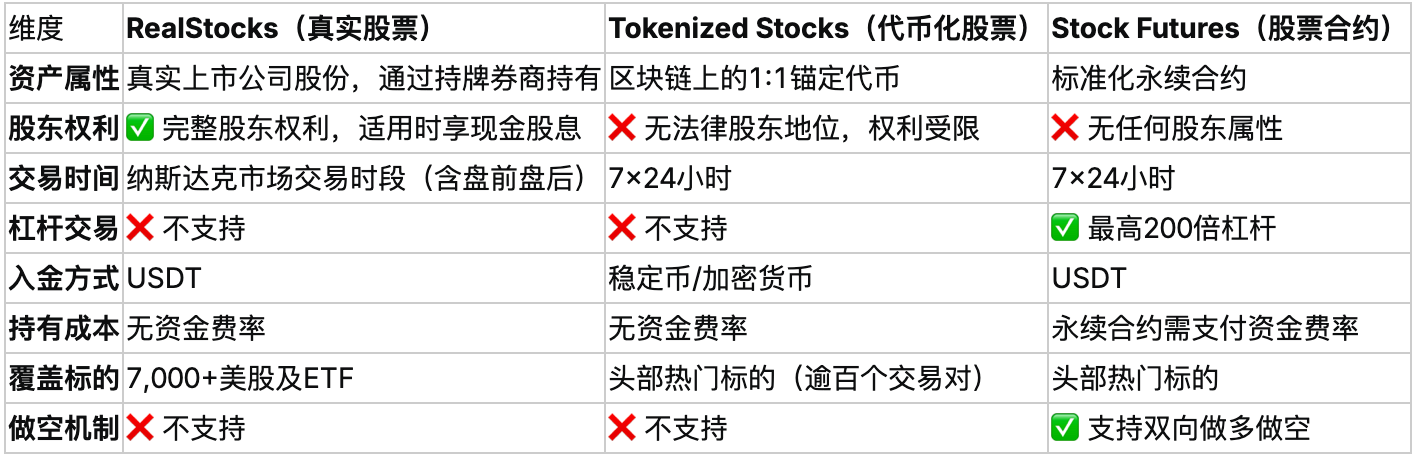
The three product types correspond to three fundamentally different participation logics. The key to choosing isn’t “which is better,” but “which better matches your goals.”
5.1 Choose RealStocks: If You Seek “Ownership”
Buying RealStocks means becoming a shareholder of a company. Your returns come not only from price appreciation but also from cash dividends where applicable. If you believe in a company’s long-term value and want to share in its growth and dividends, RealStocks is the only way to truly “hold” it.
Ideal for the following scenarios:
- Long-term investing: Confident in a company’s fundamentals and willing to hold for years or longer
- Dividend strategy: Seeking stable cash flow and dividend income
- Shareholder rights: Valuing legal rights such as voting power as a shareholder
Things to note: Trading hours are limited to traditional US market sessions and cannot operate 24/7 like crypto; leverage or short selling is not supported, limiting short-term trading flexibility.
5.2 Choose Tokenized Stocks: If You Seek “Flexibility”
Tokenized Stocks allow you to gain economic exposure to US stock prices without leaving the crypto ecosystem. The biggest advantage is 24/7 trading—whether it’s earnings releases, policy changes, or unexpected events, you can react at any time without waiting for the Nasdaq to open.
Ideal for the following scenarios:
- Round-the-clock trading: Wanting to operate during non-US market hours
- DeFi integration: Wanting to use US stock exposure as an on-chain asset, such as collateral for lending
- Fractional allocation: Gaining diversified exposure to top assets with a lower capital threshold
Things to note: You do not own equity in the corresponding company and do not enjoy full legal shareholder rights; dividends and voting rights are limited or absent.
5.3 Choose Stock Futures: If You Seek “Leverage and Two-Way Trading”
Stock Futures are pure price instruments—no ownership, no dividends, only price direction. With up to 200x leverage and long/short mechanisms, they are the top choice for short-term traders and hedgers.
Ideal for the following scenarios:
- Short-term trading: Capturing intraday or multi-day price movements
- Long/short strategies: Profiting from expected price declines via shorting
- Risk hedging: Hedging downside risk of existing positions
- Leverage amplification: Gaining larger nominal exposure with smaller margin
Things to note: Leverage amplifies losses as much as gains; perpetual contracts incur funding fees, and holding costs cannot be ignored; no shareholder rights of any kind.