American farmers are hurting — and worried about their futures : NPR
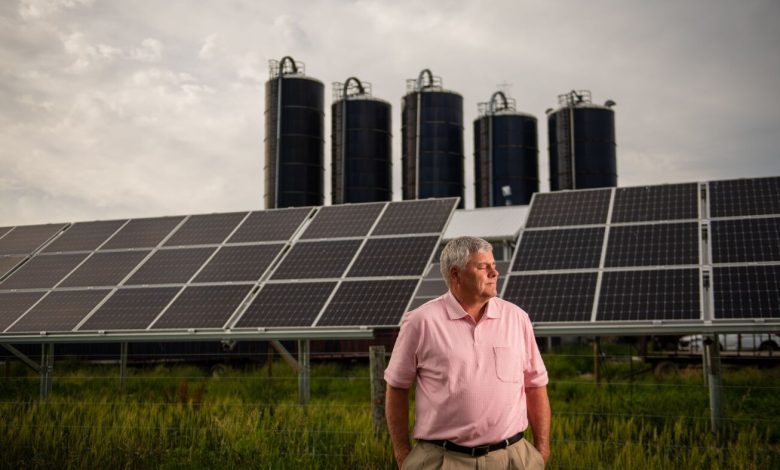
Rick Telesz farms 700 acres in western Pennsylvania. He says he’ll be lucky to break even on his corn and soybean crops this year, given the sky-high cost of diesel fuel and fertilizer.
Mike Clark’s Studio
hide caption
toggle caption
Mike Clark’s Studio
Rick Telesz raises soybeans, corn and dairy cows on about 700 acres in western Pennsylvania. He’s expecting a promising soybean crop this fall — but Telesz will be lucky to just break even.

“Am I going to make money this year?” he asks. “To be honest, I hope the harvest is good enough that I can pay for all those inputs I had this spring and summer.”
The inputs Telesz needs to raise his crops include fertilizer and fuel, which have both gotten a lot more expensive as a result of the U.S. war with Iran — adding to the woes of farmers already struggling with the fallout from the trade war.
Fertilizer prices are up 15% this year compared to last, and the price of diesel fuel has jumped by 80%, making it hard for farmers to turn a profit.
Telesz is paying about $6 a gallon for diesel and his combine alone burns through 150 gallons a day. The machines he uses to dry his grain burn more fuel.
“It’s a cost that a farmer can’t pass on,” Telesz says. “You take your trucking industry, it’s just added to the freight [charge]. But a farmer, it’s just an added cost he just has to absorb. It’s real. It’s painful.”
(The average retail price of diesel fuel is even higher — about $6.50 a gallon, according to AAA. But farmers who use diesel for off-road purposes are typically spared the federal fuel tax of 24.4 cents per gallon and some state fuel taxes as well, including Pennsylvania’s.)
Trade war also eats into farmers’ bottom line
The trade war with China has also been a headache. China is historically the third biggest market for U.S. farm exports, but the country slashed its purchases last year in retaliation for President Trump’s tariffs. Farm sales to China this year have only partially recovered.
“Soybeans are coming back a little bit, but currently [China’s purchases] are at much, much lower levels than they were pre-Trump 2.0,” economist Chad Bown told an audience this week at the Peterson Institute for International Economics. “For all of the other products — cotton, wheat, pork, beef — the exports were devastated in 2025, and there’s no evidence of them coming back.”
The U.S. Department of Agriculture projects that farm revenue will increase this year, as crop prices rebound and farmers sell more bushels and bales of soybeans, corn and cotton.
But much of that extra income will be gobbled up by rising expenses. Producers of all of the major row crops are projected to lose money in 2026 for the fourth year in a row.
“They’re paying way more to grow a crop and they’re not making near enough for it,” says economist Faith Parum of the American Farm Bureau Federation. “We’ve had a tough time in the farm economy.”

Most farmers who grow row crops are expected to lose money in 2026 for the fourth year in a row. “They’re paying way more to grow a crop and they’re not making near enough for it,” says a Farm Bureau economist.
Mike Clark’s Studio
hide caption
toggle caption
Mike Clark’s Studio
Hard times continue in the farm belt
Nationwide, some 200,000 farms have gone out of business since 2020, Parum says.
“Farmers are saying, ‘we’re ready to throw in the towel,'” says Joe Peiffer, a bankruptcy attorney who works with farmers in Iowa, Missouri and Illinois. He says clients tell him, “We’re sick of working our back ends off and losing money.”
For the 12 months ending in June, farm bankruptcies were up 19% from the previous year. But most farmers are reluctant to quit the business altogether.
“Most farmers will farm until the banker won’t loan them another dime,” Peiffer says.
Farmers who own land can try to buy time by selling off some of their property, but that’s usually a last resort.
“The hardest thing to do is get a farmer to sell part of the family farm,” Peiffer says. “I can go buy another tractor, buy another combine. But I can’t buy that 40 acres again because it probably won’t come on the market while I’m still in business.”
Peiffer says most farmers will do whatever they can to stay in business, hoping that costs go down, crop prices go up — and that somehow next year’s harvest will be better than this one.