New Weaves, New Rules and Textile Futures
Material World is a weekly roundup of innovations and ideas that are reshaping the materials sector. It covers the latest developments in how fashion is designed, engineered, and scaled—from emerging biomaterials and next-generation leathers to engineered fibers and sustainable alternatives.
Fashion technology firm Unspun is giving its 3D weaving platform a new name—and a larger materials menu.
The San Francisco- and Hong Kong-based textile technology company has rebranded Vega as OneWeave, a more literal reference to how the system turns yarn directly into three-dimensional textile shapes in a single process.
Formerly known as Vega, Unspun’s OneWeave is a proprietary 3D weaving technology created by the fashion and technology company.
Courtesy of Unspun
OneWeave suspends thousands of yarns around a central core and weaves them into seamless forms, combining fabric formation with portions of garment assembly. Unspun is developing the automated system for local, on-demand production, pitching it as a way to reduce sewing steps, material waste, inventory and supply chain handoffs.
More consequential than the new name may be the fabric developments accompanying it.
The company has produced a 2×1 canvas construction that it sees as a potential unlock for five-pocket styles and chinos, widening OneWeave’s commercial vocabulary beyond the denim-led products for which the technology is best known. Unspun has also added ready-to-dye “blank-canvas” fabrics and a weave with a raised microtexture.
Its material trials now include two blends of wool and Lenzing Ecovero viscose, along with a pure Ecovero viscose option. Ecovero is Lenzing’s branded, wood-derived cellulosic viscose, made using wood from certified or controlled sources and embedded with a molecular marker for traceability.
The expanding swatch book matters because forming a garment shape is only part of the challenge facing 3D weaving. To compete with conventional woven apparel production, the system must also reproduce the hand, drape, durability, dyeability and surface interest brands expect from established fabric supply chains.
Unspun has previously demonstrated the technology through projects including 3D-woven pants with Eckhaus Latta. Its current manufacturing pitch says OneWeave can take a product from yarn to garment in 20 minutes, although that figure is a company claim and no comparative testing methodology is provided.
Unspun also has yet to disclose the blend ratios, performance specifications or production volumes for its new fabrics, nor whether brands are already testing them commercially.
The University of Colorado Boulder
A textile lost in the mail helped expose a stubborn barrier to bringing experimental weaving into the commercial world: Even with the original design instructions, researchers could not reproduce it at the same quality.
Laura Devendorf, an associate professor at the University of Colorado Boulder’s Atlas Institute and director of its Unstable Design Lab, has received two National Science Foundation grants totaling nearly $2 million to make complex woven technologies more accessible and reproducible.

Laura Devendorf, associate professor and Unstable Design Lab director, explores textiles’ impact on scientific discovery and creative practice.
Courtesy of the Unstable Design Lab at University of Colorado Boulder’s Atlas Institute
The larger award—$1.46 million—will support the next phase of AdaCAD, open-source software Devendorf developed to apply parametric design principles to weave drafting. The funding will help turn AdaCAD from a research project into a self-sustaining ecosystem through workshops, residencies, conferences, microgrants, a summer school program and an advisory board.
Devendorf said open access is central to the project because many people trained in textiles learn to work with proprietary software that is too expensive to purchase independently. AdaCAD, by contrast, is available online at no cost and designed to create common ground among weavers, engineers, computer scientists and creative coders.
A separate $500,000 grant will tackle the difficulty of reproducing functional textiles among different weaving machines and production systems. Woven structures can combine several materials into forms that are soft, pliable and customizable, creating prospective applications in wearables, biomedical devices and aerospace. Variations in equipment and manufacturing processes, however, can make a successful prototype difficult to duplicate or scale.
That problem became tangible after an electromagnetic installation, created by Devendorf, artist Elizabeth Meiklejohn and researcher Irene Posch, disappeared in transit following an exhibition. Despite documenting how the piece had been made, Devendorf and Posch could not recreate the quality of Meiklejohn’s original weave.
“I don’t think we can ever make a perfect set of instructions to replicate a design, and that’s what is beautiful about weaving,” Devendorf said. “But I did see opportunities where we could impose particular constraints to the process that might provide some guarantees that someone else could make it at some level of quality.”
The new research will examine tools for translating a textile’s functional requirements across a wider range of looms while identifying the design changes commonly required between prototype and industrial-scale equipment. Devendorf said a better understanding of those modifications may open pathways to products that “meaningfully engage weaving.”
Oeko-Tex
A sustainability label will soon need more than a familiar logo to remain usable in European Union marketing. It will also need to demonstrate that the party checking compliance is independent from the organization that wrote the rules.
Testing and certification firm Oeko-Tex is restructuring its governance ahead of the EU’s Empowering Consumers for the Green Transition Directive, or EmpCo, which member states must apply beginning Sept. 27. The organization said the changes are intended to keep its textile and leather labels compliant as the bloc tightens its restrictions on green claims.
EmpCo prohibits companies from displaying voluntary sustainability labels unless they were established by a public authority or are based on a qualifying certification scheme. Among other conditions, private schemes must publish their requirements, consult relevant experts and stakeholders when developing them and use objective third-party monitoring that is independent of both the scheme owner and the company making the claim.
Oeko-Tex said the organization is strengthening its governance as it prepares for the future.
Courtesy of Oeko-Tex
Oeko-Tex operates a global certification system through 17 independent textile and leather testing institutes in Europe and Japan. Its portfolio includes Standard 100, which tests finished products and their components for harmful substances, as well as labels and certifications covering chemical inputs, organic cotton, production facilities and supply-chain due diligence.
Central to the reorganization is an institutional separation between standard setting and conformity assessment—the process used to determine whether a product, facility or company satisfies those standards.
The Swiss chemical management company will convert its existing German limited liability company (GmbH) into a public limited company (AG) and establish a board of directors as its highest governing body. It is also introducing a Statute of Independence, an Independence Council and an anonymous whistleblowing system.
Additional measures include an accreditation agreement aligned with ISO/IEC 17065, the international standard governing bodies that certify products, processes and services. Oeko-Tex also cited ISO/IEC 17025 accreditation among the safeguards supporting its testing and certification network.
“Consumer protection begins with trust, and trust only arises when what is claimed is independently verified,” said Alfred J. Beerli, CEO of Oeko-Tex. “With the new structure, we anchor this independence even more firmly and make it transparently verifiable for everyone.”
Testing, auditing and certification procedures will continue without changes for customers and partners, the organization said. External experts, public consultations and other stakeholder input will also remain part of the standard-setting process.
The practical change is therefore less visible than a revised hangtag or testing requirement. Oeko-Tex is reorganizing the machinery behind its labels so brands can show regulators—and consumers—that the system evaluating their sustainability claims is structurally independent from the one defining them.
Karl Mayer
Pattern complexity can become expensive before a loom weaves a single pick. German textile machinery manufacturer Karl Mayer says one of its automated warp-sampling systems is helping upholstery fabric producer Rohleder cut preparation time while pursuing designs that were previously too costly to make.
Rohleder reported saving between 50 percent and 60 percent in monthly warping time after installing Karl Mayer’s Multi-Matic 128 at its Konradsreuth, Germany, mill in 2023. The family-owned weaver, which produces upholstery and decorative fabrics for furniture manufacturers including Rolf Benz and Steelcase, selected the machine to replace three older systems.
Warping arranges the lengthwise yarns used in a woven fabric in the required sequence, alignment and tension before they reach the loom. Rohleder’s frequent product changes, short production runs, and intricate patterns had made that stage particularly labor-intensive, calling for repeated creeling and knotting while leaving partially used yarn packages behind.
Karl Mayer said the Multi-Matic’s high performance is based on a series of innovative technical solutions designed to deliver maximum flexibility, efficiency and quality.
The Multi-Matic automates much of that work using as many as 128 individually controlled yarn guides and automated color changes. The system can prepare sample warps as well as short- and medium-length production warps, reaching warping speeds of up to 800 meters per minute. Rohleder configured its machine to make production warps up to 400 meters long.
The efficiency gains increased alongside the intricacy and number of patterned warps in the production mix, the companies said. Rohleder’s designers used the system to create a 2,900-thread fabric incorporating 12 colors in a complicated distribution—an exhibition piece the mill said it could not have produced economically with its previous equipment.
“Design versatility is a true USP of the Multi-Matic,” said Leni Rohleder, the mill’s head of sustainability and marketing. “We can now realize warping sequences that were previously prohibitively expensive, thereby opening up new market segments for us.”
Automating frequent yarn changes also reduces opportunities for manual error and gives Rohleder’s nine-person design team greater freedom to test color combinations and intricate patterns. For a mill built around varied fabrics and relatively small runs, the company said the machine’s value lies increasingly in making difficult designs feasible, rather than simply making familiar ones faster.
Eastman
Specialty materials company Eastman is taking its Naia cellulosic fibers to Guatemala for the first time as the U.S. company seeks to strengthen its ties to the Western Hemisphere’s apparel supply chain.
The fiber maker will present its U.S.-produced Naia staple fibers and filament yarns at the Apparel Sourcing Show Guatemala from Aug. 18-20. The annual event brings together yarn, textile, machinery, trim and manufacturing suppliers serving the CAFTA-DR region—the group of countries bound by the Dominican Republic-Central America-United States Free Trade Agreement—where nearshoring has become part of a wider industry push for faster and more diversified sourcing.
Naia is Eastman’s brand of cellulosic fiber and yarn made primarily from wood pulp. At its Guatemala debut, the company will spotlight casualwear and activewear applications, including Naia On the Move, a fabric concept built around Naia Renew staple fiber.
Eastman will present U.S.-produced Naia staple fibers and filament yarns for casualwear and activewear, supporting closer collaboration across the regional value chain.
Courtesy of Eastman
Eastman attributes 40 percent Global Recycled Standard-certified recycled content to the fiber through mass-balance accounting, with sustainably sourced wood pulp making up the remaining 60 percent. Under a mass-balance system, recycled and conventional feedstocks are mixed during production, with the recycled input allocated to specific outputs through bookkeeping rather than kept physically separate.
The company said Naia On the Move is intended for active, everyday garments that require softness and breathability alongside moisture management and quick-drying performance. Eastman is positioning the application for urban environments where heat, humidity and changing activity levels can require clothing to perform across several settings.
“The Western Hemisphere is becoming an increasingly important part of the sourcing conversation,” said Chad Doub, Eastman’s global segment market manager for casualwear and home. The Guatemala show, he added, will allow the company to explore fabric development with regional manufacturers, brands and sourcing teams.
The appearance builds on Eastman’s participation in the Americas Apparel Producers’ Network’s pro:Americas conference in May. The company did not name any new regional mill, manufacturer or brand partners in its announcement, making the show an early relationship-building step rather than a commercial expansion with disclosed orders or production volumes.
Vibram
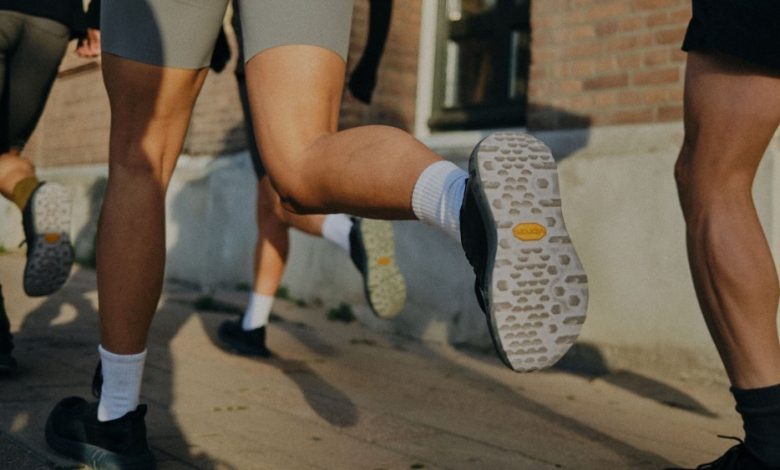
Vibram is targeting the territory between road and trail with an outsole compound designed for runners whose routes move across pavement, dirt, gravel and light trails.
Vibram introduces XS Dura: A new outsole compound “engineered for exploration.”
Courtesy of Vibram
The Italian outsole manufacturer developed XS Dura to combine the responsiveness expected from a road-running shoe with the traction and durability required on less predictable surfaces. Vibram said the rubber compound performs in wet and dry conditions, with particular emphasis on grip across wet gravel and mixed terrain.
XS Dura is making its commercial debut exclusively on Altra’s Torin 9, a running shoe intended to move between urban pavement and unpaved routes. Vibram said the outsole provides up to 8.5 percent more grip than the shoe’s previous version, though the companies did not disclose the testing protocol, surface conditions or metric used to calculate that improvement.
“XS Dura represents an important advancement in our approach to developing materials for the evolving needs of runners,” said Fabrizio Gamberini, Vibram’s global chief brand officer. “We engineered this new outsole compound to deliver the durability, grip and confidence runners need as they move across roads, gravel and light trails.”
Outsole formulation requires a trade-off among grip, flexibility and wear resistance. Softer rubber can produce stronger traction but may abrade more quickly, while harder compounds tend to last longer at the expense of grip. Vibram is positioning XS Dura as a middle ground capable of tolerating repeated transitions between abrasive pavement and looser natural surfaces.
The company did not disclose the compound’s formulation, recycled or bio-based content or quantified wear-life results. Its sustainability case, if any, therefore rests for now on the unverified prospect that a durable, multipurpose outsole could extend shoe use or reduce the need for terrain-specific footwear.
XS Dura will remain exclusive to the Torin 9 initially, with additional footwear partners expected to introduce the compound in early 2027. Those launches should provide a clearer test of whether Vibram has created a broadly useful new outsole platform or a specialized feature for one hybrid running shoe.