Bond Market Sends Warning on America’s Finances

WASHINGTON, DC – September 12, 2026 (STL.News) Bond Market – America’s massive federal debt, persistent budget deficits and growing infrastructure obligations are beginning to collide with something governments ultimately cannot legislate away: the price investors demand to lend them money.
The U.S. bond market is sending a warning.
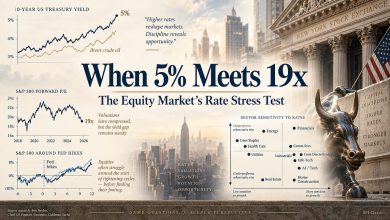
The benchmark 10-year Treasury yield climbed to approximately 5% during the past week, while the 30-year Treasury yield moved above 5.3%, putting long-term government borrowing costs near multiyear highs. Federal Reserve data showed the 10-year constant-maturity Treasury yield at 4.95% on Sept. 10.
Those numbers may appear abstract to Americans who do not own Treasury bonds.
They are anything but abstract.
Treasury yields help establish the price of money throughout the American economy. They influence mortgages, corporate debt, municipal bonds, and countless other forms of financing. When Treasury yields remain elevated, governments, businesses, and ultimately consumers generally face a more expensive financial environment.
That makes the bond market an important addition to a broader financial problem STL.News has been examining: enormous federal borrowing, financially stressed municipalities, aging infrastructure, rising utility costs, increasingly expensive housing and insurance, and households being asked repeatedly to absorb higher taxes, fees, rates and assessments.
The individual problems are different.
The underlying financial question is increasingly the same:
Who will pay for all of it?
Bond Market – The Federal Government Is Already Borrowing Heavily
Start in Washington.
The federal budget deficit reached approximately $1.97 trillion through the first 11 months of fiscal 2026, according to Treasury data reported Friday. That already exceeds the entire fiscal 2025 deficit of approximately $1.775 trillion.
Even more significant, federal interest costs continued climbing. Fiscal-year-to-date interest expense increased approximately $143 billion, or 13%, compared with the corresponding period a year earlier.
This isn’t a temporary problem created solely by one administration, one recession, or one emergency spending package.
The Congressional Budget Office’s 2026 outlook projects a federal deficit of approximately $1.9 trillion this year, growing to $3.1 trillion by 2036 under its baseline assumptions.
The deficit represents approximately 5.8% of gross domestic product in 2026 and is projected to reach 6.7% in 2036. For perspective, federal deficits averaged approximately 3.8% of GDP during the previous 50 years.
Debt held by the public is projected to increase from approximately 101% of GDP in 2026 to 120% in 2036, exceeding the previous post-World War II record.
And then there is interest.
CBO projects net federal interest outlays will rise from approximately $1 trillion in 2026 to $2.1 trillion annually by 2036.
By that point, interest expense alone would approach the size of all federal discretionary spending projected for that year.
That is where today’s bond market becomes so important.
Bond Market – Five Percent Means Something Different With $40 Trillion in Debt
A 5% Treasury yield isn’t historically unprecedented.
America has experienced much higher interest rates.
But America did not carry today’s enormous debt load during most previous high-interest-rate periods.
That distinction is critical.
A household with a $50,000 mortgage can survive an interest rate that would financially overwhelm another household carrying a $500,000 mortgage.
Governments operate according to the same basic mathematics.
The size of the debt matters.
The interest rate matters.
And the combination matters enormously.
The United States has gross federal debt around $40 trillion, while debt held by the public exceeds 100% of annual GDP.
Therefore, even interest rates that would have appeared relatively ordinary historically can generate extraordinary interest expenses when applied gradually across today’s enormous stock of government debt.
Not every Treasury security refinances simultaneously. The federal government has debt of different maturities, so higher market rates feed into federal interest expense progressively as securities mature and new borrowing occurs.
That provides Washington some time.
It does not eliminate the mathematics.
Bond Market – The Bond Market Is Repricing Risk
Treasury securities remain among the world’s most important financial assets.
No evidence suggests the United States suddenly cannot borrow money, and describing the current situation as a Treasury-market collapse would overstate what is happening.
The more significant development is subtler.
Investors are demanding substantially greater compensation for holding long-term government debt.
During trading on Sept. 11, the 10-year yield approached the psychologically important 5% level before retreating, while the 30-year remained around 5.3%. The recent global bond selloff reflects a combination of inflation concerns, energy prices, monetary-policy expectations, fiscal deficits, and the enormous amount of government debt coming to market.
Reuters Breakingviews described the international selloff as reflecting concerns including government deficits, inflation, and the credibility of fiscal and monetary authorities.
In other words, the bond market isn’t necessarily predicting that America is going broke.
It is doing something much more immediate.
It is increasing the price America must pay to borrow.
And that has consequences far beyond Washington.
Bond Market – The Federal Government Competes for Capital
One of the most important observations in CBO’s fiscal outlook receives relatively little attention outside financial circles.
Federal borrowing does not occur in isolation.
When Washington sells Treasury securities, it is competing for capital with other borrowers.
CBO notes that large federal borrowing can push interest rates higher and crowd out private investment because the government competes with other market participants for funds.
Think about the number of entities seeking enormous amounts of capital simultaneously.
The federal government needs trillions.
States and municipalities need capital for roads, bridges, schools, water systems, sewer systems, and public facilities.
Utilities need billions for aging infrastructure.
Corporations need capital.
Artificial-intelligence companies and data-center developers need extraordinary amounts of capital.
Homebuyers need mortgages.
Businesses need loans.
Consumers need credit.
All of them are participating, directly or indirectly, in the same financial system.
Capital is not unlimited at any given price.
When the supposedly risk-free Treasury benchmark approaches 5%, other borrowers generally must offer investors something more attractive to compensate them for additional risk.
That is how a federal fiscal problem eventually migrates through the rest of the economy.
Bond Market – America’s Municipalities Face Their Own Problem
This connects directly with another issue STL.News has been examining: the financial condition of American cities.
Municipalities have enormous infrastructure responsibilities.
According to the National League of Cities, state and local governments account for nearly 75% of public infrastructure spending, and municipal bonds are a major way to finance it.
Municipalities issued about $525 billion in bonds in 2025, leaving roughly $4.3 trillion to $4.4 trillion outstanding.
Cities use that borrowing for schools, roads, bridges, water systems, sewer systems, transportation, and other public infrastructure.
But local governments face aging infrastructure as financing becomes more expensive.
The National League of Cities’ 2026 Municipal Infrastructure Conditions survey found that funding availability remains the most important factor determining local infrastructure investment.
Cities continue to identify streets, water, sewer, stormwater, and water-treatment systems among their highest priorities.
The survey also found municipalities increasingly relying on locally generated cash and reserves rather than borrowing, reflecting fiscal caution and, in some communities, limited financing capacity.
That is an important signal.
Local governments cannot simply borrow unlimited amounts at unlimited interest rates.
Eventually the debt must be serviced.
And local governments generally obtain the money to service that debt from taxpayers and ratepayers.
Bond Market – America’s Water Problem Shows the Scale
Water infrastructure demonstrates how enormous the underlying obligations have become.
Federal surveys cited by the Pew Charitable Trusts estimate that America’s drinking-water and clean-water systems require more than $1.2 trillion in repairs, maintenance and upgrades over approximately the next two decades.
Much of that ultimately will be financed locally, including through higher water rates.
St. Louis residents do not have to look across the country to understand the problem.
The City of St. Louis has acknowledged years of deferred maintenance in its water system. City documents have previously cited approximately 1,300 miles of water mains, 15,500 fire hydrants and 26,000 valves that must be operated and maintained.
The city’s Water Division says current rates are necessary to generate enough money to operate its waterworks and facilities, and rates effective July 1, 2026 include provisions for inflation adjustments.
This year, the Missouri Department of Natural Resources also awarded Missouri American Water a record $289 million Drinking Water State Revolving Fund loan to improve its St. Louis Central Water Treatment Plant.
Separately, Missouri American Water has sought new rates to support approximately $1.6 billion in statewide water and wastewater investments between June 2025 and May 2028.
None of these expenditures is optional in the conventional sense.
Water systems must operate.
Pipes must eventually be replaced.
Sewer systems must function.
Bridges must remain structurally sound.
Roads must be maintained.
Schools must operate.
Police and fire departments must be funded.
The problem is that postponing infrastructure investment does not eliminate the bill.
Frequently it makes the eventual bill larger.
Bond Market – This Is the Same Problem We Have Seen With HOAs
An interesting parallel exists between America’s public-sector infrastructure problem and another financial issue STL.News has examined extensively: homeowner associations.
The scale is obviously different, but the financial principle is remarkably similar.
An HOA may collect dues that appear affordable for years while failing to accumulate adequate reserves for predictable future expenses.
Roofs eventually need replacement.
Private roads deteriorate.
Sidewalks crack.
Retaining walls fail.
Pools and clubhouses require maintenance.
Insurance costs increase.
Landscaping costs increase.
Labor becomes more expensive.
If an association fails to reserve enough money during the useful life of those assets, the obligation does not disappear.
It is transferred into the future.
Eventually homeowners receive the bill, frequently through substantially higher dues or special assessments.
Municipal governments can experience a similar phenomenon on a much larger scale.
Deferred maintenance can make budgets look more manageable today while creating enormous capital requirements tomorrow.
The federal government has another tool unavailable to an HOA: it can borrow on an extraordinary scale.
But borrowing does not make expenditures free.
It shifts costs across time and adds interest.
That is why the bond market matters.
It establishes the price of postponement.
Bond Market – The Same Household Is Paying Every Bill
This may be the most overlooked part of America’s developing financial problem.
Government finance is frequently discussed as though federal taxpayers, state taxpayers, municipal taxpayers, utility customers, homeowners, and consumers were different groups of people.
Frequently they are the same household.
Consider an ordinary family.
Its members pay federal income and payroll taxes.
They may pay state income taxes.
They pay sales taxes.
They pay property taxes directly or indirectly through rent.
They pay water and sewer bills.
They pay electricity and natural gas bills.
They pay insurance premiums.
They may pay HOA assessments.
They pay mortgage interest or rent.
They pay for healthcare.
They pay for transportation.
They pay for food.
They may carry credit-card, automobile, student-loan, or other debt.
Every institution examining its own balance sheet can independently conclude that it needs more revenue.
The federal government can raise taxes or borrow.
A state can raise taxes or fees.
A municipality can raise taxes or issue bonds.
A utility can request higher rates.
A school district can seek additional revenue.
An HOA can increase dues or impose a special assessment.
An insurer can raise premiums subject to applicable regulations and market conditions.
A business can increase prices when the market allows it.
Viewed individually, every increase may have a rational explanation.
Viewed from the household’s perspective, however, they accumulate into one enormous cost-of-living problem.
The American household is the financial endpoint of much of the system.
And households have limits.
Bond Market – Borrowing Cannot Permanently Replace Income
The same principle applies at every level of finance.
Debt is useful when used prudently.
Borrowing can finance infrastructure whose useful life spans generations. A city does not necessarily need enough cash today to construct a water plant expected to serve residents for 50 years.
A family can finance a house appropriately.
A company can borrow to construct a factory.
A government can issue bonds to build infrastructure.
The danger appears when borrowing stops functioning primarily as a financing mechanism for productive long-term investment and becomes necessary to sustain persistent structural gaps between revenues and expenditures.
That concern is embedded in the federal numbers.
CBO isn’t forecasting deficits disappearing after the economy improves.
It projects large deficits continuing year after year.
Federal debt held by the public rises.
Interest expense rises.
Additional borrowing becomes necessary.
And borrowing needed to cover higher interest costs itself adds to future interest costs.
CBO explicitly describes that mechanism in its budget outlook.
That is a fiscal feedback loop.
Bond Market – Higher Yields Can Make the Problem Worse
Suppose investors become increasingly concerned about inflation or government borrowing and demand higher Treasury yields.
Federal interest expense eventually increases.
That contributes to larger deficits.
Larger deficits require additional borrowing.
Investors must then absorb additional Treasury supply.
If investors require still greater yields to absorb that supply, interest expense increases further.
This does not mean such a spiral is inevitable.
Economic growth can increase federal revenue.
Inflation can decline.
Fiscal policy can change.
Government spending can be restrained.
Tax policy can change.
Interest rates can fall.
Productivity growth could improve the country’s fiscal capacity.
But the present trajectory makes the system increasingly sensitive to interest rates.
Investors are now watching that sensitivity.
Bond Market – Housing Gets Caught in the Middle
The consequences also reach prospective homeowners.
Mortgage rates don’t move in perfect lockstep with the 10-year Treasury, but long-term Treasury yields are an important benchmark in mortgage markets.
Mortgage News Daily reported the average 30-year fixed mortgage rate around 7.12% on Sept. 11.
That creates another affordability problem.
A household buying the same house at a 7% mortgage rate faces a dramatically larger monthly payment than one financing at 3% or 4%.
Meanwhile, that household may simultaneously encounter higher property taxes, homeowners insurance, utility rates, and HOA dues.
Housing affordability therefore isn’t simply about home prices.
It is increasingly about the cumulative carrying cost of owning the property.
This is another example of America’s individual financial problems converging.
Bond Market – The Economy Faces a Dangerous Contradiction
Bond Market: Policymakers should also pay attention for another reason.
Consumers represent an enormous portion of American economic activity.
Governments depend on consumers and businesses for tax revenue.
Businesses depend on households to purchase products and services.
Banks depend on borrowers remaining able to service debt.
Municipalities depend on property and sales taxes.
Utilities depend on customers paying their bills.
HOAs depend on homeowners paying assessments.
The system therefore cannot indefinitely solve every institutional financial problem by extracting progressively more money from households.
At some point, something gives.
Households reduce discretionary spending.
They postpone purchasing vehicles.
They delay home purchases.
They eat at restaurants less often.
They postpone vacations.
They carry larger credit-card balances.
They fall behind on bills.
Businesses then experience weaker demand.
Employment can soften.
Tax collections can weaken.
Governments can encounter additional fiscal pressure.
That is how what begins as a household affordability problem can become an economic-growth problem.
Bond Market – Stocks and Bonds Are Sending Different Messages
Bond Market: One particularly interesting development is that stocks and bonds have recently appeared to tell somewhat different stories.
Equity markets have remained relatively strong, supported in part by corporate earnings and optimism surrounding parts of the economy.
Bond investors have been more concerned about inflation, government spending, fiscal policy and the enormous supply of debt.
Barron’s noted this unusual combination Friday: stocks trading near highs while long-term Treasury yields also remained near multiyear highs.
Neither market is guaranteed to be correct about the future.
But bond investors are particularly sensitive to inflation and fiscal sustainability because a long-term bond’s value depends heavily on being repaid with dollars that retain purchasing power.
A 30-year investor must think decades ahead.
That makes long-term Treasury yields a particularly useful financial warning system.
Bond Market – What Would Constitute a More Serious Warning?
Bond Market: One day’s movement in Treasury yields should never be exaggerated.
Markets fluctuate.
A yield touching 5% and subsequently retreating does not establish a fiscal crisis.
What matters is persistence.
Investors should watch whether the 10-year Treasury remains around 5% or moves materially higher, whether the 30-year yield continues rising, whether Treasury auctions keep attracting sufficient demand without substantially higher yields, and whether federal interest expense continues to consume a larger share of government revenue.
Municipal borrowing costs deserve similar attention.
So do mortgage rates.
If Treasury yields remain elevated while federal deficits approach $2 trillion or more annually, America’s fiscal debate changes.
The government would no longer be dealing primarily with yesterday’s accumulated debt.
It would refinance yesterday’s debt at today’s higher prices while borrowing enormous additional amounts for tomorrow.
Bond Market – America Has an Infrastructure Bill Coming Due
Bond Market: This brings the discussion back to the broader issue STL.News has been investigating.
America has spent decades building an extraordinarily expensive physical and governmental system.
Roads.
Bridges.
Water systems.
Sewer systems.
Schools.
Government buildings.
Public transportation.
Electrical infrastructure.
Telecommunications networks.
Housing developments.
Private community infrastructure.
All of those assets depreciate.
They require maintenance.
Eventually, they require replacement.
The National League of Cities reports that local governments own almost half of America’s road miles and bridges as well as water and wastewater infrastructure serving millions of residents.
Someone must finance that replacement.
The problem is becoming increasingly apparent:
America has accumulated enormous financial liabilities even as its physical infrastructure requires enormous reinvestment.
And now the cost of capital has risen.
That combination deserves considerably more attention.
Bond Market – There Is No Single Villain
Bond Market: It would be overly simplistic to attribute this situation entirely to Democrats, Republicans, President Donald Trump, former President Joe Biden, or any single Congress.
The federal debt accumulated across decades and administrations of both parties.
Municipal infrastructure problems developed across decades.
Many water systems rely on infrastructure installed generations ago.
HOA reserve problems can develop across multiple boards.
The fundamental problem is structural.
Americans have repeatedly benefited from services, infrastructure, government programs, and assets whose full long-term costs were not always funded at the time.
Debt and deferred maintenance bridged the gap.
Now some of those obligations are converging.
Bond Market – The Bond Market Cannot Be Voted Away
Bond Market: Governments possess extraordinary powers.
They can tax.
They can regulate.
They can borrow.
Congress can change laws.
Cities can approve bond issues.
Utilities can request rate increases.
HOAs can impose assessments according to their governing documents and applicable law.
But none of them can permanently repeal financial mathematics.
A borrower that needs increasingly large amounts of money must find lenders willing to provide it.
Those lenders determine what return is sufficient.
That is why the Treasury market deserves attention.
Bond investors don’t need to win an election.
They don’t need to attend a city council meeting.
They don’t need to issue a political statement.
They simply decide what yield they require before buying the debt.
When that required yield rises, the borrower’s cost rises.
America is discovering that reality again.
Bond Market – The Warning Is Not Collapse — It Is Cost
Bond Market: The responsible conclusion is not that the United States is bankrupt.
It isn’t.
Treasury securities haven’t suddenly lost buyers.
They haven’t.
And a financial collapse isn’t inevitable.
It isn’t.
The warning is more straightforward and more defensible:
America’s financial model is becoming increasingly expensive to maintain.
The federal government is running deficits approaching $2 trillion even without a conventional recession.
Debt held by the public exceeds the size of annual GDP.
Interest expense is approaching or exceeding $1 trillion annually depending on the accounting measure used.
Cities face massive infrastructure obligations.
Water systems require extraordinary investment.
Municipalities rely heavily on bonds.
Homeowners face expensive mortgages.
Utilities require additional revenue.
Some HOAs confront underfunded reserves and deferred maintenance.
And consumers ultimately encounter much of the resulting cost.
The bond market is now pricing in that financial environment.
A 10-year Treasury around 5% isn’t merely another number flashing across a financial television screen.
It is the approximate price investors currently demand for lending money to the United States government for a decade.
And because Treasury securities provide a foundation for pricing credit throughout the economy, that price matters to nearly everyone.
The financial problems STL.News has been examining — federal deficits, municipal stress, infrastructure deterioration, utility increases, housing affordability and household financial pressure — are not isolated stories.
Increasingly, they appear to be different parts of the same larger story.
America has accumulated enormous financial and physical obligations.
Those obligations require capital.
Capital has become considerably more expensive.
And governments, businesses, utilities, associations, and households are increasingly competing over who will ultimately absorb the cost.
For decades, borrowing and deferred expenditures allowed difficult financial decisions to be pushed into the future.
The bond market may be signaling that the future is arriving.