Woke Was Never the Problem
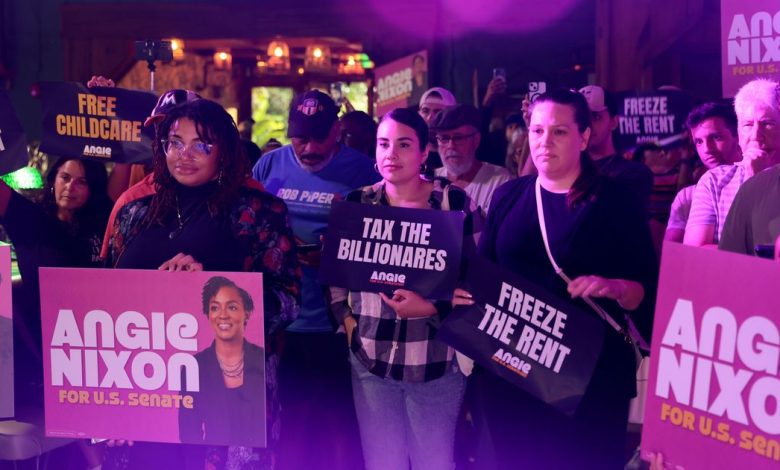
Supporters listen as Democratic U.S. Senate candidate and Florida state representative Angie Nixon speaks in Miami.
Photo: Joe Raedle/Getty Images
The American commentariat has lived inside a state of suspended animation for at least a decade. To them, it is 2014, 2016, or 2020 or somehow all three at once — and wokeness is the only subject worth talking about. Democratic strategist James Carville has nothing to do but appear on TV so he can say, for the hundredth time, that his party is now too woke. In August, CNN wanted to know if Democrats are trying to “shrug off” peak woke to win over skeptical voters. After all, Francesca Hong disavowed a few social-media posts, including a quip about canceling Thanksgiving, before she lost the Democratic primary for governor in Wisconsin. Asked about Hong’s posts in an interview, Representative Alexandria Ocasio-Cortez quoted City Councilman Chi Ossé, joking, “I have a local city councilman that has this saying: ‘Woke 1 was crazy.’” People should say what they believe, Mayor Zohran Mamdani said in the middle of the news cycle, but “what you believe can change and develop,” which is why he no longer wants to defund the police.
Pundits and consultants are only too eager to keep the conversation alive. Their careers depend on the formulas they’re selling, and “woke” is a useful antagonist. According to strategist Kaivan Shroff, jokes about “woke 1” give progressives permission “to admit that some of the politics of 2020 and the pandemic era went too far.” What politics? Which policies? Shroff doesn’t elaborate. Adam Jentleson, an operative who once worked for Senator John Fetterman, criticized the party in an interview with The New Yorker. Democrats hurt themselves — and the country — by deciding “to collectively plant our flag on the fringiest examples,” like trans rights, he said. At The Atlantic, Idrees Kahloon disdainfully recalls Nancy Pelosi in kente cloth, DEI initiatives on campus, and newsroom revolts “against colleagues they deemed counterrevolutionary.” He added, “Republicans will never let voters forget this.”
That may be true. The Trump administration stakes much of its reputation with voters on culture-war battles, but that tactic is riskier than today’s conversation can explain. While they target trans athletes, grocery prices are rising, and households are struggling to keep children fed. The discourse around woke 1, or peak woke, or whatever people call it, has become so divorced from material reality that it obscures far more than it clarifies. Woke is censorship, or trans rights, or defunding the police, except when it’s something else, like Me Too or basic empathy. As deployed by its critics, the definitions are blurring. Sometimes it’s a proxy for generic liberal politics; sometimes it’s a more pointed assault on the very notion of civil rights. It means anything, so it means nothing at all.
“Woke” once meant something more pointed, Jamelle Bouie recently explained at the New York Times. In the Black vernacular of the 1930s, it was advice, or a warning. As Bouie put it, “Be aware of the ways that this society is not built for you.” If “peak woke” did begin somewhere around 2020, as some suggest, it’s not hard to understand why. A global pandemic was killing people, with disproportionate early effects on low-wage, frontline workers and other vulnerable groups. A police officer murdered George Floyd in the street. Donald Trump was the president, and he was running for reelection. Within that context, there was concern, especially on the left, that corporations and the political class would co-opt and exploit identity politics for their own aims. In an essay for the Boston Review, the philosopher Olúfẹ́mi O. Táíwò called it a form of “elite capture,” as the most powerful “political, social, and economic” groups at the top deploy identity politics “in the service of their own interests, rather than in the service of the vulnerable people they often claim to represent.” Sure, Pelosi kneeled in kente cloth — but at the time, she was roundly mocked for the empty gesture, and for thanking Floyd for “sacrificing” himself, Natasha Lennard has argued at the Intercept. Police abolition may not be popular, but that doesn’t mean it’s crazy or that it appeared, magically, during the summer of 2020. Instead, it belongs to “an intellectual and activist history” with deep and vital roots in American public life, Mychal Denzel Smith wrote in a piece for Defector. What some call crazy, or woke, or simply ineffective, began as a response to death and injustice.
Critics of woke 1 often point to jargon, or political sloganeering, which was real enough at the time. Some point to Democratic losses in 2024 and beyond as evidence that American voters had grown weary of identity politics. Jentleson highlights Kamala Harris, who responded “yes” to a 2019 ACLU questionnaire about surgeries for trans migrants and prisoners only for Trump to campaign on her answer five years later. A melodramatic ad accused Harris of backing “taxpayer-funded sex changes for prisoners” and warned, “Kamala is for they/them. President Trump is for you.” Alas, “Harris had no heterodoxy to point to,” Jentleson wrote, and the country suffered for it. As proof, he cited a postelection Blueprint Research survey of swing voters. Among those who broke for Trump, 67 percent said that Democrats were “too focused on identity politics,” he wrote. “The ad had found its mark.”
Did it, though? The ad saturated airwaves at the time, but a serious reckoning with the Harris loss must account for less salacious factors, like inflation and grocery prices. The Biden economy was deeply unpopular, and so was Israel’s genocide in Gaza, but Harris did not distinguish herself on either issue, which cost her votes. “Wokeness,” defined here as health care for the vulnerable, did not reelect Trump; Harris did that all on her own. Two years later, Hong lost her primary to a centrist candidate, but the dangers of woke don’t entirely explain why or account for her strong showing in the primary. She ran on a data-center moratorium, not canceling Thanksgiving. Nationwide, voters lean conservative on some traditionally “woke” issues, like trans kids in school sports, but that tells us little about their priorities. In Florida, Angie Nixon won her Senate primary as a member of DSA and a labor organizer, who’s fought Governor Ron DeSantis and his war on “woke” for years. “I’m the biggest pain in Ron DeSantis’s ass,” she told donors recently. She’s also running on affordability, including free child care and paid family leave.
Meanwhile, the right wing is stuck in the past along with Carville and Jentleson. In 2024, influencer Allie Beth Stuckey published Toxic Empathy: How Progressives Exploit Christian Compassion and described a sea of black squares on her Instagram feed. People had changed their profile photos in a brief — some might say superficial — expression of solidarity with victims of police brutality. Everyone blamed the killing on racism, Stuckey wrote, but they’re wrong. “Thousands of people of all ethnicities tragically die every day, many of them in unjust ways,” she mused, “and few, if any, receive social-media attention.” Although she felt “pressure” to join in and show a little sorrow over Floyd, she read conservative authors instead, and decided that “toxic empathy,” or the “stoking” of “undue resentment among Black Christians and unjustified guilt among white Christians,” was the real problem facing America.
A few weeks after Toxic Empathy debuted, Trump won a second term in the White House, and the war on woke picked up force. “Wokeness” has become an excuse for nearly everything the administration does, from mass firings of federal workers to blocking promotions for women and people of color in the military. Elsewhere, empathy takes fresh hits. Gad Saad, a popular writer, warns of “suicidal empathy” in a new book. Elon Musk has attacked “shallow empathy” for years. To be anti-woke is to lack empathy for others, to be purposefully cruel while offering no solutions to hunger or the cost of health care.
Perhaps it’s easy to forget now, but the strongest criticisms of “woke excess” once focused on free speech and association rights. In one notable case, an adjunct professor lost a contract for showing an artistic depiction of the Prophet Muhammad in class. The instructor, Erika López Prater, included a warning in her syllabus that she would display “representational and non-representational depictions of holy figures,” including Muhammad and Jesus Christ, but a Hamline University student complained, and López Prater lost her job. In a statement, Hamline’s then-president, Fayneese S. Miller, said that “for many Muslims,” it is “against their faith” to look at an image of Muhammad, and it was “important” that “our Muslim students, as well as all other students, feel safe, supported, and respected both in and out of our classrooms.” That sounded woke at the time, but was López Prater’s unjustified firing really a story about wokeness, or spineless college administrators, or an adjunct workforce without much power?
Years later, the administration — and the right wing at large — have done nothing to shore up free speech on campus or anywhere else. No one forced Stuckey to put a black square on her Instagram account in 2020, but immigration authorities have detained migrants over their support for Palestine. The government is investigating universities in the name of fighting antisemitism. Professors are suing the Texas A&M University system over prohibitions on “race or gender ideology” in coursework. After Charlie Kirk was killed last year, at least 600 people were punished for criticizing him, a Reuters investigation found. Some lost their jobs.
Democrats gain nothing by debating peak woke. There is no reason to pivot right (and single out trans athletes, as U.S. representative Seth Moulton did in Massachusetts) in order to win votes. In fact, Trump is making peak woke irrelevant. Roughly 3 million people dropped health-insurance plans under the Affordable Care Act by late June, as the White House cut subsidies and medical costs rose. Economic growth is beginning to slow. Meanwhile, Trump’s popularity is sinking, and the right wing is ready to go down with the anti-woke ship. “Even if you don’t agree with us on every issue, the other party is consumed by craziness,” Vice-President J.D. Vance said recently. If “craziness” means empathy, if it means leaving trans kids on sports teams while easing the strain on our bank accounts, maybe it’s not so bad.
Credit: Source link