Supply, demand to dominate market dynamics in 2026
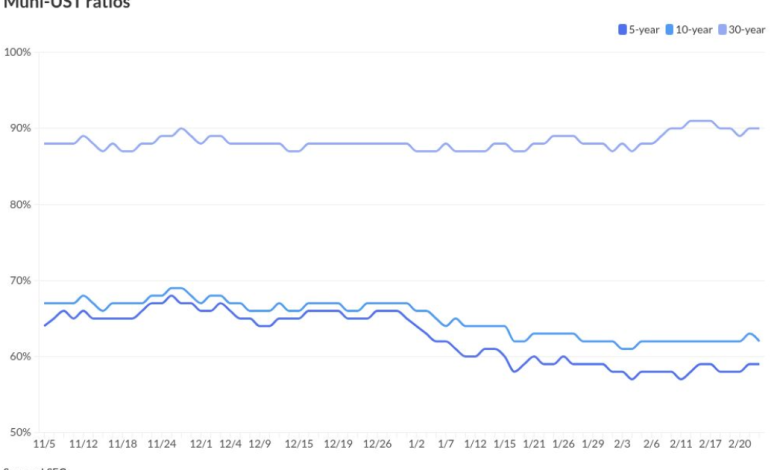
Munis were steady to a touch firmer Tuesday as U.S. Treasuries were little changed, no more than a basis point or two, and equities ended up.
Processing Content
The two-year muni-UST ratio Tuesday was at 59%, the five-year at 59%, the 10-year at 62% and the 30-year at 90%, according to Municipal Market Data’s 3 p.m. EDT read. The two-year muni-UST ratio was at 60%, the five-year at 59%, the 10-year at 62% and the 30-year at 89%, according to ICE Data Services.
Following policy uncertainty and uneven performance last year, the muni market enters 2026 with “clearer technical and fundamental signals,” said Pat Haskell, head of the municipal bond group at BlackRock.
While broader economic risks remain, market dynamics are being driven by supply, demand and income generation, rather than macro headlines, he said.
Over the past few days, the market has faced some macro headlines, but munis have barely moved.
Bond markets had a muted reaction Friday to the news that President Donald Trump will impose a 10% global tariff, hours after the Supreme Court struck down the administration’s use of the International Economic Emergency Powers Act to enact tariffs.
Over the weekend, Trump announced he would raise global tariffs to 15%, but that news did little to move the muni market as yields were little changed Monday.
Furthermore, by Tuesday, it appeared financial markets had shifted their focus from the tariffs to other events.
Last week, issuance for the holiday-shortened week totaled $7.6 billion, while demand continued to “flood” the market, with LSEG Lipper reporting $1.269 billion of inflows into muni mutual funds, said Daryl Clements, a municipal portfolio manager at AllianceBernstein.
Issuance is also manageable this week at an estimated $10 billion, he noted.
“Light supply and strong demand should lead to another positive week for munis,” Clements said.
Overall, supply will remain robust this year as COVID-era fiscal stimulus wanes and construction and labor costs rise, Haskell said, noting BlackRock estimates 2026 issuance at $575 billion.
“With policy uncertainties better defined, supply should follow traditional rhythms — lighter early year and summer,” he said.
Supply will likely remain “concentrated” in the intermediate part of the curve, especially between seven and 20 years. This aligns with issuer preferences and investor demand, Haskell said.
Demand conditions remain “structurally supportive,” he said.
Inflows in 2025 were primarily driven by money flowing into separately managed accounts and exchange-traded funds, which totaled over $100 billion. SMAs and ETFs are expected to remain key this year, he said.
However, demand — which has been strong this year, with mutual fund and ETF flows approaching $18 billion — has caused the steepness of the muni yield curve, which is as steep as it’s been in over a decade, Clements said.
“Demand has been somewhat concentrated in the belly and shorter end of the yield curve, which has resulted in a steep yield curve,” he said. “This uneven demand has resulted in shorter-maturity muni bonds becoming relatively expensive, while longer bonds remain relatively cheap.”
Meanwhile, so far this year, munis are the best-performing U.S. fixed income class, Clements said.
Munis, after lagging comparable USTs last year, now face a more “favorable relative setup,” Haskell said.
“Consecutive years of underperformance are rare and typically tied to weaker fundamentals,” he said.
Credit quality remains “sound,” aided by “strong state and local balance sheets and resilient essential service revenue streams,” he said.
This backdrop, along with supportive technicals, positions munis to recapture relative performance, Haskell said.
Overall, the muni market enters the year with “solid fundamentals, manageable supply, and durable demand,” he said.
While volatility may continue, munis remain “well positioned to deliver attractive, tax-efficient income with selective opportunities for outperformance,” he said.
New-issue market
In the primary market Tuesday, Goldman Sachs priced for the Black Belt Energy Gas District (A2///) $1.094 billion of gas project revenue bonds, Series 2026E, with 5s of 7/2027 at 3.08%, 5s of 2031 at 3.54% and 5s of 2033 at 3.73%, callable 4/1/2033.
Wells Fargo priced for the Arizona Board of Regents (Aa2/AA//) $265.065 million of Arizona State University system revenue bonds, Series 2026A, with 5s of 7/2027 at 2.05%, 5s of 2031 at 2.22%, 5s of 2036 at 2.74%, 5s of 2041 at 3.30%, 5s of 2046 at 3.95% and 5s of 2047 at 4.06%, callable 7/1/2036.
Raymond James priced for the Monmouth County Improvement Authority, New Jersey, $250.645 million of governmental pooled loan project notes, with 4s of 3/2027 at 2.23%, noncall.
Goldman Sachs priced for the New York State Environmental Facilities Corp. (Aaa/AAA/AAA/) $242.02 million of state clean water and drinking water revolving funds revenue bonds (New York City Municipal Water Finance Authority projects-second resolution bonds), Series 2026A, with 5s of 6/2027 at 2.00%, 5s of 2031 at 2.13%, 5s of 2036 at 2.55% and 5s of 2041 at 3.15%, callable 6/15/2036.
Ramirez priced for the Pittsburgh Water and Sewer Authority (A2/A+//) $156.425 million of water and sewer system first lien revenue bonds, Series A of 2026, with 5s of 9/2028 at 2.18%, 5s of 2031 at 2.32%, 5s of 2036 at 2.82%, 5s of 2041 at 3.40%, 5s of 2046 at 4.14%, 5s of 2052 at 4.46% and 5s of 2056 at 4.55%, callable 9/1/2036.
BofA Securities priced for the Montgomery County Housing Opportunities Commission, Maryland, (Aaa///) $150 million of non-AMT multifamily housing development bonds, Series 2026A, with all bonds priced at par: 2.75s of 1/2031, 2.8s of 7/2031, 3.4s of 1/2036, 3.45s of 7/2036, 4.05s of 7/2041, 4.5s of 7/2046, 4.65s of 7/2051, 4.75s of 7/2056, 4.9s of 7/2061, 5s of 7/2066 and 5.15s of 1/2071, callable 1/1/2034.
CUSIP requests fell
In January, the aggregate total of identifier requests for new municipal securities — including municipal bonds, long-term and short-term notes, and commercial paper — fell 13.6% versus December totals.
On a year-over-year basis, overall municipal volumes were up 11.1% through the end of January.
Texas led state-level municipal request volume with a total of 110 new CUSIP requests in January, followed by New York (69) and California (56).
For the specific category of municipal bonds, there was a decline of 19.4% month-over-month and a drop of 3.8% year-over-year.
AAA scales
MMD’s scale was bumped up to two basis points: 2.05% (-1) in 2027 and 2.05% (-1) in 2028. The five-year was 2.12% (-1), the 10-year was 2.52% (unch) and the 30-year was 4.22% (-1) at 3 p.m.
The ICE AAA yield curve was bumped up to two basis points: 2.06% (-2) in 2027 and 2.05% (-1) in 2028. The five-year was at 2.11% (-1), the 10-year was at 2.52% (-1) and the 30-year was at 4.19% (unch) at 4 p.m.
The S&P Global Market Intelligence municipal curve saw small bumps: The one-year was at 2.05% (-1) in 2027 and 2.06% (-1) in 2028. The five-year was at 2.12% (-1), the 10-year was at 2.51% (-1) and the 30-year yield was at 4.20% (unch) at 3 p.m.
Bloomberg BVAL was unchanged: 2.05% in 2027 and 2.04% in 2028. The five-year at 2.09%, the 10-year at 2.49% and the 30-year at 4.08% at 4 p.m.
U.S. Treasuries were little changed.
The two-year UST was yielding 3.46% (+2), the three-year was at 3.462% (+2), the five-year at 3.599% (+1), the 10-year at 4.038% (+1), the 20-year at 4.637% (-1) and the 30-year at 4.696% (-1) near the close.
Primary to come
The Regents of the University of California (Aa2/AA/AA/) is set to price $1.934 billion of general revenue bonds, consisting of $962.275 million of Series 2026CE and $976.27 million of Series CF. J.P. Morgan.
Lee County, Florida, (A2//A/AA-/) is set to price Thursday $681.315 million of airport revenue bonds, consisting of $464.145 million of Series 2026A-1 AMT bonds, $169.85 million of Series 2026-A2 AMT bonds and $47.32 million of Series 2026B non-AMT refunding bonds. BofA Securities.
The Western Maricopa Education Center District No. 402, Arizona, (/AA//) is set to price Wednesday a $223.545 million deal. Stifel, Nicolaus & Co.
The Public Finance Authority (//A-/) is set to price $132.385 million of tax-exempt revenue bonds, Series 2026 (Maniilaq Association Employee Housing Project). Goldman Sachs.
Competitive
The Santa Clara County Financing Authority, California, (/AA+/AA+/) is set to sell $400 million of lease revenue bonds, 2026 Series A, at 11:30 a.m. Eastern Thursday.
The Clark County School District, Nevada, (A1/AA-//) is set to sell $300.145 million of GO building and refunding bonds, Series 2026A, at 11:30 a.m. Thursday.
Hoboken, New Jersey, is set to sell $193.441 million of bond anticipation notes of 2026, Series A, at 11:00 a.m. Thursday.
The Virginia Commonwealth Transportation Board (Aa1/AA+/AA+/) is set to sell $118.96 million of Commonwealth of Virginia transportation capital projects revenue refunding bonds at 10:30 a.m. Wednesday.
The University of Illinois Board of Trustees (Aa2/AA//) is set to sell $113.06 million of auxiliary facilities system refunding revenue bonds, Series 2026A, at 10:30 a.m. Wednesday.
Franklin, Tennessee, (Aaa///) is set to sell $105.690 million of GOs at 11 a.m. Wednesday.