April muni issuance falls, but remains above 10-year average
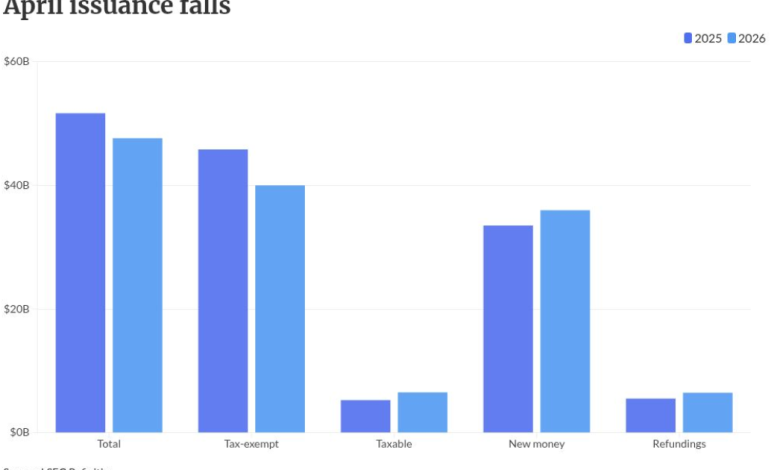
New issue municipal bond volume was down year-over-year in April, but is still healthy comparatively, given the geopolitical backdrop.
Processing Content
Issuance was $47.607 billion in 797 issues, down 7.8% year-over-year from $51.651 billion across 805 transactions.
Supply year-to-date is at $178.929 billion, up 3.9% year-over-year.
While issuance was down in April year-over-year, it follows a robust year of issuance, and the April number in 2025 topped $50 billion for only the second time.
Furthermore, April issuance is above the 10-year average of $37.323 billion and was the third-largest supply figure for the month of April.
Supply was very healthy, said Giles Nicholson, senior managing director and head of the Public Finance Quantitative Solutions Group at Siebert Williams Shank.
“Recent strength has been driven by a confluence of factors, including a rebound in infrastructure demand following subdued issuance during the rate volatility of 2022-2023, policy uncertainty surrounding the election and the passage of the ‘One Big Beautiful Bill’ and ongoing inflationary pressures increasing the cost of infrastructure projects,” said Sam Weitzman, a product manager at Western Asset.
Rates came down somewhat during April, which would normally mean some volume “to come in from that,” Nicholson said.
However, some geopolitical uncertainty may be holding issuers back, Nicholson said.
Overall, he does not believe the low supply figure in April is a “harbinger of a lower volume year or a bad volume year. In totality, it’s a [pretty] healthy level.”
Even with the overall strength, the decline makes some sense, other market participants said.
“With the rate move, we’ve seen the uncertainty, the volatility. You’re coming out of March, which is seasonally a lousy month anyway, and then you throw a
The muni market is slower to move, so issuance has been “pushed out,” he said.
The next few weeks of supply may be on the “heavier side,” but with interest rates at current levels for longer, refundings may be reduced this summer, said Ajay Thomas, head of public finance at FHN Financial.
“We anticipate new money financings moving forward to take advantage of investors having more investment cash from higher summer redemption months,” he said.
Through the first four months of the year, supply is only up 4%, and “a lot will depend on the next four months as issuance was extremely heavy from May until August of last year, beating the previous record by a large margin,” Barclays strategists said.
“We are still anticipating robust issuance for 2026 and yes, potentially surpassing 2025 issuance if the Mideast conflict ends soon and the transition of the Fed Chair does not create too much disruption of Fed policy,” Thomas said.
April details
Tax-exempt issuance fell 12.7% to $39.995 billion in 708 issues from $45.792 billion in 717 issues a year ago. Taxable issuance rose 23.9% to $6.525 billion in 85 issues from $5.265 billion in 82 issues in 2025. AMT issuance was $1.088 billion, up 83.3% from $593.4 million in April 2025.
New-money issuance rose to $35.961 billion from $33.509 billion, up 7.3%, while refundings rose 17% to $6.461 billion from $5.525 billion.
Revenue bond issuance grew 10.8% to $27.615 billion from $24.918 billion in April 2025, and general obligation bond sales decreased 25.2% to $19.992 billion from $26.732 billion in 2025.
Negotiated deal volume was down 16.5% to $35.811 billion from $42.862 billion a year prior. Competitive sales rose 39.2% to $11.371 billion from $8.167 billion in 2025.
Bond insurance decreased 34.5% to $2.418 billion from $3.693 billion.
Bank-qualified issuance was down 10.6% to $619.7 million in 151 deals from $693.5 million in 171 deals a year prior.
California claimed the top spot year-to-date among states.
Issuers in the Golden State accounted for $28.306 billion, down 7.7% year-over-year. Texas was second with $22.446 billion, up 43.2%. New York was third with $18.286 billion, down 16.5%, followed by Pennsylvania in fourth with $6.804 billion, up 33.9%, and Florida in fifth with $6.8 billion, a 6.5% increase from the same period in 2025.
Rounding out the top 10: Alabama with $6.356 billion, up 55.1%; Massachusetts with $5.688 billion, unchanged from 2025; Tennessee with $5.522 billion, up 395.2%; Illinois with $5.458 billion, up 12.4%; and Minnesota with $4.99 billion, up 169.9%.