California will pay you to buy your first EV; some aren’t eligible
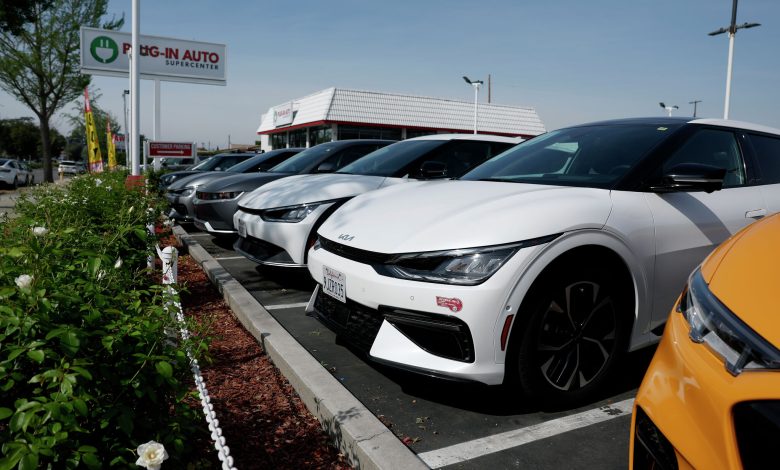

Used electric vehicles sit on a sales lot at Plug-In Auto in West Covina (Los Angeles County) in March. California’s new rebate program will offer first-time EV buyers $3,500 off qualifying new vehicles and $1,750 off qualifying used ones.

Gas prices bumming you out?
If the pain of filling up has you pondering the potential cost savings of an electric car, great news: California has a new rebate program that will make it less expensive for people to buy or lease their first zero-emission vehicle.
Later this summer, the state will launch a rebate program that will take $3,500 off the price of a first new ZEV bought or leased by a California resident, and $1,750 off a first used ZEV purchase. The governor’s office announced that California is partnering with 13 automakers to match state contributions for a $270 million pot of funds.
Article continues below this ad
Those rebates — offered at the point of sale, or “cash on the hood” in car dealership parlance — do have limits, though income isn’t one of them. The program is open to California residents regardless of how much they earn, as long as it’s their first ZEV. It applies only to fully electric vehicles, not hybrids. For new ZEVs, the cost of the vehicle must have an MSRP of $50,000 or less, and $25,000 for a manufacturer pre-owned vehicle program.
An exception: If the manufacturer is headquartered in California and its entire fleet consists of ZEVs, there is no limit on the MSRP or used-vehicle sales price. The most notable companies that qualify in that category are Rivian and Lucid; while Tesla originally operated out of California, Elon Musk moved headquarters to Texas in 2021, meaning its vehicles are subject to the $50,000 cap — so while some lower-end models will qualify, you’re out of luck on a rebate for a new Cybertruck, Model S sedan or pricier Tesla trims.
Other participating automakers include Ford, General Motors, Honda, Hyundai, Kia, Mitsubishi, Nissan, Subaru, Toyota and Volvo.
If this concept sounds familiar, it’s because it’s similar to the federal tax rebate program that was implemented under President Joe Biden’s 2022 Inflation Reduction Act. Until last September, income-qualified buyers could get a tax credit of $7,500 for new electric vehicles and $4,000 for used electric vehicles. It was one of many green energy programs axed by the GOP’s big tax and spending bill signed by President Donald Trump in July 2025.
Article continues below this ad
When the Inflation Reduction Act’s clean-vehicle credits took effect in January 2023, they prompted a rush of people getting EVs: A new report from car information site Edmunds reported 12.4% of leases from dealerships in 2023 were either fully electric vehicles or plug-in hybrids — 7.6% and 4.8%, respectively. Nationally, only 1.9% of all registered cars on the road are all-electric.
As of 2026, 6% of all used car listings are EVs in California, and 23.3% of all used electric cars on the market are here in California, according to data provided to the Chronicle by Edmunds.
Will this credit move the needle on EV adoption?
The move is part of the California government’s big-picture climate goals, said Scott Evans, the features editor for MotorTrend.
Article continues below this ad
“A big part of California’s goal here is to reduce emissions and reduce the number of gas-powered cars on the road,” he said. “They’re trying to encourage more people to take the plunge.”
These cost savings won’t solve every problem standing between California drivers and electric cars — but they’ll help, experts say.
“This incentive gives the next round of Californians the opportunity to learn about EVs but also learn about the cost savings benefits of going electric,” said Josh Boone, the founding executive director at Veloz, a nonprofit organization that offers educational resources on the benefits of electric cars. He said people can visit Veloz’s website ElectricForAll.org and plug in their ZIP code to see what incentives are available at the federal, state, local and utility levels.
Right now it’s a particularly good time to be shopping for used EVs. Typical leases are around 3 years, so the cars leased in the flurry of activity in 2023 are now coming back into the used market, Caldwell said. Overall off-lease availability is projected to rise just over 25% from 2025, according to Edmunds. And the $25,000 limit on used EVs means dealers may be inclined to price vehicles just below it, an attractive sticker number a bit below the average $31,500 price of a 3-year-old used car.
Lease shoppers are particularly conscientious of the monthly cost, said Jessica Caldwell, the head of insights for Edmunds, and anything that brings that number down helps move models. She said when the federal tax credit was in play, she would see dealerships advertising low monthly costs for leases.
Article continues below this ad
“It attracts more eyeballs, and that’s what’s going to help,” she said.
• No-Nonsense Money: There are great deals on EV leases. Should I get one and then buy it out right away?
• Got money questions? Here’s how to send them to our California budgeting advice columnist
Closing the enthusiasm gap
There’s a reason this credit targets first-time buyers. Right now, the EV industry is transitioning, Caldwell said: The enthusiastic early adopters who were excited about the technology have their electric cars parked snugly in their garages; now, the challenge is getting drivers on board who are mostly excited about saving money.
Article continues below this ad
Once people make the shift to an EV, they tend to stick with it: “If you have already purchased an EV, the probability that your next vehicle will be an EV is 80%,” said Scott Moura, a professor of civil and environmental engineering at UC Berkeley and acting director of the Berkeley Institute of Transportation Studies. Subsidizing purchases for people who were going to buy another EV anyway isn’t a particularly effective use of taxpayer dollars, he said.
It is less expensive to keep an electric car charged than a gas-powered car fueled up. That was true before the Iran war spiked gas prices, and has become more true since then: According to a Chronicle data analysis from March, electric vehicle owners save about $90 to $145 a month on fuel costs, depending on the model they drive.
With fewer moving parts and fluids to replace, EVs also have fewer maintenance costs: no oil changes, no spark plugs, no “check engine light.” They cost more to register, and are also more expensive to insure and repair, but those latter two costs are starting to come down as more EVs get on the road.
Anything that brings down the cost of ownership helps nudge people toward EVs, said Evans, who said he’d recently seen gas prices reach $6.50 a gallon at a station near where he lives in Inglewood (Los Angeles County).
“People looking at buying a new car are looking more carefully at the numbers these days,” he said. “I do think (the credit) will make a difference, especially right now, when finances are tight. Everyone’s feeling the struggle.”
The exact date when the credit goes into effect hasn’t been announced; a press release put out in mid-July by the governor’s office said details are expected to come out next month.
Moura pointed out another key difference between this program and Biden’s: The money is not unlimited. So if you’ve been considering a new EV, you should take advantage of this program before the money runs out, which he estimated could be in six months or less.
“These incentives are going to go away fast,” he said.