Cattle Futures Recover as Packers Maintain Positive Margins
Today’s cattle slaughter estimate was 94,000 head compared to 102,000 head last Wednesday. Tuesday’s slaughter was adjusted to 100,000 head from 105,000 head for a week-to-date total of 299,000 head compared to 313,000 head last week. With week-to-date slaughter now 14,000 head below last week, slaughter is on track to be 515,000 head this week. With plants in the black, we doubt slaughter remains that low, with the plant that lost hours expected to make up the slaughter this week. The estimate for this week’s slaughter remains in the 530,000–540,000 head area.
Almost daily, we hear another story or sound bite from the Department of Agriculture about how important it is to make it possible for the local producer, that is to say rancher, to process and sell his cattle as beef. Competing with the large packer and the retailer? Of course!
Once the federal government becomes involved, there will be safety and health inspectors. Maybe ICE will come calling one day? Then what about wastewater? You know there will be another group of inspectors to check up on effluent, right? This is just a start on regulation. For argument’s sake, let’s assume the producer can stomach all the good things the federal government is going to do for him.
Unfortunately, the producer has another more serious and pressing issue. His country is in the third year of a severe drought. He has very little pasture, and he is using the hay stocks at an alarming rate. He has liquidated all the cattle except the breeding stock. He expects to start rebuilding his herd when it rains. All his neighbors are suffering through the same drought. What does he process when he doesn’t have any cattle to process?

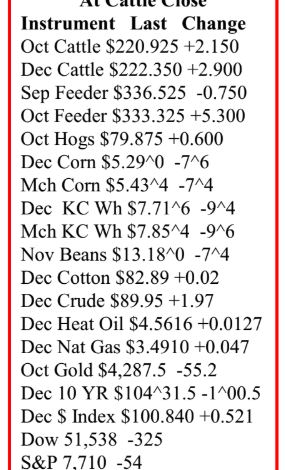
Turning to cattle futures today, price action in the most active December contract was an inside day with a higher close, which took back all of Tuesday’s loss. Evidently, the heavy sellers in the market on Tuesday discovered they were selling on news that did not equal the rumors that prompted the selling on Tuesday. Once again, cattle futures have been subjected to the vagaries of sellers that enter orders based on rumors and/or headlines without any fact detection. Perhaps those particular trading programs don’t have a fact-checking protocol included in the initial AI programming?
With today’s close in the December contract above the moving averages, we expect to see some follow-through buying on Thursday. Technical indicators have turned up after correcting the overbought condition. We look for December to test the overhead resistance at the $225 area sooner rather than later.
Moving on to the cutout price, this morning Choice was down $0.39, with Select down $4.58. As the day progressed, weakness continued in the cutout, with Choice finishing $1.58 lower at $377.31, while Select declined $5.51 to finish at $352.34. This afternoon’s Choice quote was $1.50 above last Wednesday, with Select $2.23 lower. Boxed cut volume today was 68 loads compared to 88 loads last week.
We hear the beef trade is uneventful, but we also hear mixed reports about the outlook. Very astute observers tell us the business is slow and prices appear to be headed lower, while others in the trade expect more holiday business to develop that will hold prices together.
One way to judge the future beef trade is to look at packer margins. The three-day average Choice cutout is $3.26 higher than last week at $377.52. Even so, we did not increase the comprehensive cutout price from last week’s price of $379.13 in calculating the packer margins for this week. This morning, USDA reported over 3,000 head of cattle trading at $350 during the day on Tuesday in Nebraska, which was steady with last week. Today, Nebraska reports 296 head at $350, while Iowa reports 370 head at $220 live and $350 hot. As a result, the calculated margin based on the Nebraska fed cattle price at $222 and a steady comprehensive cutout price improved about $5 per head. Our estimate for this week suggests a positive margin in the $125–$150 per head range.

We suspect a steady positive margin won’t force the packer to cut kills, and it suggests to us the packer will readily pay steady money for fed cattle this week.
One of our subscribers sent an article today about barbecue in Texas. According to the article, some BBQ joints are beginning to remove some beef items from the menu rather than raise prices. According to the article, some restaurants are taking beef ribs off the menu. It doesn’t say it, but it suggests that brisket might be taken off in some locations. We cannot imagine a BBQ place in Texas staying open without brisket. Chicken is good, and pork is definitely a staple, but it appears to us that brisket carries the load.
Of course, the price is important, and the chart at the bottom of Page 2 shows the brisket price from USDA’s cutout this afternoon. Note that during the first six months of this year, the price differential between this year and last year was exceptional. At times, the price this year at $515 was as much as $130 above last year’s price at $385. It is not that way today at $428.62 compared to $434.66 last year.
HALES CATTLE LETTER © 2026 is a publication of Hales Trading Co., Inc. ©2026. P.O. Box 1623, Amarillo, Texas 79105-1623, 806 463 2144, Website: halestradingco.com. The information contained in this letter is taken from sources believed reliable but it may not necessarily be complete and cannot be guaranteed. Any opinions expressed herein are subject to change without notice. Neither the information presented nor any opinions expressed constitutes a representation by us or a solicitation of the purchase or sale of any commodity or security. Reproduction of all or any part of this publication is strictly prohibited without written consent. All of the material contained herein is believed to be correct, however, Hales Trading Co., Inc, will not be held responsible for accidental oversights, typos, or incorrect information from sources that generate fundamental and technical information. Futures and futures options trading carries significant risk, is not for every investor, and only risk capital should be used. Past performance is not necessarily indicative of future results. Any person who chooses to use this information as a basis for their trading assumes all the liability and risk for themselves and hereby and absolutely agrees to indemnify and hold harmless Hales Trading Co., Inc, its principals, its agents, and its employees. Publication is daily except for days markets are closed. Cost is $440 US for e-mail. fax is $465 US . Hales Trading Co., Inc. is registered with the CFTC as a Commodity Trading Advisor.