Chainlink Becoming Most Important Crypto Infrastructure
Chainlink rarely generates the excitement attached to a new blockchain, trading platform, or artificial intelligence token. Instead, it provides infrastructure that decentralized finance protocols and tokenized assets increasingly depend on.
Chainlink’s decentralized oracle networks deliver external data to smart contracts. Its Cross-Chain Interoperability Protocol, or CCIP, moves information and tokens between blockchains. Proof of Reserve verifies whether assets backing on-chain products exist. Automation and compliance tools help financial applications execute complex operations without relying on one centralized party.
At approximately $8.62 per token, LINK▲$7.97 has a market capitalization of about $6.45 billion. That is substantial, but modest compared with the value of the markets Chainlink is trying to connect.
Related: The Next 100% Crypto Movers? Top 7 Altcoins That Could Dominate H2 2026
That is the strongest argument that LINK could be undervalued. The weakness is equally important: Chainlink adoption does not automatically create proportional demand for the token.
Contents
Chainlink Solves the Oracle Problem
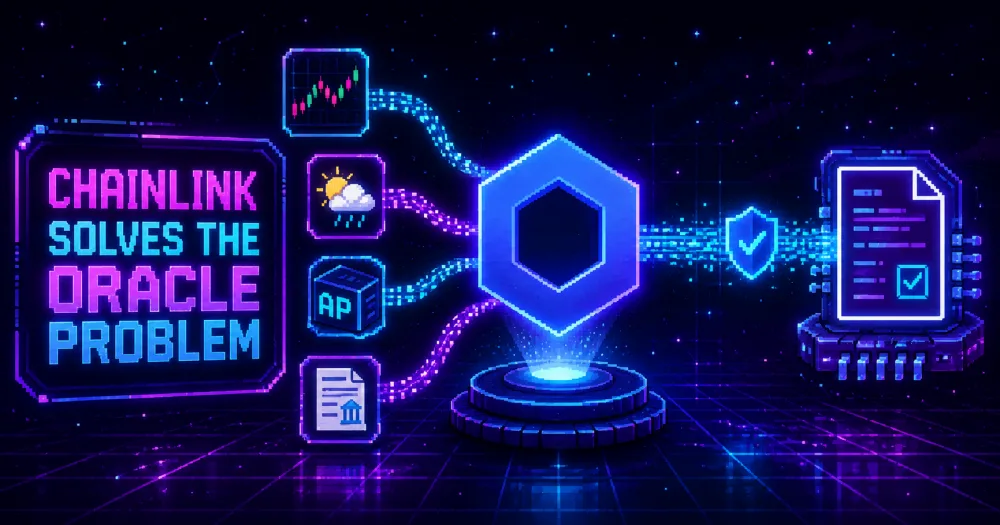
Blockchains cannot independently verify information outside their own networks.
A lending protocol can confirm that a transaction occurred on Ethereum, but it cannot determine the current dollar price of ETH▲$1,761.17 without external data. A tokenized fund cannot prove that its off-chain reserves exist solely by examining its smart contract. An insurance application cannot independently determine whether a flight was delayed or a storm reached a particular location.
Sending this information through one conventional data provider creates a centralized point of failure. If the provider submits incorrect information, is hacked, or stops operating, the smart contract may execute incorrectly.
Chainlink uses decentralized oracle networks composed of independent node operators. Multiple sources collect and validate information before it is delivered on-chain.
This infrastructure supports applications that need reliable:
- Asset prices
- Interest rates
- Reserve data
- Market indexes
- Weather information
- Random numbers
- Event outcomes
- Cross-chain messages
Price feeds remain Chainlink’s best-known product. They are embedded across major lending, derivatives, stablecoin, and asset-management protocols. Their importance becomes clearest during volatility, when inaccurate prices can trigger wrongful liquidations or leave protocols with bad debt.
The oracle layer is therefore not a decorative feature. For many financial applications, it is part of the security model.
Chainlink Is Expanding Beyond Price Feeds
The undervaluation thesis depends on Chainlink becoming more than a price-oracle provider.
Price feeds are useful but relatively narrow. Chainlink’s larger ambition is to provide a complete platform for moving data, instructions, and assets between blockchains and conventional financial systems.
Its product stack now includes:
- Data Feeds for market information
- Data Streams for high-frequency pricing
- CCIP for cross-chain transfers and messaging
- Proof of Reserve for collateral verification
- Automation for smart contract execution
- Functions for connecting external APIs and computation
- Digital identity and compliance tools
- The Chainlink Runtime Environment for orchestrating financial workflows
This matters because institutional tokenization requires more than issuing a token.
A tokenized security may need price data, reserve verification, investor eligibility checks, corporate-action processing, cross-chain distribution, payments, compliance controls, and connection to existing bank systems.
A platform capable of coordinating those functions becomes more valuable than an isolated oracle feed.
Chainlink is effectively positioning itself as middleware for on-chain finance: the layer connecting assets, blockchains, data providers, institutions, and payment systems.
Related: What’s the Next Big Crypto Narrative After AI Tokens? Top Sectors to Watch in H2 2026
CCIP Could Become Chainlink’s Most Valuable Product
Crypto has hundreds of blockchains and Layer 2 networks, each with separate assets, applications, and liquidity.
That fragmentation creates demand for interoperability. It also creates security risks. Cross-chain bridges have suffered some of the industry’s largest exploits because they must verify activity occurring on another network and control assets held across different systems.
CCIP is designed to provide a standardized method for sending tokens and instructions between chains.
Rather than every bank, fund, stablecoin issuer, or blockchain building its own bridge, the institution can connect through one interoperability framework. CCIP includes multiple oracle networks, transaction limits, monitoring systems, and an independent risk-management network.
The potential market extends beyond ordinary token transfers.
CCIP can support:
- Cross-chain stablecoins
- Tokenized funds distributed across several networks
- Delivery-versus-payment transactions
- Collateral movement
- Cross-chain lending
- Automated fund subscriptions and redemptions
- Communication between private and public blockchains
If blockchain finance remains fragmented across many networks, interoperability becomes unavoidable. Chainlink benefits without needing one blockchain to defeat all competitors.
That gives LINK a different investment thesis from Layer 1 tokens. Chainlink can serve Ethereum, Solana, Layer 2 networks, private ledgers, and future systems simultaneously.
Swift Trials Validate the Institutional Thesis
Chainlink’s work with Swift is one of the strongest pieces of evidence that its institutional strategy is more than marketing.
Swift connects more than 11,000 financial institutions and provides messaging infrastructure used throughout global banking. It does not directly move money, but its standards and network coordinate international financial transactions.
In trials involving Swift and financial institutions, Chainlink served as an enterprise abstraction layer connecting existing Swift infrastructure to blockchain networks. CCIP enabled interoperability between source and destination chains.
A later pilot with Swift and UBS Asset Management demonstrated how existing payment infrastructure could support subscriptions and redemptions for tokenized investment funds.
These experiments do not guarantee large future revenue. Institutions conduct many pilots that never become commercial products.
They nevertheless demonstrate an important advantage: banks may not need to abandon existing systems to interact with blockchain assets. Chainlink can connect conventional infrastructure to new networks instead.
Swift continued expanding its digital-asset work in 2026, including a blockchain-based shared-ledger project. Chainlink is not guaranteed to power every part of that system, but its earlier involvement has established it as a credible institutional interoperability provider.
Tokenization Creates a Large Addressable Market
The market for tokenized assets is still small compared with global stocks, bonds, funds, and private credit, but it has moved beyond experiments.
RWA.xyz currently tracks approximately:
- $27.65 billion in distributed tokenized asset value
- $441.38 billion in represented asset value
- $10.93 billion in tokenized U.S. Treasuries
- $309.8 billion in stablecoins
Represented value includes assets recorded or represented on-chain even when the corresponding tokens are not distributed broadly to investors. Even so, the figures show that financial institutions are building real blockchain-based products.
Tokenized assets need trustworthy information. A tokenized Treasury fund may require net asset value data, reserve confirmation, interest-rate information, identity controls, and connections to cash settlement systems.
They also need interoperability. An asset issued on one network may need to reach investors, exchanges, collateral systems, and applications on several others.
Chainlink can provide both. The platform may become part of the technical standard used to issue, verify, transfer, and service them.
Proof of Reserve Could Become Essential Stablecoin Infrastructure
Stablecoins require users to trust that their backing assets exist and remain sufficient.
Traditional attestations are periodic and usually published as documents. They do not continuously prevent a protocol from issuing additional tokens when reserves are inadequate.
Chainlink Proof of Reserve can deliver reserve information directly to smart contracts. Applications can then use that data to monitor collateral or pause certain operations when backing falls below required levels. The service is also relevant to wrapped assets, tokenized commodities, funds, and bridged tokens.
In July 2026, United Stables selected Chainlink Data Feeds and Proof of Reserve for U, a stablecoin with more than $1 billion in circulation. The project also plans to use CCIP for cross-chain expansion.
One integration does not prove market dominance. Yet it illustrates how Chainlink’s products can be combined: price data, reserve verification, and interoperability can operate as one infrastructure package.
As stablecoin regulation becomes stricter, issuers may face greater demands for transparent and continuous reserve monitoring. That could turn Proof of Reserve from an optional feature into standard infrastructure.
Read more: Chainlink Price Prediction July 2026: LINK Market Analysis
Chainlink Benefits From a Multi-Chain Future
Many crypto investments depend on one network winning market share. But Chainlink’s position is different. It benefits from complexity. The more fragmented the market becomes, the greater the need for a neutral coordination layer.
This resembles the role of middleware, payment networks, and data providers in traditional finance. They can earn revenue across competing markets without taking responsibility for the performance of every underlying asset.
Chainlink is not completely neutral. It has technical dependencies, governance decisions, and competition from other oracle and interoperability systems. However, it is less exposed to the success of one blockchain than most crypto infrastructure projects.
LINK Has Real Utility, but Value Capture Remains Unclear
The LINK token is used to pay service providers and support Chainlink’s economic security.
Node operators can receive LINK for delivering data and performing network services. Staking allows participants to lock LINK to support oracle security and receive rewards. Chainlink’s long-term economic model envisions users paying for services while node operators and stakers secure the system.
This creates a credible reason for the token to exist.
The harder question is whether usage generates enough LINK demand to justify a higher valuation.
Many integrations remain subsidized or operate under arrangements that are not publicly disclosed. Institutions may pay in conventional currencies, with conversion occurring behind the scenes. Service revenue, operating costs, and the amount ultimately reaching LINK stakers are not reported as transparently as the revenue of a public company.
LINK also does not represent equity in Chainlink Labs. Token holders do not own its intellectual property, corporate revenue, or profits.
This is the central weakness in claims that LINK is undervalued. Chainlink can become essential infrastructure while LINK captures only part of the resulting economic value.
The investment case improves if adoption produces measurable service fees, greater staking demand, and sustained purchases of LINK by users or service providers.
Staking Could Strengthen LINK’s Economics
Staking is intended to increase the security of Chainlink services by requiring participants to commit LINK.
If a node operator performs dishonestly or fails to meet required standards, its economic stake can be placed at risk. This makes attacks more expensive and aligns operators with the reliability of the network.
Expanding staking could affect LINK in two ways.
First, more LINK could be locked rather than held on exchanges. Second, increased service activity could support rewards from user fees rather than relying primarily on token incentives.
A sustainable model would create a cycle:
- More assets rely on Chainlink.
- Greater economic value requires stronger security.
- More LINK is staked to secure services.
- Users pay fees to node operators and stakers.
- Stronger incentives attract additional operators and institutional adoption.
The model remains incomplete. Staking capacity has been limited, and rewards have not yet demonstrated that demand from paying users can support the full security budget.
Until that changes, staking is evidence of potential value capture rather than proof of it.
Is LINK Undervalued Relative to Other Crypto Assets?
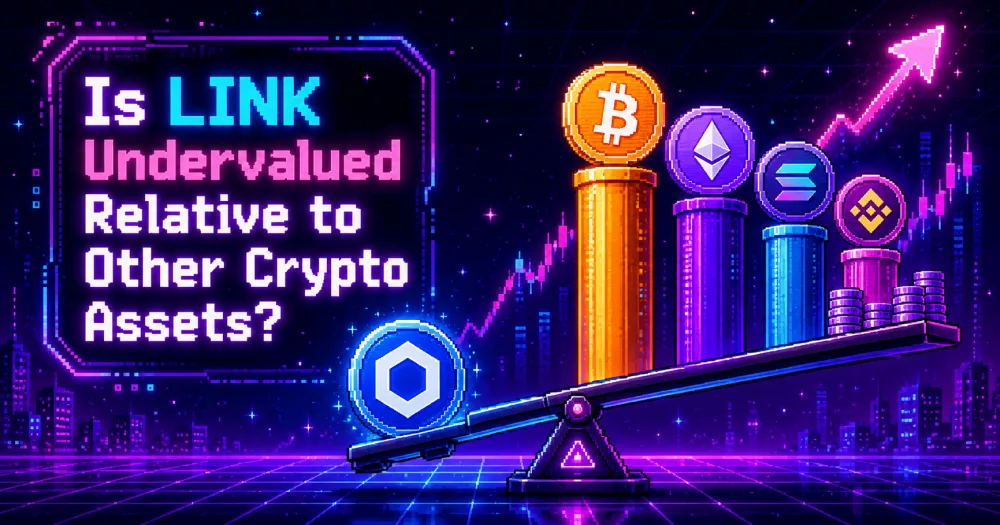
LINK trades near $8.62, with approximately 750 million tokens circulating and a market capitalization of about $6.45 billion.
Its maximum supply is one billion LINK, placing its fully diluted valuation near $8.6 billion. Roughly 75% of maximum supply is therefore already circulating, making dilution less severe than for many newer tokens.
The comparison with other assets is striking.
Many Layer 1 networks command valuations in the tens of billions despite competing in crowded markets and generating limited revenue. Some application tokens trade at multibillion-dollar valuations based on one product or speculative narrative.
Chainlink supports multiple networks and sits underneath lending, derivatives, stablecoins, tokenized assets, and institutional pilots. Its infrastructure may be harder to replace than many consumer-facing blockchain applications.
That does not prove LINK is cheap. Crypto valuations rarely correspond cleanly to revenue or cash flow.
However, a $6.45 billion valuation appears restrained if Chainlink becomes the standard interoperability and data layer for a tokenized asset market worth hundreds of billions—or eventually trillions—of dollars.
Why LINK May Remain Undervalued
Chainlink’s role is difficult to communicate.
Investors can see transactions on a Layer 1 network, trading volume on an exchange, or deposits in a lending protocol. Infrastructure operating underneath those applications is less visible.
Chainlink also lacks a simple consumer narrative. It is not digital gold, internet money, an AI agent, or a high-speed blockchain. Its products involve data validation, messaging, reserve verification, compliance, and workflow orchestration.
Those functions sound technical because they are technical.
LINK’s weak direct value-capture data adds to the discount. Investors can identify integrations but cannot easily calculate how much recurring demand each one creates for the token.
Finally, infrastructure adoption develops slowly. Banks test systems for years, and major financial networks do not replace core technology during one crypto cycle.
The market may therefore undervalue Chainlink precisely because its strongest opportunity is long-term and operational rather than speculative.
What Could Drive a Major LINK Revaluation?
LINK is unlikely to revalue permanently based on partnership announcements alone.
The strongest catalysts would be measurable evidence that adoption is becoming economically important:
- Institutions using CCIP for live commercial transactions
- Higher cross-chain transfer volume
- More stablecoins adopting Proof of Reserve
- Tokenized funds using Chainlink for subscriptions and redemptions
- Growth in service fees paid to node operators
- Expansion of staking capacity
- Rewards increasingly funded by user fees
- Clearer reporting of LINK demand generated by institutional services
- Regulatory standards favoring transparent oracle and reserve systems
A broad crypto rally could lift LINK regardless of these developments. A durable revaluation requires proof that Chainlink’s infrastructure position creates token demand.
The Main Risks to the Chainlink Thesis
Chainlink’s institutional relationships do not guarantee commercial dominance.
Banks may build proprietary infrastructure, use Swift’s own shared ledger, or select competing interoperability systems. Blockchain networks may develop native oracle and messaging services. Institutions could adopt private systems that require little public-chain connectivity.
Chainlink also faces technical risk. An oracle failure, cross-chain exploit, or compromised data source could damage confidence in infrastructure protecting billions of dollars.
Other risks include:
- Slow institutional adoption
- Undisclosed or limited service revenue
- Weak connection between usage and LINK demand
- Competition from native oracles and interoperability protocols
- Staking rewards dependent on token incentives
- Centralization among node operators
- Remaining token-supply expansion
- Regulatory restrictions on staking or cross-chain services
The largest risk is not that Chainlink becomes irrelevant. It is that Chainlink succeeds operationally without producing equivalent returns for LINK holders.
Could Chainlink Become Crypto’s Most Important Infrastructure?
Chainlink already performs one of crypto’s least visible but most important jobs: allowing smart contracts to interact with information and systems outside their native blockchains.
Its role is expanding from price feeds into cross-chain messaging, reserve verification, automation, compliance, and institutional workflow orchestration.
The addressable market is substantial. Stablecoins are worth nearly $310 billion. Directly distributed tokenized assets are worth approximately $27.65 billion, while represented assets exceed $441 billion. Global capital markets are vastly larger.
At a $6.45 billion market capitalization, LINK does not appear priced as though Chainlink will become the dominant infrastructure layer for that transition.
The discount may be justified. Token value capture remains difficult to measure, commercial adoption is slow, and institutional pilots do not guarantee revenue.
But the asymmetry is increasingly clear.
If tokenization remains limited, LINK may continue trading like another established altcoin. If banks, funds, stablecoins, and blockchains require one common layer for data, verification, and interoperability, Chainlink could become infrastructure that much of on-chain finance cannot easily function without.
That is why LINK may be undervalued—not because Chainlink is louder than its competitors, but because it is becoming harder to avoid.
FAQ
What does Chainlink do?
Chainlink connects blockchains and smart contracts to external data, other networks, payment systems, reserve information, and off-chain computation.
Why is CCIP important for Chainlink?
CCIP allows tokens and instructions to move between different blockchains. It could support cross-chain stablecoins, tokenized funds, collateral transfers, and institutional settlement.
Does LINK represent ownership in Chainlink Labs?
No. LINK is a utility and staking token used within Chainlink’s networks. It does not represent equity, corporate ownership, or a legal claim on Chainlink Labs’ profits.
Why could LINK be undervalued?
LINK’s market capitalization is approximately $6.45 billion despite Chainlink’s position across DeFi, stablecoins, interoperability, and tokenized finance. The undervaluation thesis depends on increased adoption creating stronger demand for the token.
What is the biggest risk for LINK investors?
The main risk is weak value capture. Chainlink could gain institutional adoption without producing enough fees, staking demand, or token purchases to justify a substantially higher LINK price.