Chuck Schumer Unveils Anti-Corruption Bureau Bill Targeting Trump’s Crypto Self-Dealing: how 13 outlets framed it
Schumer targets Trump crypto
Schumer told MS NOW, “We have reached a level of corruption unseen in America in all of history,” and said Trump has developed “pernicious, but very clever new ways to enrich himself at the taxpayers’ expense.”
The bill is tied to President Donald Trump’s financial disclosures, including more than $1.4 billion in cryptocurrency-related income and more than $500 million from World Liberty Financial, the cryptocurrency company he co-founded in 2024 with his sons, Eric Trump and Donald Trump Jr.
MS NOW also reported that the disclosure listed $635 million in income tied to sales of his $TRUMP meme coin, while Reuters and other outlets cited in the broader coverage described the legislation as referencing those disclosures as justification for the bureau’s authority.
The proposal would create an independent agency with “sweeping” investigative, subpoena and enforcement powers, led by a seven-member, Senate-confirmed board, and it would empower private plaintiffs, including state attorneys general, to sue to recover money obtained through alleged corruption by a president, members of an administration, campaign officials or government contractors.
Quotes and political fight
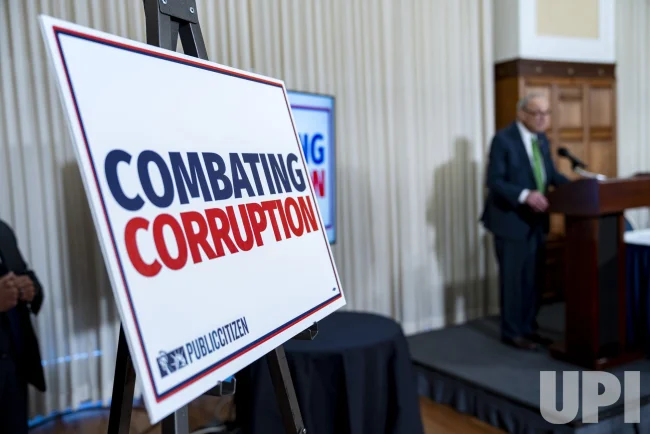
In a Public Citizen “Combatting Corruption” forum, Schumer framed the bureau as giving Americans a “day in court,” saying, “The idea is simple: if Donald Trump or one of his lackeys, sons, or cronies uses government influence to steal from you, you deserve your day in court.”
Schumer’s plan also drew a direct quote from Senator Alex Padilla, who said, “When a president uses the office for personal profit, that is not ‘just the way it is,’ despite what Trump wants you to believe,” as Padilla joined Schumer in introducing the Anti-Corruption Bureau Creation Act.
The bill’s design, as described in the sources, would consolidate the Federal Election Commission, the Office of Government Ethics and the Office of Special Counsel “under one roof” and would give the bureau subpoena power and the ability to refer cases for criminal prosecution.
MS NOW reported that Schumer said he crafted the proposal to withstand efforts to cripple the agency, including by removing or not appointing new members to the board, with judges on the U.S. Court of Appeals for the D.C. Circuit able to temporarily appoint board members to keep it operational.
The legislation’s path was described as uncertain, with MS NOW saying it would need Republican backing and either Trump’s signature or enough GOP lawmakers to override a veto, while the sources also noted that even if Democrats retake Congress, Trump would still have veto power for the next two years.
What’s at stake next
Schumer’s proposal would also bar presidents and vice presidents, along with their spouses and adult children, and many senior administration officials from “corruptly” seeking or accepting anything worth more than $50,000, and it would allow investigations into violations committed on or after Jan. 20, 2025, with a 10-year statute of limitations.
The bill’s enforcement and independence mechanisms, as described in the sources, include a seven-member board with fixed terms and partisan-balance requirements, plus a “self-sustaining funding source similar to that of the Federal Reserve” to prevent Congress from cutting funding.
MS NOW reported that Schumer said the measure would empower private plaintiffs to sue to recover money obtained through alleged corruption, and it illustrated the concept by pointing to Trump’s meme coin and saying that if an attorney general felt it was “ripping off her citizens,” they could sue and “get the money back and return it to the citizenry.”
For crypto-related stakes, the sources tie the bureau’s justification directly to Trump’s disclosed cryptocurrency-related income, including $1.4 billion, and to the claim that the Trump family holds more than $1 billion in a cryptocurrency fund with ties to foreign governments, while the bill’s introduction was also linked to ongoing debate over the CLARITY Act and the question of how to handle digital-asset disclosures for public officials.